Reading List / 10 Articles

Weekly Reading

2026-10-18

01

How Donald Trump Made Himself Into The Dominant American Of Our Age

SOURCE https://www.vanityfair.com/story/donald-the-great

The Great American State Fair, the centerpiece of the official celebration of the United States’ 250th birthday, was made in the image of the president who called it into being. On its face, the fair, slated for June 25 to July 10, was a bombastic mess. President Donald Trump promised “the most unforgettable birthday party any country has ever seen,” and for reasons unintended this may well prove to be true. Half the fair’s announced musical guests promptly dropped out. Power outages crippled the Ferris wheel and melted ice cream. On July 4, a storm drove the fair’s guests into museums for shelter. The National Museum of African American History and Culture, which Trump has tried to dismantle, quickly reached capacity. Later, once the rains cleared, an attempt was made to put on “the largest fireworks display in history.” Air pollution levels in Washington, DC, increased more than sixfold.

However ridiculous Trump’s public commemoration appeared, the president had private reasons to celebrate. In the week leading up to the nation’s birthday, it was revealed that in 2025, Trump had raked in some $1.4 billion in income from his cryptocurrency ventures. Among those efforts was the $TRUMP meme coin, which The New York Times characterized as having “no intrinsic value itself” but was instead “a bet on the aura around Mr. Trump.” The bet went swimmingly for the house and poorly for its takers. By July 4, $TRUMP had declined 97 percent from its peak. Meanwhile, Trump appeared to have had the most lucrative period of his long and dubious career as a businessman, all in the first year of his second term. “Presidential historians said they could identify no other president in American history,” wrote New York Times investigative reporter Eric Lipton, “who entered into new business enterprises just before moving into the White House, and then continued to personally profit from them during his term.”

Trump’s quarter millennial—featuring overt buffoonery and historic grifting as neighbors—was characteristic of his two presidencies. But both emanate from something his opponents have never quite grasped. Trump is not just the most acquisitive politician of his era, he is also the most visionary, gifted with the ability to appreciate his country’s darkest pathologies and profit from them. Perhaps more ­importantly, Trump understood that the inanities and shibboleths of this country’s alleged institutional guardians, its senators, lawyers, elite universities, and free press, were little more than that, and the guardrails of this liberal democracy were illusions easily dispelled by one who would dare. One such as Trump.

Through a mix of moxie, cynicism, and misanthropy, Trump has made himself into the dominant American of our age. Sometimes a man meets his moment, and Trump met his in the wake of a black presidency and a conservative movement doggedly and patiently pursuing a decades-long counterrevolution. The marriage of Trump’s charisma to a fundamentalist right wing has been bountiful: three Supreme Court justices in four years, the subsequent destruction of national abortion rights, the banishment of affirmative action, the hollowing of the Voting Rights Act.

The anti-tax activist Grover Norquist once said he wanted to shrink the government to a size where he could “drag it into the bathroom and drown it in the bathtub.” No president has more committed himself to this ethos than Trump. His Department of Government Efficiency slashed government payrolls, destroyed USAID, and has made a mockery of public health. That hundreds of thousands are projected to die around the world as a result of the administration’s foreign aid cuts, that the United States is enduring its worst measles outbreak in decades, that Americans are avoiding salad for fear of explosive diarrhea is, for those who believe the government that governs best is the one that governs least, a feature, not a bug.

Whatever Trump’s disdain for regulation, he has proved an aggressive employer of state power against the perceived enemies of the conservative movement. Universities in Texas are seizing and scrubbing syllabi, and some of the country’s most storied institutions of higher learning have been cowed into paying protection money. Journalists, long a thorn in Trump’s side, have watched their bosses bend the knee—killing editorials, deriding their reporters to the president, and settling lawsuits widely criticized as meritless. After Trump forced ABC News into a humiliating settlement, he subsequently threatened to sic the attorney general on the outlet’s star reporter, Jonathan Karl. “Your company paid me $16 million,” Trump told Karl. “So maybe [the attorney general] will have to go after you.” Karl would be wise to take the threat seriously: For Trump counts among his growing cast of supplicants some of the most powerful law firms in the country—firms that once championed progressive causes. He has extracted nearly a billion in pro bono legal services from these firms and even turned them into servants of the regime.

Conditioned by such feckless opposition, Trump has taken his intimidation tactics abroad. The second Bush administration pushed the boundaries of international law. But Trump, summarily killing alleged drug runners on the high seas, abducting a foreign leader to face disputed drug-trafficking charges, brazenly assassinating a foreign head of state, has shattered those limits and burned the order they were designed to preserve. “No stupid rules of engagement,” said Trump’s secretary of war, Pete Hegseth, as the administration sought to bring Iran’s regime to its knees. “No politically correct wars.” Most interestingly, it is here, in a world of theocracy and despotism, not self-styled democracy and freedom, that Trumpism finds its limits. The Trump administration, facing a foe that actually believes in things, is presently headed to a strategic defeat in Iran.

Back at home, Trump has been fortunate to face an elite opposition that mostly believes in handing over their lunch money. He has not defeated them through diabolical genius. He is not playing three-dimensional chess so much as just punching people, in the great assurance that they will not punch back. That could always change. Perhaps, emboldened by a majority, Democrats who once urged their party to “roll over and play dead” or made cryptic appeals to a higher power will be forced to recover their fight and embrace the drastic means necessary to roll back the worst of the age of Trump.

But some things can’t be unseen. The example that Trump has set, the scope of what is possible should one embrace the dark powers of the White House, will not dissipate. It turns out that you can deploy secret police onto American streets. You can deport immigrants in defiance of the courts. You can have the Justice Department badger your enemies. And you can become very rich while doing it. And some of the most powerful sectors in America, those who most loudly extol their own love of country, will stand around and watch you do it. Asked why he was making deals during his second term, Trump gave a succinct and chillingly accurate summation: “I found out that nobody cared.” And to the extent that there is a genius to Trump, it is in his apprehension of this reality—so very few people who matter care. When you’re president, they let you do it.

More Great Stories From Vanity Fair

02

Databricks is no longer about tuning knobs

SOURCE https://blog.dataexpert.io/p/databricks-is-for-data-analysts-not

For years, Databricks positioned itself as the true home of serious data engineers. They offer Spark jobs, distributed systems, lakehouse architecture, the works. But that’s old Databricks.

But if you zoom out and look at the product direction over the last few years, a much different pattern emerges.

Here are three observations that show that Databricks has moved on from data engineers:

1. Physical data modeling is a skill that no longer matters (according to Databricks)

Since the early 2010s, Data engineers have been physically modeling data via partitioning, sorting, bucketing, etc.

These types of physical data modeling techniques created things like zorder, SMB join (a join without shuffle), file compactions, and data index skipping.

Now, Databricks says “don’t partition or sort or bucket” your tables. Your expertise is no longer needed here.

Instead of partitioning or bucketing, you now have “liquid clustering.”

Instead of file compaction and table layouts, you now have “predictive optimization.”

Databricks has steadily abstracted away the entire physical data modeling skillset. This is fantastic for analysts.

They don’t want to think about small files, metadata bloat, or clustering keys. They want queries to run fast and solve business problems even faster.

But engineers?
Engineers care about mechanics. File pruning behavior. Snapshot retention. Metadata growth. Table property tuning. Failure modes.

The philosophical shift is clear: reduce footguns by reducing access to the gun.

Once you upgrade beyond Databricks 13.3, you can retire your physical data modeling skills and put them in the trash.

2. Databricks spent $1B on Tabular to slow Iceberg’s progress

With open-source Iceberg, you get:

Nearly two years after the acquisition, you can create managed Iceberg tables in Databricks. But you cannot optimize them. You cannot call file compaction. You cannot manage the snapshots. You cannot use hidden partitioning.
Databricks’ support of Iceberg is flawed.

  • It doesn’t support the hidden partitioning using things like

    days(event_time), year(event_time), etc
  • Managed Iceberg doesn’t allow you to do your own file compaction. You can do auto file compaction with liquid clustering only

  • To use managed Iceberg, predictive optimization

    HAS TO BE ENABLED.
    Screenshot from Databricks AI assistant. If you don’t enable predictive optimization and give up control, you can’t use managed Iceberg.

All of this is saying, “We bought Tabular not to support the strengths of Iceberg.”

When Databricks deprecated the Tabular metastore, I migrated my 13,000 tables to Glue catalog instead of Unity Catalog because its offering was flawed, and I prefer to teach true physical data modeling, not “Databricks magic.”

Data engineers love determinism, explicit table layouts, visibility, and control.

Databricks now offers ease of use, unpredictable table layouts, opacity, and a lack of control.

Don’t get me wrong. This isn’t a bad thing for Databricks. The trade-off makes their product more available to less technical people, but it alienates experts who know what they’re doing.

3. Most businesses don’t actually want to learn data.

Data is seen as an impediment to business value. It’s raw, unrefined, and very easy to do wrong.

Also, data engineers are expensive, burn out quickly, and are increasingly automatable. The parts of the job that companies used to pay a premium for: writing boilerplate Spark jobs, tuning clusters, managing file layouts, optimizing joins. These are exactly the things AI can now scaffold in seconds.

What most companies actually want is not better data engineering.

They want:

  • Dashboards that load instantly

  • Models that work

  • Pipelines that don’t break

  • Costs that don’t spike unpredictably

  • Governance without reading a whitepaper

They don’t want to debate partitioning strategies.
They don’t want to argue Iceberg vs Delta.
They don’t want to tune shuffle partitions.

They want it to just work.

If you have:

  • Analysts writing transformations in SQL

  • AI generating pipeline code and tests

  • Databricks handling optimization (Liquid Clustering, Photon, Predictive Optimization)

  • Unity Catalog abstracting governance

You’ve effectively collapsed the traditional data engineering function into the platform.

That combination is extremely powerful — and usually cheaper than hiring a senior data engineer.

From an executive’s perspective, this is obvious:

  • Lower headcount

  • Faster iteration

  • Fewer specialized bottlenecks

  • Less infrastructure decision risk

This is the Snowflake playbook, and Databricks loves to follow their lead

The uncomfortable truth for data engineers is this: The market is rewarding abstraction, not control.

The companies growing fastest aren’t selling “deep control over distributed systems.”

They’re selling “you don’t have to think about it.”

And most businesses will choose that every time.

So what does this mean?

Databricks isn’t bad for data engineers. But teaching Databricks has become increasingly more boring.

When the answer to the question: “How to make my job more efficient?” is “Just let Databricks handle it.” It undermines the value of truly understanding how data works.

The pendulum is swinging in favor of analysts with these changes. The closer you are to the business, the more valuable you will become. Because Databricks is boldly telling you, “Your physical data modeling skills are no longer needed.”

I want to leave you with a few questions. Please comment on what you think:

  • With Snowflake and Databricks both leaning into “it just works” magic, where is the home for the data experts who actually know what they are doing?

  • How will we discover new physical data modeling techniques if all the control is ceded to Databricks?

03

AI did not speed up your engineering team

SOURCE https://www.kasaei.com/p/ai-did-not-speed-up-your-engineering

I have been writing code since 1995. For most of those years the job had one shape: the hard part was producing the thing. You sat down, you thought, you typed, and what came out the other side was the constraint on how fast the company could move. Everything around that job got built to serve it. Sprint length. Team size. Hiring plans. The whole apparatus assumed that making software was expensive and slow.

That assumption died about eighteen months ago. Almost nobody has redesigned around its absence.

Here is my claim, and you are welcome to disagree with it: your engineering organisation is not slow because your people are slow. It is slow because it was optimised for a constraint that no longer binds, and the real constraint moved somewhere nobody is measuring.

The constraint moved to review

Faros AI tracked 22,000 developers across roughly 4,000 teams. The productivity numbers are real. Epics completed per developer rose 66%. Task throughput per developer rose 33.7%. The share of AI-generated code accepted without editing went from 20% to 60%.

Then look at what happened downstream in the same dataset. Median code review time rose 441.5%. Median time to first review rose 156.6%. Code churn rose 861%. Bugs per developer rose 54%. The ratio of production incidents to pull requests rose 242.7%. Pull requests merged with no review at all rose 31.3%.

LinearB looked at 8.1 million pull requests across 4,800 teams in 42 countries and found the mechanism. An unassisted pull request at the 75th percentile is 157 lines. An AI-assisted one is over 400. Reviewer pickup time goes from roughly 200 minutes to more than 16 hours. And the number that should stop you: the 30-day merge rate for unassisted pull requests is 84.5%. For AI-assisted pull requests it is 32.7%.

Two thirds of the AI-assisted work does not merge within a month. It was generated. It was not delivered. Your throughput metric counted it. Your customers never saw it.

What is actually happening

The mechanism is simple. Adding an agent to the writing step and nothing to the review step does not make the system faster. It makes the queue longer. This is not a novel insight about software. It is the oldest result in operations research, and every CTO who has read about a factory floor already knows it. We are just failing to apply it to ourselves.

The reason we fail to apply it is that the writing step is where the visible cost sits. Engineers are expensive, so tooling that makes engineers produce more looks like an obvious win. Review capacity is invisible on a budget line. It is a byproduct of having senior people with context, and it does not appear anywhere in a procurement process.

So the org buys more production and inherits more queue.

The three shapes it takes

I want to be careful here and describe patterns rather than claim outcomes I have not measured. What I see across the engagements I run falls into three shapes.

The first is the large organisation with real seniority on the bench. Team-level velocity improves and looks convincing in a steering committee. The number that does not move is time from commit to customer, because the gain is absorbed in the gap between a pull request opening and a senior engineer having enough uninterrupted time to reason about four hundred lines they did not write. The work exists. It is queued.

The second is the mid-sized team where the senior engineers quietly become a bottleneck they were never staffed to be. Their week used to be roughly half building and half reviewing. It inverts. Nobody decides this and nobody announces it. The input rate changed and the roles did not, so the system rebalanced itself in the only place it could.

The third shape is the small product team with no senior reviewer at all. There, the 31.3% rise in unreviewed merges is not a statistic, it is the operating model. Those teams genuinely are shipping faster this quarter. They are also the population where the incident-to-pull-request ratio, up 242.7% in the Faros data, is going to show up as a customer-visible event rather than a dashboard.

GitHub has now run over 60 million automated code reviews, and roughly one in five reviews involves an agent. That helps with the mechanical layer. It does nothing for the judgement layer, which is the layer that is actually saturated.

Where this argument is weak

I should be honest about two things.

First, these are aggregate numbers across thousands of teams at a moment of rapid adoption. Some of the review-time increase is a learning curve, not a structural fact. Teams that adopted agents 18 months ago look different from teams that adopted them last quarter, and I would expect some of this to compress as review tooling catches up.

Second, the argument does not apply evenly. If your codebase is small, your team is three people, and everyone has full context, the review step was never a real queue and adding an agent genuinely does just make you faster. The constraint I am describing shows up when context is distributed across people, which is a function of headcount and codebase age, not of AI.

What I do not accept is the version of this argument that says the numbers will fix themselves. Queues do not self-correct. They get worse until somebody changes the capacity or the arrival rate.

What I would do on Monday

  • Measure time from pull request opened to merged, and split it by whether an agent was involved. If you measure one thing from this post, measure that. Most organisations report throughput and have never looked at this number.

  • Cap pull request size. The 400-line AI-assisted pull request is the specific object that breaks review. A hard cap forces decomposition at the point of generation, where it is cheap, instead of at the point of review, where it is not.

  • Make review capacity an explicit, staffed role rather than a tax on whoever has the most context. If two thirds of generated work is not merging, the reviewer is your production line, not your overhead.

  • Stop reporting throughput per developer to your board without the merge rate beside it. One of those numbers is activity. The other is delivery.

  • Move at least one senior engineer out of writing entirely for a quarter and watch what happens to flow. In every case where I have seen this tried, the organisation discovers the constraint was never where the budget was pointed.

The part I keep coming back to

In 1995 the scarce thing was someone who could make the machine do what you wanted. That scarcity built our entire profession, our salary bands, our org charts and our hiring funnels.

The scarcity is gone. What replaced it is the ability to look at four hundred lines of plausible-looking code and know which thirty are wrong. We did not build any of our institutions around that skill, and right now we are not staffing for it either.

The code was never the bottleneck. It just looked like one for thirty years.

I run AI transformation programs through PADISO. If the gap between your throughput metric and what your customers actually received is the problem you have, book a call at padiso.co.

04

Why I love classic markup - Both.org

SOURCE https://www.both.org/?p=14624

puzzle_computer_solve_fix_tool

When I was an undergraduate student in the early 1990s, I discovered a loophole in the university’s computer lab policy: they charged you per-page to print to the lab’s laser printer, but printing to the line printer or dot matrix printer was free—as long as you didn’t abuse it.

While I had used a DOS word processor until then (and was quite happy with it) I decided to take advantage of the “free” printing. That started me on a journey to learn my first document markup: nroff.

Unix and nroff

The story of how nroff became nroff is one of my favorite stories about Bell Labs Unix. Here’s a quick overview:

Ken Thompson and others on the Unix team had used an old PDP computer system to work on the first Unix system. But that system was slow, and they wanted to buy a newer, faster system. They put in several requests to purchase a new PDP computer.

However, that wasn’t too long after Bell Labs had tried (and failed) to participate in the Multics project, and management was feeling “burned out” on operating system development. Every request was rejected.

Around that same time, the Bell Labs legal department was about to purchase a computer system that would allow them to write patent applications, which required specific formatting. The hardware was ready, but the vendor would need more time to finish the software. The Unix team struck a deal: you buy us a new computer, we’ll put Unix on it, and make updates to the current roff document preparation system to support patent applications.

And technically, no one would be working on operating systems. It just happened that they would have to make updates to Unix to support the new hardware—but technically, not operating systems development. You get the idea.

That’s how the Unix team got a new computer. And that’s how the roff command became nroff (or new roff).

It was dot commands

Back to my story of learning nroff. A document is just a plain text file with dot commands that make nroff do certain things or apply special formatting. Each dot command starts on a new line; otherwise, it’s just text. For example, you can center the next line with the

.ce
command, add extra spaces between paragraphs with
.sp
, set the left margin or “page offset” with
.po
, or set the temporary “first line” indent for a new paragraph with the
.ti
command.

You could format a document entirely using these basic commands, but it more likely you’d use a macro package that applied formatting for you. One macro system was created by Eric Allman, called the e macros, invoked with nroff’s

-me
command line option. The “standard” macro package was the s macros, developed at Bell Labs; you’d use these with the
-ms
command line option. At the time, I used the
-me
macros, although these days I prefer the
-ms
macros.

Let’s look at a short document written for the

-ms
macros. The Bell Labs macros are all uppercase, which makes it easy to identify them.

In this sample document, I’ll define the document’s title with the

.TL
command, and set the author’s name and institution with
.AU
and
.AI
respectively. In technical writing, the first paragraph in a new section should be “block” formatted, with no first line indent; use the
.LP
command for that. Other paragraphs use the
.PP
command.

.TL
Class Paper
.AU
J. Hall
.AI
Univ. of Wisconsin-River Falls
.LP
This is a sample report written in nroff.
I wrote many class papers in nroff when I was an
undergraduate student because nroff produced
output that could be easily printed on a
dot matrix printer.
.PP
That meant I could write my papers in nroff and
print them on the low-cost printer in the computer
lab.
Note that nroff automatically justifies the output
so the left and right margins look nice.
This is also called "adjusted" text.

Let’s save this file as

report.ms
, although the file extension doesn’t really matter. When I process this input file using the nroff command and the
-ms
macros, I’ll get a 1-page document with all lines starting on the left margin.

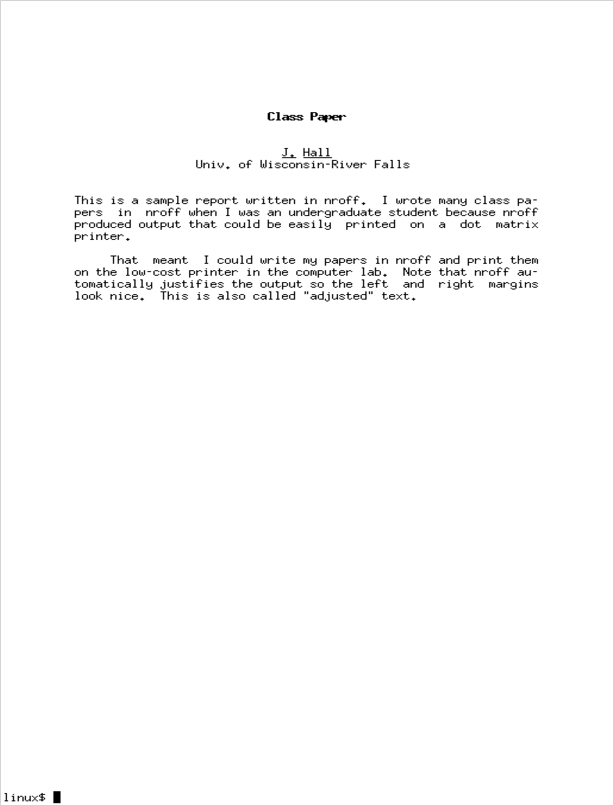
A printed page on a dot matrix printer, or any other typewriter-like device, typically used 10 characters per inch and 6 lines per inch. For what we call “US Letter” page size today, that’s 8 ½ × 11 inches, or 85 columns wide and 66 lines long. You can simulate a printed page by shrinking the font size in a terminal window and resizing the terminal so it is 85 columns wide and 67 lines long (the extra line means you can see the next command prompt without “losing” the top line of the document). But for this sample, I’ll just show the text output without the extra lines:

linux$ nroff -ms report.ms
 
                          Class Paper


                             J. Hall
                 Univ. of Wisconsin‐River Falls


This is a sample report written in nroff.  I wrote many class pa‐
pers  in  nroff when I was an undergraduate student because nroff
produced output that could be easily  printed  on  a  dot  matrix
printer.

     That  meant  I could write my papers in nroff and print them
on the low‐cost printer in the computer lab.  Note that nroff au‐
tomatically justifies the output so the left  and  right  margins
look nice.  This is also called "adjusted" text.

The justified lines are each 65 characters wide. For paper that is 85 columns wide, we need to add extra space on the left side with the

.po
(page offset) command. If we add 10 spaces on the left, and each line is 65 columns wide, that means we’ll have 10 spaces left over on the right side. The output will be neatly balanced:

linux$ (echo '.po 10' ; cat report.ms) | nroff -ms
1-page document with a title, author, and two paragraphs, as plain text

Upgrading to typesetting

Later, Bell Labs purchased a phototypesetter, and they updated nroff to become troff (or typesetter roff). When they purchased a second typesetter, troff became ditroff (device independent troff). These days, you can use groff (or GNU roff) to simulate typesetter output; to generate a PDF file as the output, use the pdfroff command and redirect the output to a file.

The Bell Labs team continued to develop the

-ms
macros to support the extra formatting in the typesetter. That means extra font styles like italic and bold, and (eventually) new fonts like Courier and Helvetica.

Let’s update the

report.ms
file to support this extra formatting. To add bold text, use the
.B
command. Use
.I
to turn on italic text,
.CW
for constant-width text (like a typewriter), and
.R
to go back to normal or “roman” text style. Each command will switch the type style—although it will limit formatting to just a word if you provide that word as the next option on the same line. This is easier to see in a demonstration:

.nr PS 18
.TL
Class Paper
.AU
J. Hall
.AI
Univ. of Wisconsin-River Falls
.LP
.I
This is a sample report written in nroff.
.R
I wrote many class papers in nroff when I was an
undergraduate student because nroff produced
output that could be easily printed on a
dot matrix printer.
.PP
.B
That meant I could write my papers in nroff and
.R
print them on the low-cost printer in the computer
lab.
Note that nroff automatically justifies the output
so the left and right margins look nice.
This is also called
.I adjusted
text.

To make the output easier to see as a screenshot, I’ve also used the

.nr
command to set a number register. In this case,
PS
is the number register for the text size (“point size”) which I’ve set to 18-point text. The default font is Times.

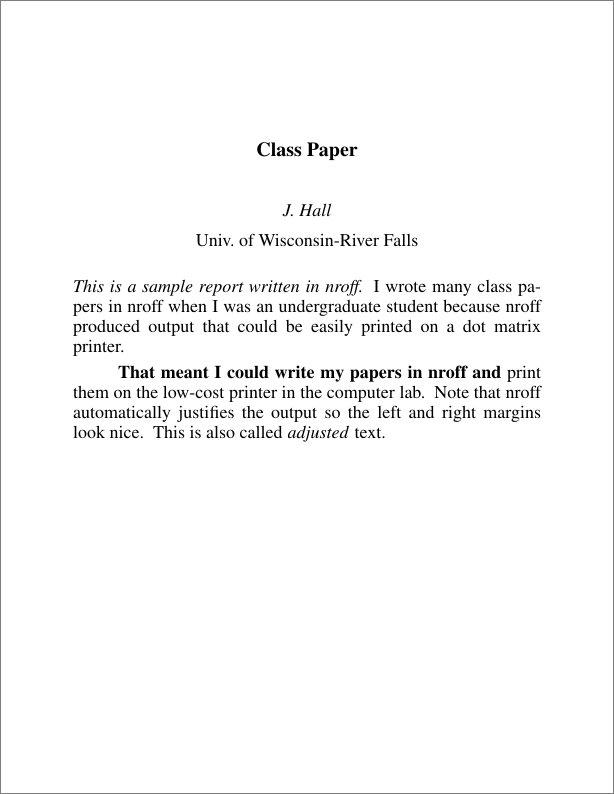
Let’s process this using pdfroff so we can see what the output might have looked like on a phototypesetter:

$ pdfroff -ms report.ms > report.pdf
1-page document with a title, author, and two paragraphs

More to learn

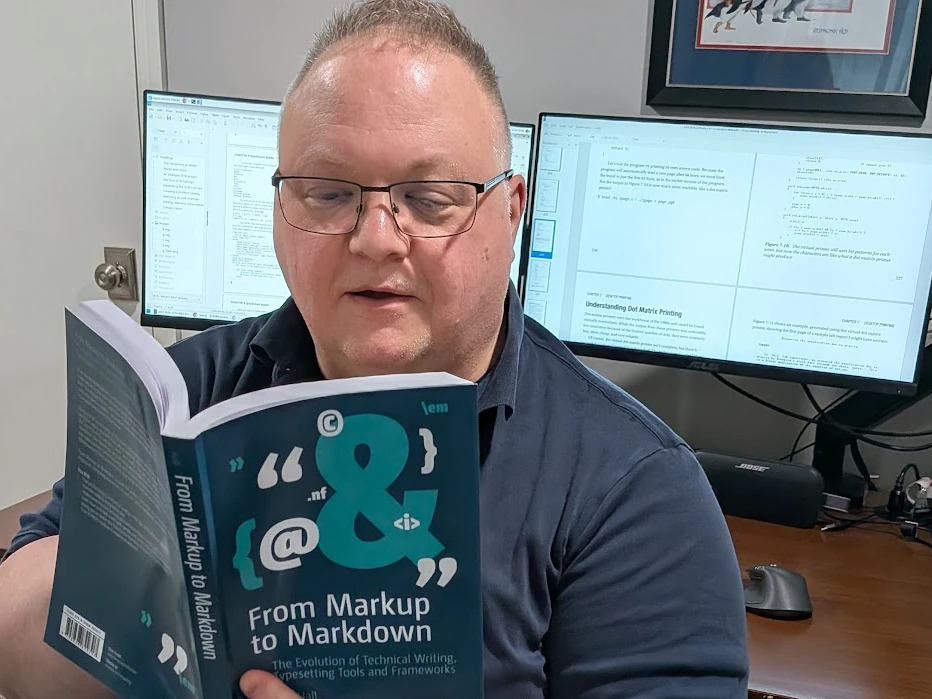
This is a simplified version of what I talk about in my new book, From Markup to Markdown, now available from Springer/Apress. If you’re a programmer or technical writer, you’ll love this book!

From Markup to Markdown is about how we’ve used computers for writing, including RUNOFF, nroff, LaTeX, HTML, and DITA. There’s even a chapter in there about word processing with WordStar, one of the first desktop word processors. I added a ton of references and examples in each chapter, so you can see how to create and format documents. Many chapters also provide source code of a simple implementation of each system, to show how things worked.

I have so many favorite parts of this book; I can’t really pick just one thing that I love. But I think the nroff and troff chapters really stick with me. That’s how I got started with document preparation, before I learned other markup and writing tools.

From Markup to Markdown is available in print and ebook editions from Springer/Apress. You can also order it from Amazon and other book sellers.

a man reading a book at a desk
05

Degree vs. Certification vs. Experience

SOURCE https://itguyeric.com/blog/degree-vs-certification-vs-experience/

Degree vs. Certification vs. Experience

The degree versus certification versus experience argument is one of those debates that never dies in IT, and everyone who weighs in tends to argue for whatever path they personally took. I am going to try not to do that, because I have done all three and I teach the college side of it now, and the honest answer is that they are not really competing for the same job. They are answering different questions. Let me lay out what each one actually does, tradeoffs included, and let you sort out what that means for you.

My own path, so you know where I am standing: I have two degrees, I hold my RHCSA, and most of what I actually know I learned with my hands on real systems that were on fire in various ways. I also teach Linux Administration as an adjunct at JCCC, which means I now watch students come at this from the front end, and that has changed how I think about the whole question.

Start with the degree, because it is the most misunderstood in tech circles. The common take among sysadmins is that a degree is a waste, that nobody checks it, that you learn nothing useful. That is partly true and mostly wrong. What a degree actually buys you is not Linux skills. It buys you a credential that clears automated filters, the ability to communicate and write and think in structured ways, and in a lot of larger and more traditional organizations, a checkbox that is quietly required no matter what the job posting says. It also buys you the foundational stuff you will resent while learning and be quietly grateful for later, like how networks actually work underneath the commands you memorized. The tradeoff is real, though. It is slow, it is expensive, and it will teach you almost nothing about the specific tools you will use on day one of an actual job. A degree is a long, broad bet. It pays off over a career, not over a job hunt.

Certifications are the opposite bet, and here my own opinion is split, because “certification” covers two very different things that get lumped together. There are multiple-choice certs, the ones you pass by picking the right answer, and there are practical certs, the ones that sit you in front of a broken system and tell you to make it work while the clock runs. I value them differently, and I think you should too. A multiple-choice cert is a perfectly good layer of knowledge validation. It proves you studied, that you know the vocabulary and the concepts, and there is real worth in that, especially early on. But it proves you can recognize the right answer, not that you can produce it under pressure. A practical cert is a different animal entirely. When I earned my RHCSA, nobody handed me a list to pick from. They put me in front of systems that did not work and told me to fix them, graded on whether they actually worked at the end. That is worth a great deal more, and here is the concrete reason why. When a savvy hiring manager is comparing two candidates who look similar on paper, the one holding a Red Hat practical cert has provably done the job under a time limit, and the one holding a stack of multiple-choice certs has provably passed some tests. Those are not the same signal, and a good hiring manager knows it.

That distinction leads straight into something I mentioned only in passing and want to say plainly, because it matters more than people think: a wall of certs can actually work against you in a job hunt. It feels backwards, because collecting them feels like progress, but past a certain point a resume stacked with a dozen certifications and thin experience starts reading as a warning sign instead of a strength. An experienced hiring manager sees it and wonders why someone spent all that time testing instead of doing, or quietly suspects the certs are there to paper over a lack of real work. It can signal professional exam-taker rather than practitioner. I am not telling anyone to avoid certs, mine got me through doors that were otherwise closed. I am telling you the goal is a couple of the right ones sitting on top of real experience, not a trophy case. More is not better here, and past a point, more is actively worse. And whichever kind you hold, a cert is still a snapshot, and snapshots go stale. It proves you could do the thing on exam day. It does not prove you have the judgment that only comes from doing the thing for years, and it does not prove you will make good calls when the situation looks nothing like the exam.

Which brings us to experience, the one everybody claims is the real answer. And it mostly is, with an asterisk. Experience is the only one of the three that teaches judgment, and judgment is the actual job. Knowing which command to run is a cert-level skill. Knowing which command not to run at four in the morning on a production box because you have been burned before is experience, and there is no shortcut to it. You get it by being responsible for real systems and living with the consequences of your own decisions. Nothing else produces it. But here is the asterisk nobody likes: experience has a bootstrapping problem. You need it to get the job, and you need the job to get it. That gap is exactly where degrees and certs earn their keep. They are how you get someone to take a chance on you before you have the experience that will eventually make them obsolete.

That is the thing I have landed on after doing all three and now teaching the entry point. They are not ranked. They are sequenced, and they solve different problems at different moments in a career. Early on, when nobody knows you and you have nothing to point to, a degree or a cert is how you get through the door. Once you are inside and the systems are real, experience takes over and quickly becomes the thing that actually matters, to the point where nobody asks about your degree anymore. The mistake is treating it as a single choice you make once. It is not. It is a progression, and which one matters most depends entirely on where you are standing when you ask the question.

Teaching has made me gentler about all of it. I watch students who will clearly be excellent at this someday, and the credential is not the point for them, it is the on-ramp. Whatever gets you onto the road is a good choice. The road is where you actually learn to drive.

06

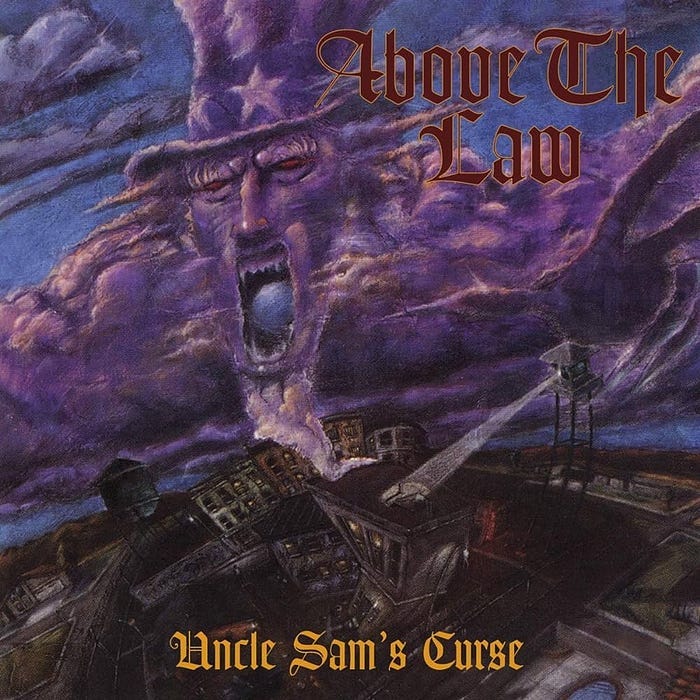
Backspin: Above the Law — Uncle Sam’s Curse (1994)

SOURCE https://backspin.substack.com/p/backspin-above-the-law-uncle-sams

A stylized image of America’s Uncle Sam in clouds above drawings of buildings strewn about at odd angles.

Originally published 12/8/24 on Medium.

G-Funk is the double-edged sword that makes the gangsta rap arsenal so confounding.

On one side, its winding synths and bubbling basslines lend an easy accessibility to the subgenre that pushed Southern California to the forefront of the national hip-hop scene. Wrapped in a lush cocoon of warm musicality, stark portrayals of urban brutality suddenly went down a lot easier for Top 40 radio programmers, suburban soccer moms, and hip-hop’s more squeamish fans who embraced the jazzy whimsy of New York’s early ’90s new wave over the abrasiveness of gangsta rap’s first iteration.

On the flip, as G-Funk’s smooth grooves made deeper inroads into the mainstream, some of the rough edges that gave gangsta rap its raw power got sanded down. The dark shadow of danger moved from the foreground to the backdrop. Sudden outbursts of violence were buried under soothing melodies. How many listens did it take to realize Nate Dogg was crooning a mass murder on “Regulate”?

Already ubiquitous drugs and alcohol were suddenly celebrated as part of a decedent gangsta party rather than a fleeting escape from a life of desperation. Depravity was glorified rather than lamented as G-Funk became feel-good “lifestyle music” - hip-hop’s yacht rock.

Uncle Sam’s Curse, the third long-player from gangsta rap’s perennial peripheral players, Above the Law, holds a singular place in the G-Funk canon. It’s a riveting hoo-ride down an alternate timeline offering a tantalizing snapshot of where G-Funk could have gone had it hewed a little closer to its roots in Golden Age hip-hop and classic funk.

“Return of the Real S***” delivers everything an opener should, setting the tone sonically, lyrically, and conceptually. Above the Law founding member Cold 187um, quietly one of the West’s most skilled producers since the group’s 1990 debut Livin’ Like Hustlers, seizes back the musical hallmarks of the G-Funk sound he helped shape and spins them on their head.

Elongated synth lines linger ominously, conveying tension and foreboding rather than carefree cool. Heavy drum kicks batter with blunt force rather than seducing with crisp precision. Even the instantly familiar “More Bounce to the Ounce” sample, already a staple in West Coast rider music by ’94, is slowed to a menacing rumble. In totality, the aural palette evokes a surrealist nightmare scape. The familiar is rendered unsettling via distortions just subtle enough to service latent truths.

On the mic, 187 and his partner in rhyme, the late KM.G the Illustrator, match the track with dystopian rhymes of urban corrosion. Tropes often softened, even romanticized, through the warmth of G-Funk’s grooves are present. However, Above the Law present them with stark matter-of-factness, offering context for the seemingly unrepentant lifestyle omnipresent in the era’s West Coast music.

His opening verse building to a crescendo, 187 confronts gangsta rap’s largely suburban audience with their privilege:

I got a question I wanna ask you Have you ever sold dope cause you had to?[No]Or ever watched a junkie shoot up in ya alley?[No]Or ever watched Sally get pimped by her dear old daddy?I did; I told the cop I don’tBut ya’ll think you know, cause you watched Strapped on HBO

“Set Free” provides a respite from the the sonic whirlwind of the opener. The guitar-tinged blues groove provides a meditative backdrop for a measured examination of urban plight. The production’s southern shadings feel like the migration pattern in reverse, inviting minds to roam with 187’s as he muses, “We were once the kings before we became the slaves… We were once the leader, but now we’re just the follower separating ourselves in packs that we call sets.”

The spoken intro proves a potent conduit into a jarring exercise in contrast. 187’s rhymes present the gangsta lifestyle as a necessary evil—perhaps the only path to freedom from generations-old pathologies. KM.G’s closing verse portrays those same behaviors, ultimately tightening the chains they were intended to break.

And the news starts to glorify them homicides and drive-bys While we get high and rock them fly rhymesStill serving that powder by the gramWhile some of my n****s go to the pen, and some to Uncle Sam

Above the Law aren’t absent from the gangsta party that opened its doors to the world via G-Funk. Hit single “Kalifornia” interpolates the bump-n-grind boogie of The Time’s “Gigolos Get Lonely Too” into an infectious ode to warm weather revelry. Still, 187 and KM.G don’t revel in debauchery for debauchery’s sake. “Kalifornia” celebrates the resilience required for basic survival in a landscape built to take life, whether by sudden bursts or slow decay. A bracing beat switch takes the track’s final leg on a dark detour, abruptly ending the temporary diversion and taking us back to the streets where the hustle and its omnipresent specter of danger never cease.

“Concreat Jungle” and “Rain Be For Rain Bo,” built off broodingly deliberate keys and basslines, deliver a poignant one-two punch unpacking the conditions through which criminality is perpetuated. The former depicts a concrete jungle of desperation, a dog-eat-dog world in which every canine is eventually devoured.

The latter zooms out to a macro view. American capitalism is positioned as the true ghetto, driven by machinations of the same criminal ethos as the street hustle. The distinction between criminal and mogul is presented as simply one of narrative.

To myself I’m livin’ like Donald Trump But to my people, I’m just like Fred Sanford, sellin’ junk

Above the law, indeed.

The B-Side kicks off with a triumphant and much needed moment of catharsis. “Black Superman,” Uncle Sam’s Curse’s lead single and Above the Law’s highest charting hit, is a B-12 shot of uncut swagger. Crisp drums slap. A rich bassline throbs. Piercing keys cut through a low end as dense as LA smog. “Black Superman” epitomized Black superhero music a decade before Jay-Z committed the term to wax.

KM.G delivers a bravado-fueled day-in-the-life account of the hood superstar, illustrating that simply maneuvering the treacherous terrain of urban life demands superhuman heroism. 187 demonstrates how one person’s villain can be another’s superhero with a heartfelt tale of personal salvation through ill-gotten gains:

Before my mama f*** with the county again I’d rather take the risk of doin’ five-to-tenI’m not takin’ them checks, I’m straight makin’ them checksSo now we deserve to get what we wanna getI got my mama up outta thereBecause y’all motherf***ers just don’t careUh, you really wanna know why I sold scum?Because my mama, to me, comes number oneNow you sucker motherf***ers don’t understandBut to my mama, I’m her real Black Superman

The sumptuous synth groove of “The ‘G’ In Me” continues the swagger-fest. While on the surface, it luxuriates in the carnal spoils of the gangsta life, in context, it conveys the raw allure of the same bravado cultivated as a survival system.

If the true meaning of the album’s title was slowly taking shape in the subtext of its first 40 minutes, the title track yanks it to the forefront. “Uncle Sam’s Curse” is poverty. It’s racism. It’s ghettos. It’s the lifestyle bred of deprivation and despair suddenly celebrated through G-Funk’s seductive grooves.

When you’re mobbin’ through the neighborhood And you have to fade your strap, cause it’s like thatThat’s Uncle Sam’s Curse

If you’re a rebel and you’re movin’ the product And everybody hates youThat’s Uncle Sam’s Curse…

And if you’re preyin’ on a fool to jack And you don’t care about the colorEven if he’s BlackThat’s Uncle Sam’s Curse

“Uncle Sam’s Curse” is barely controlled chaos musically and lyrically. It’s desperate and resilient. Triumphant and tragic. Angry and resigned. It’s a veritable cauldron of contradictions bubbling over after centuries of struggle.

The show-stopping closer, “Gangsta Madness,” is as mesmerizingly measured as the title track is explosive. With apologies to DJ Jazzy Jeff & The Fresh Prince, 187 anchors the track in the most ingenious interpolation of “Summer Madness” committed to wax. Where Kool & The Gang’s summer staple is typically leveraged for its easy-riding tranquility, 187’s rendering draws a chilling mournfulness out of the rising synth lines.

“Gangsta Madness” synthesizes the album’s moods and themes, putting faces and stories to the victims of Uncle Sam’s curse. The ultimate fatalism at the core of the gangsta lifestyle undergirding the rhymes is perhaps best summed up by 187’s attempts to determine the less tragic option:

Yeah, I never knew what was worse To die first or see one of my people die before me

Rap is presented as a glimmer of ligh; one of the few viable paths out. But it comes at a cost, as the lived experiences that make for the most profitable narratives can take a lasting toll on the human spirit.

A pensive chorus from Kokane evokes a funeral dirge. In many ways, it’s the culmination of a performance that marks the then-emerging MC/vocalist as the album’s unsung hero. Kokane appears on nearly half the tracks, consistently delivering hooks and backing vocals that pair swagger with sadness in a way that further shades arguably G-Funk’s most nuanced record.

The power of Uncle Sam’s Curse is a tantalizing hint of where G-Funk could have gone had more artists approached it with Above the Law’s artistic ambition. Earth, Wind & Fire leader Maurice White once imparted the following bit of wisdom to fledging songwriter Allee Willis: “Never let the lyric get in the way of the groove.” By the mid-90s, that might as well have been the G-Funk mantra. A cadre of gifted groove merchants churned out masterfully crafted tracks on which slick, melodic flows were incorporated more as a form of instrumentation than communication tool.

With Uncle Sam’s Curse, Above the Law showed another path. The trio (187Um and KM.G were backed by DJ K-Oss) used one of the era’s best produced sets to draw listeners into songs that ultimately pushed us to think a little more deeply about the social pathologies too often reduced to an atmospheric backdrop for a gangsta boogie with the devil.

That their path wasn’t more widely followed is perhaps the most damning indicator of the pervasiveness of the curse itself.

By the Numbers

Production: 10 Lyrics (how the words are put together): 8Delivery & Flow: 8Content (Substance): 9.5Cohesiveness: 10Consistency: 10Originality: 9.5Listenability: 9.5Impact/Influence: 6.5Longevity: 6.5

Total — 87.5

Backspin is a look back at the albums that shaped and defined hip-hop. It explores what made them resonate, the impact they had on the culture, and where they fit in today’s ever-expanding hip-hop canon.

07

Ed Zitron's AI prediction track record

SOURCE https://danluu.com/zitron/?_bhlid=347970aaa3d09c533ffea7a20e439df61dc8e288

I was curious how well the predictions of the most widely cited AI skeptic I've seen (Ed Zitron) have done, so I looked at how his predictions panned out. To disclose my own biases, I've never had a particularly strong pro or anti AI progress position. For example, in 2022, I did a comprehensive look at predictions Futurists made, including well-respected folks like Kurzweil and found them to be generally wrong on both the prediction results as well as the reasoning. On the flip side, in 2015, I wrote about how people were underestimating AI's ability to displace humans in jobs and have repeatedly been on the record as saying that many people are underestimating AI's ability to displace humans from jobs. My position on AI has been extremely boring and is basically, "if something is currently happening, the people who are saying that it's impossible that it will ever happen are probably wrong".

One comment I've seen from a lot of AI skeptics when someone responds to an AI skeptic is that all of the people who are saying that AI isn't fake are self-interested liars. Personally (to my obvious detriment), I have no particular financial interest in AI companies. I own whatever the standard share of them is via boring index funds. I have some seed stage investments, but just due to the timing and what's gotten big, that part of my portfolio is underweight on AI. I don't work at an AI lab or a company that supplies AI labs. I've mentioned being hilariously bad at interviews before, and I did interview at an AI lab a number of years ago and failed the phone screen in a performance that was the kind of performance that must've inspired Jeff Atwood's famous Why Can’t Programmers... Program? where he concludes that there must be a lot of fake programmers out there because nobody could fail a coding interview that badly if they knew how to program. I don't benefit in any particular way if AI does well, except insofar as anyone who holds broad index funds benefits, but I do care about accuracy.

Because there are quite a few prediction results, let's look at one in detail before the complete list to get an idea of the kind of reasoning Zitron uses. We'll arbitrarily look at this November 2024 talk where Zitron says, among other things, the major tech companies (like Meta and Google) are dying and they're thrashing around on AI because they don't know how to grow.

Zitron specifically named Meta as a company that's dying ("it's a dying product, and it's kind of a dying company"). Meta's revenue and profit (GAAP operating income) have been

PeriodRevenueProfit
Amount%Amount%
2023$135B16%$47B62%
2024$165B22%$69B48%
2025$201B22%$83B20%
First half 2026$117B30%$42B10%

When he talked about companies not knowing how to grow ("none of these companies anymore really know how to grow ... in the desperation to try to reignite growth in a dying ecosystem the tech industry is going to shove this [AI] shit into everything"), he named Google and then Microsoft. Alphabet (Google's parent company) has had the following revenue and profit numbers:

PeriodRevenueProfit
Amount%Amount%
2023$307B9%$84B13%
2024$350B14%$112B33%
2025$403B15%$129B15%
First half 2026$230B23%$80B30%

And Microsoft's numbers have been (note that, for consistency, all numbers are calendar year numbers and not fiscal year numbers):

PeriodRevenueProfit
Amount%Amount%
2023$228B12%$101B21%
2024$262B15%$118B17%
2025$305B17%$143B21%
First half 2026$173B18%$79B19%

Although this wouldn't be in the spirit of Zitron's statement, one could argue that Meta is actually dying, it just hasn't died yet. However, the reasoning in Zitron's argument is incorrect here—the Meta, Google, and Microsoft ecosystems are not dying. Given how fast these companies are growing (in terms of revenue and profit), it doesn't seem that AI is, as Zitron implied, some kind of desperation move they're reaching for because "they don't know how to grow" and are all out of ideas. I don't think it's worth spending this much text on each prediction, but the pattern Zitron used here is illustrative.

To make the case that these things are dying, he pulls on minor issues that are not positioned to cause the very large changes he suggests are about to occur. For Meta, he cited some kind of alleged MAU drop for Facebook. Rather than use Meta's own MAU figures or any kind of revenue or profit numbers, he seems to have used numbers from Similarweb. My experience with 3rd party tracking numbers like this is that they're quite inaccurate and generally useless for anything other than a rough order of magnitude comparison, making the Zitron's cited decline meaningless. FB stopped reporting MAU publicly in December 2023, but most estimates have FB MAU increasing over time and the numbers Meta does report show generally increasing usage over time for their products; Zitron cherry-picked an outlier low estimate to make his point.

For Google, he cites Prabhakar Raghavan, who he calls truly evil and "a computer scientist class traitor that sided with the management consultancy sect", as having done some kind of grievous damage to Google search. In his rants about Raghavan, he never credibly establishes that Raghavan is doing severe harm to Google search, and the Google search engineers who've commented on his rant don't seem to agree with the Raghavan as sole or even major reason for search issues hypothesis.

But even if we posit that Zitron is right and the villain Prabhakar Raghavan defeated the hero Ben Gomes, causing some kind of issue for Google search, this still doesn't make the case that Google revenue growth is in trouble at large because they have a number of other major products (such as YouTube and Google Cloud) that could drive growth even if search wasn't growing.

Every significant part of the chain of reasoning here is not only incorrect, it's not plausible if you know anything about Google or big companies in general. I'll be the first person to say that Google search quality has some serious problems and that Google has been increasing the relative priority of revenue over the user experience over time. This was a source of consternation for a number of user-focused engineers at Google when I was there in 2013.

For one of the issues Zitron cites, ads being confusing to users, in 2013, I asked a search engineer about Google changing the background color of ads to look more like search results because there was a previous study that showed that more an ad looked like a search result, the more users got confused over whether a result was an ad or a real search result, and I'd heard that Google deliberately made the ads not look like search results to avoid user confusion. The search engineer said that because some people didn't want users to get confused, it was impossible to make ads nearly identical to search results in a single change because it would be too obvious what's going on.

The way this was going to happen was that every time you A/B test tweaking ads to look a bit closer to search results, you make a lot more money, so the change would happen over multiple years in multiple parts, each small enough that the people who want to fight back against this kind of thing would have a hard time making a case. That happened just as this engineer predicted, but it was going to happen whether or not Raghavan ended up overseeing search. And, of course, that kind of thing happening doesn't cause Google to run out of room to grow and become desperate to reignite growth in a dying ecosystem. Whether or not you think Google should do it, it's something that makes Google more money.

How do people cite Zitron?

From what I can tell of how people cite Zitron, they cite him as an authority so they can say that this guy who looked at the numbers has made this claim, so their claim is backed up by the numbers. It turns out that if you look at the claims Zitron makes and know anything about the topic, the claims don't make sense, but I don't think that's the point. The point is one can say that someone looked at the numbers. The other point seems to be that this guy is angry, which is a good way to drive engagement.

But when people bring him up, they're of course not generally citing his anger; they're saying here's this guy who's looked at the numbers and, if you're angry about AI, he's right there with you being angry about AI, and he's got numbers on his side. Like I said above, I don't want to go into this level of detail on each claim; this is just an illustrative example about how the claims below look. For any of his posts that I read, while there are numbers thrown around, the numbers don't actually connect to a coherent argument. In many cases, as we saw above, the numbers don't even really support his argument (such as an MAU decline in Facebook causing Meta financial problems which would then cause Meta to spuriously insert AI in places it doesn't belong). I suspect he's relying on people's eyes glazing over when they see numbers and just not thinking about what the numbers mean.

With the predictions below, someone could have the exact same prediction record and have completely reasonable reasons that just didn't pan out. Or someone could be correct in every case and also be wrong because all of their reasons are wrong. Someone like the latter person might have some kind of intuition that they're unable to articulate, or perhaps they're someone who just got lucky. Fortunately for us, we don't have to make this difficult judgement call because Zitron is wrong on the predictions and also wrong on the reasoning.

People with attention to detail on Zitron

Since I've been living under a rock for years and am just catching on the AI discourse, I hadn't actually read or watched anything by Zitron or any of the big AI commentators, but on looking up what people who have good judgement say, they also seem to find that Zitron's use of numbers is just sleight of hand, such as this comment by Juho Snellman:

His writing is certainly flamboyant, but the aggression and expletives seem more targeted at hyping up people who already believe the things he writes, not for making people change their minds. He found a niche in anti-tech grift, and is now exploiting the niche for all he can. But you might want to actually fact-check a few of the things he says that convince you, because at least for his written articles basically everything is made up or misrepresented. There's plenty of links to sources, sure, but if you follow them down to the primary source what they're saying is very different from what Zitron is implying

Here's an example where commenters seem to assume that Zitron's analysis is good for some reason, to which Juho Snellman replies: > The key problem is that his economic analysis is absolute trash. I used to think he was just totally incompetent at it, but given the bias in the errors, it is pretty clearly intentional deception. But it's often pretty hard to address that, because every article he writes is a 10k word gish gallop. I've tried debunking key points a few times in HN comments for just one of the intentional mistakes he makes, and people complain about the reply being too long.

For example, when Timothy B. Lee looked at a spreadsheet that Zitron used to create a projection of Anthropic's revenue, he found

He doesn't count February 1-10, counts March 1-10 twice, counts August 21-October 21 as one month instead of two, and doesn't count October 21-November 1. [another commenter notes that his spreadsheet also contains February 30] ... Ed claims he tried to compute Anthropic's revenue for 2025 and came up with $3.6 billion, suggesting some funny business [but the numbers work out once you fix the errors]

Some Zitron predictions

  • Feb 2024: "I believe we're reaching the upper limits about what generative AI can do and how accurate its outputs can be."
  • March 2024: "Have We Reached Peak AI?"; another prediction that hallucinations mean that AI progress is limited to then-current levels
  • April 2024: "As I previously warned, artificial intelligence companies are running out of data ..."; another prediction that models can't improve because there's no more data
  • June 2024: OpenAI growth is stalling (with the implication it will continue to stall), which will lead to some kind of collapse of OpenAI
    • Wrong (it could be the case that OpenAI will collapse but, if so, it won't be due to any kind of growth stall from 2024)
  • July 2024: "Generative AI, as I said back in March, is peaking, if it hasn't already peaked. It cannot do much more than it is currently doing, other than doing more of it faster with some new inputs"
  • July 2024: "Generative AI models aren’t getting more energy-efficient, nor are they getting more “powerful” in a way that would increase their functionality"
    • Wrong (models continued to get more powerful)
  • August 2024: "generative AI is a dead-end technology that has peaked”
  • August 2024: re-iteration that the AI bubble has 3 quarters to prove itself (from March 2024) or there will be a collapse
    • Wrong (Bartek Ogryczak notes, arguably Right because AI proved itself, but Zitron also argues no improvement, so Wrong by Zitron's accounting)
  • September 2024: "o1 shows that OpenAI is both desperate and out of ideas", with a re-iteration of the idea that models can't improve due to lack of data
  • Oct 2024: OpenAI's forecast of $3.7B revenue in 2024 and $11.6B in 2025 and $100B in 2029 are absurd, "a statement so egregious that I am surprised it's not some kind of financial crime to say it out loud"
    • Wrong (2025 goal exceeded, 2029 TBD but not an egregious financial crime level of implausible)
  • Oct 2024: "[OpenAI revenue] growth is already slowing, and will slow dramatically as we enter the new year"
    • Wrong (OpenAI exceeded the forecasts and contiued to grow quickly)
  • Dec 2024: "I also warned you in March that generative AI had already peaked.”
    • Wrong (also, bizarrely, implying no progress since March 2024)
  • Jan 2025: "I believe we’re at peak AI"
  • Jan 2025: "DeepSeek has commoditized the [LLM]"
    • Wrong (OpenAI and Anthropic had and still have significant pricing power and can maintain prices well above DeepSeek)
  • February 2025: Anthropic making $34.5B in revenue 2027 is "is laughable on many levels, chief of which is that OpenAI, which made around twice as much revenue as Anthropic did in 2024, barely made a billion dollars from API calls in the same year."
    • Wrong (whether or not they make that in 2027, their 2026 ARR greatly exceeding that makes the 2027 estimate non-laughable; also note that Zitron's belief that investment in AI can never have positive returns hinges on these estimates being false but they have so far been exceeded despite Zitron's confidence that it would be impossible to even meet the estimates)
  • February 2025: "Sundar Pichai wants Gemini to be 'used by 500 million people before the end of 2025, 'a number so unrealistic that someone at Google should have been fired, and that someone is Sundar Pichai."
    • Wrong (Gemini hit 750M users)
  • February 2025: "Sam Altman deputizing Orion from GPT-5 to GPT-4.5 suggests that OpenAI has hit a wall with making its next model, requiring him to lower expectations";
    • Possibly right? (GPT-4.5 wasn't very exciting, though if his "hit a wall" framing is part of his thesis that models can never improve, this would still be wrong as GPT-5 was a substantial improvement)
  • February 2025: "I will keep writing this stuff until I’m proven wrong."
    • Wrong (Zitron continues to write despite repeatedly being proven wrong)
  • March 2025: "In my years writing this newsletter I have come across few companies as rotten as CoreWeave ..." Zitron goes on to say that the company will not be able to survive for six months except with fundraising, though $4B raised might by them a year
    • Wrong (CoreWeave still exists and it's currently at more than double its IPO price as of this writing; CoreWeave only raised $1.5B at IPO)
  • April 2025: Zitron calls the bubble again and says "We're about to find out if I'm right."
    • Wrong (in that Zitron implied momentous events were about to happen which would prove him right and no such events happened)
  • April 2025: "It also, at this point, is pretty obvious that generative AI isn't going to do much more than it does today."
  • May 2025: "I do not know how you come away from this story and not think Cohere is going to die. Their projections are so far off from reality."
    • Technically unfalsifiable because there's no end date, but implied claim is wrong
  • July 2025: "I am not trying to be dramatic, but it's pretty easy to come to the conclusion that Cursor is going to die"
    • Wrong (Cursor gets a $60B exit)
  • August 2025: "These models have clearly hit a wall where training is hitting diminishing returns"
  • August 2025: Zitron says Cursor is dying and expects that it will sell for a firesale price; a price as high as $10B is not plausbie: "Is Cursor worth $10 billion? Nope! No matter how good its product may or may not be, it is not good enough to be sold at a price that doesn’t require Cursor to incinerate hundreds of millions of dollars with no end in sight."
  • October 2025: In response to the question, “If you had to guess, what is the timeline we are looking at for the AI bubble to pop?”, Zitron answers, "No later than Q2 2026"
    • Wrong (note that Zitron threw in a "no later than", which makes the stronger claim that this is an upper bound and not just a best guess)
  • Nov 2025: "the fact we're running out of high quality training data and we're hitting the walls of scaling laws, in the training paradigm, these models aren't getting better. What we're seeing today is pretty much what they're always gonna be like"

After this point, most further predictions that I saw were either non-falsifiable or resolve in the future. Note that I didn't attempt to catalogue statements that are nonsensical or were simply factually incorrect statements at the time, such as his December 2024 claim that “Generative AI's products have effectively been trapped in amber for over a year” or his January 2026 claim that "[models are] basically the same as they were a year ago. They have the same efficacy". Zitron has not only made forward-looking statements that AI capabilities will not improve, he's also consistently made backwards-looking statements that capabilities have not improved which, while obviously false at the time, seem to play well to his base (along with his other false statements). If you connect all his statements together, it's implied that AI had the same capabilities in January 2026 as they did in December 2023 (and if you connect later statements, it's actually implied that capabilities in August 2026 are the same as in December 2023, though to be fair to Zitron he frequently contradicts himself and has also admitted to limited improvement in mid 2026).

To be fair, we could say that Zitron is speaking colloquially, so we when he says things like "have effectively been trapped in amber for over a year", that doesn't mean there's actually be no change December 2023, so the statements aren't transitive. If we were talking about 100 years of progress, someone might say there's been no change in a year to mean there's only been 1% chance, but this might still mean 100% change over 100 years. However, we're talking about three years here. Even if you assume a kind of colloquial sloppiness, the collection of statements still implies that, from December 2023 to August 2026, improvements have been minimal (perhaps except, as noted above, when he contradicts himself and admits there have been limited improvements in some areas).

Comparing to respected Futurists

If we compare to how futurists did in our analysis of futurists, on style, Zitron relies much more heavily on anger than any of the futurists we looked at. On the quality of reasoning, he was probably about average compared to the futurists. Despite being wrong on roughly everything, he's not more unreasonable than someone like Buckminster Fuller, who suggested we'll be able to send people by radio because atoms have frequencies and radio waves have frequencies so it will be possible to pick up all of our frequencies and send them by radio.

In terms of the style of reasoning, of the futurists reviewed, he's probably closest to Kurzweil, in that he uses numbers to give a kind of aura of credibility, but if you know something about the topic he's discussing or look at the numbers, the reasoning falls apart. Zitron's reasoning isn't worse than Kurzweil's, who (for example) continually made new predictions of extremely fast progress that didn't pan out (such as, in 2001, predicting unbounded lifespans by 2011). Continually predicting that AI progress will stop for reasons that are incorrect is just taking the flip side of the bet on progress. Instead of having infinite progress, we're going to have no progress. Every time that prediction is proven wrong, you can just make another similar prediction and then move the date forward a bit (fans of both use the same techniques as well; fans of Zitron simply claim that his predictions are true, just like fans of Kurzweil cite his 86% prediction accuracy even though his actual accuracy on those predictions is 7% if you actually look at the results on the exact predictions he allegedly got 86% right). Michał Zalewski (lcamtuf) has some thoughts on why this happens:

The surest way to build [a] popular following is to articulate positions that are crisp, strong, and leave no room for doubt. You can't get too many podcast or TV appearances out of "well, the market could go either way", "both political parties make good points", "there's some merit but also some hype to AI". Or, to tap into the example in the post, "Harry Potter is an OK book".

In fact, there's a positive feedback loop. If you take a provocative, edgy stance, you get more attention and likes, so you sort of... self-radicalize? At some point, it's no longer an opinion that can be changed. It's an identity, a personal brand.

It's ... why Ed Zitron has a blockbuster blog about how it's all just one big scam. If you take a more nuanced view, you will at best get no reaction, or at worst, you'll invite scorn from both sides.

For anoyone looking for well-reasoned anti-AI takes, I find whitequark to be quite good (not that I agree, but I think the reasoning is sound and I could see how someone would agree if they have slightly different premises than I do), but of course whitequark doesn't draw the kind of big audience that Zitron does.

How long can you maintain an incorrect position for?

I'm curious what people do after being on the wrong side of a set of failed predictions about progress like this. For the futurists, even the ones who were nearly completely wrong (which was every single one reviewed here), they can still make some kind of case like "a quarter of the things I said would happen happened, it just took two to twenty times longer than I expected" and if they're not so stuck on accuracy, they can round this up to "the things I said would happen happened", which is often what they've done. That seems to have served them well as nobody really cares to look at the details anyway, which is how, for example, Kurzweil's alleged 86% prediction accuracy became a well-established fact; people don't actually care how the predictions panned out even though refuted the 86% claim in 2022.

But what happens to someone like Paul Ehrlich, who predicted imminent catastrophe when this clearly was not happening as he was writing and then did not happen? Just looking at Ehrlich's Wikipedia page, we have

A common criticism is that Ehrlich's predictions routinely failed to come true; for instance, Ronald Bailey of Reason magazine has termed him an "irrepressible doomster ... who, as far as I can tell, has never been right in any of his forecasts of imminent catastrophe."[41] On the first Earth Day in 1970, he warned that "[i]n ten years all important animal life in the sea will be extinct. Large areas of coastline will have to be evacuated because of the stench of dead fish."[41][42]

In a 1971 speech, he predicted that: "By the year 2000 the United Kingdom will be simply a small group of impoverished islands, inhabited by some 70 million hungry people." "If I were a gambler," Professor Ehrlich concluded before boarding an airplane, "I would take even money that England will not exist in the year 2000."[41][42]

When this scenario did not occur, he responded that "When you predict the future, you get things wrong. How wrong is another question. I would have lost if I had had taken the bet. However, if you look closely at England, what can I tell you? They're having all kinds of problems, just like everybody else."[41]

Ehrlich wrote in The Population Bomb that, "India couldn't possibly feed two hundred million more people by 1980."[27] In 1967, Ehrlich called to cut off emergency food aid to India as "hopeless".[43] This position was later criticized, as India's food production subsequently skyrocketed through the Green Revolution in India, and its per capita caloric intake rose significantly in the following decades, even as its population doubled.[44]

A large increase in global food production since the 1960s and a slowing of population growth have, within the current context of continued depletion of non-renewable resources, averted the scale of food shortage, famine and catastrophe foretold by the Ehrlichs.

Canadian journalist Dan Gardner, in his 2010 book Future Babble,[45] argues that Ehrlich has been insufficiently forthright in acknowledging errors he made, while being intellectually dishonest or evasive in taking credit for things he claims he got "right". For example, he rarely acknowledges the mistakes he made in predicting material shortages, massive death tolls from starvation (as many as one billion in the publication Age of Affluence) or regarding the disastrous effects on specific countries. Meanwhile, he is happy to claim credit for "predicting" the increase of AIDS or global warming.[13]

In the case of disease, Ehrlich had predicted the increase of a disease based on overcrowding, or the weakened immune systems of starving people, so it is "a stretch to see this as forecasting the emergence of AIDS in the 1980s." Similarly, global warming was one of the scenarios that Ehrlich described, so claiming credit for it, while disavowing responsibility for failed scenarios is a double standard. Gardner believes that Ehrlich is displaying classical signs of cognitive dissonance, and that his failure to acknowledge obvious errors of his own judgement render his current thinking suspect.[13]

Barry Commoner has criticized Ehrlich's 1970 statement that "When you reach a point where you realize further efforts will be futile, you may as well look after yourself and your friends and enjoy what little time you have left. That point for me is 1972."[46] Gardner has criticized Ehrlich for endorsing the strategies proposed by William and Paul Paddock in their book Famine 1975!. They had proposed a system of "triage" that would end food aid to "hopeless" countries such as India and Egypt. In Population Bomb, Ehrlich suggests that "there is no rational choice except to adopt some form of the Paddocks' strategy as far as food distribution is concerned." Had this strategy been implemented for countries such as India and Egypt, which were reliant on food aid at that time, they would almost certainly have suffered famines.[13] Instead, both Egypt and India have greatly increased their food production and now feed much larger populations without reliance on food aid

Amazingly, following the series of incorrect predictions Ehrlich made in and after writing The Population Bomb in 1968, he followed this up with The Population Explosion in 1990 and has continued saying that we have global overpopulation that is causing or will cause a dire crisis unless we cut worldwide population. He has said the same thing this century and even this decade. It appears the only reason he's not saying that today is that he died earlier this year.

If I didn't look it up, I would've guessed that his recent position would be something like "well, I got some things wrong, but it was only due to actions that were inspired by my work that crisis was averted" or "while crisis was averted, it was a lucky roll of the dice and, in most universes, the agricultural advancements that staved off the mass starvation deaths I was predicting don't happen", not "just you wait, the crisis is happening now and I'm about to be proven right"; in 2015, referring to his incorrect 1968 book, he said "[m]y language would be even more apocalyptic today". That's the pattern we've seen from Zitron, but I wouldn't have guessed that the one person I looked up would've kept that up for 50 more years. Maybe we'll get 50 more years of Zitron predicting the end of AI progress.

Some reactions to Zitron

In one of the quotes from Juho Snellman, above, Snellman says that he writes a large amount of gish gallop, which is a term for when someone floods you with so much cheap (as in cheap to produce) nonsense that no one would want to take the time to bother to refute it. In discussing one small part of Zitron's talk in detail, we spent more than 1000 words explaining why Zitron has an incorrect understanding of how corporations work and how Zitron got the reasoning wrong. Someone can read that and then say, "but you didn't address X" in the talk, which is true. When I first watched the talk, I actually closed the tab after 90 seconds because there was so much nonsense that it didn't seem worth the time to go any further. I could write 5k words on the first 90 seconds of the video. Because Zitron is just saying a bunch of nonsense, he can do that very cheaply and it would take 30-60 minutes to refute 90 seconds of his nonsense if I had all the facts at hand. With time to look up the exact right information, it probably would take double or triple the amount of time. When someone who has good judgement sees something like this, they tend to immediately write the person off. Just for example, I mentioned to a friend of mine that I'm writing this post and they said

I was listening to this podcast with the guy and I couldn't get through it. My heart rate was going up because he would just say this false thing and then the interviewer, who was reasonable, would ask about it, "what about X?", and then we would just jump to another falsehood ...

... before I ducked out, he talks about how LLMs haven't gotten a lot better over the past year, and the interviewer says people use them and they've definitely gotten a lot better in the past year, and Zitron denies it and says 'have they?', and the interviewer is just like, "yes..." At that point, I'm just like, why am I listening to this conversation?

We mostly discussed predictions and not incorrect statements about the past or present, but everything I've read or watched by Zitron is also full of things like this. Many people will look at something like this and decide the guy is a crank and stop paying attention. But many other people will look at something like this, see someone refute a set of things, and then say, "but you didn't refute X" and, in general, the person doing the refuting may respond to a couple of these, but they eventually give up because the gish gallop method has the same properties as an amplification DoS attack. It's very cheap to generate new nonsense, but it takes some effort to refute it.

BTW, I was curious what this interview was, so I put the above quote into ChatGPT and asked it to find the interview. It was able to identify an interview with the relevant exchange (it actually identified multiple, as this appears to be a common question and response pattern by Zitron) and the timestamp of each relevant statement in the interview (the start of the general argument is here and a "have they" response is here. Prior to the "have they?" comment, the interviewer tries to establish a baseline that agents have improved in capability. Zitron denies that this has happened, and then when the interviewer notes that people who use these things for their jobs Zitron denies this with the "have they?" comment (he actually makes multiple contradictory statements in the sequence).

Another thing to note here is Zitron's extremely high level of stated confidence. Some that we noted were OpenAI's forecast that is "a statement so egregious that I am surprised it's not some kind of financial crime to say it out loud" (which they've achieved so far) and his claim that Google's forecast for Gemini users is "a number so unrealistic that someone at Google should have been fired, and that someone is Sundar Pichai" (they managed to exceed the forecast by 50% when Zitron's claim was that it would be completely absurd for them to reach the number at all).

I've made quite a few predictions, and quite a few of those predictions are wrong. When I'm really making a prediction, I attach a confidence level to the prediction just for my own sake, so I can look back at these things and see how well calibrated the predictions are. I have never been wrong about a prediction that has anywhere near the confidence Zitron gives to some of his predictions. Given the stated level of confidence, even a single incorrect prediction would be a sign of an extremely high degree of overconfidence. One should effectively never be wrong about a prediction delivered with that level of confidence but Zitron is routinely wrong about predictions he makes with what is rhetorically pretty much the highest possible degree of confidence.

BTW, a funny thing about Gemini hitting 500M users being "so unrealistic that someone at Google should have been fired, and that someone is Sundar Pichai" is that Zitron has also (incorrectly) said that Google doesn't know how to grow, and that as a result they're shoving AI everywhere. Dennis Snell pointed out that, if Zitron takes his own statement seriously, Google can make Gemini's user numbers go to any number it wants by doing the exact thing Zitron said they would do, sticking AI everywhere.

You can't actually take Zitron's statement about Google's lack of growth leading to AI desperation seriously and also take it seriously when he says that Sundar is committing some kind of gross malpractice by naming a number like 500M users. This is another thing that is immediately obvious on watching one of his talks or reading his writing. There are a bunch of disconnected statements that don't fit together, except insofar as they're statements about how AI companies and people and companies that are using AI are evil and bad. The actual numbers and logic of the statements are contradictory. It seems to be whatever comes to mind that can be used to paint the villains as evil. And, funnily enough, the 750M user number Gemini hit shows that both of Zitron's statements were incorrect. If Google were as desperate to juice the numbers as Zitron claimed, they could've easily gotten the number above 1B by sticking Gemini everywhere, and of course 750M > 500M.

BTW, the point at which I stopped the talk for the first time was

a market obsessed with year-over-year revenue growth. And this progression was natural. It was horrible. You can blame Marc Andreessen. He's a horrible man. You can blame many horrible men. There are so many guys to be mad at the moment.

That last sentence really sums up Zitron's position. "There are so many guys to be mad at the moment". In this talk, he throws in this jab at Andreesen and blames Andreesen for Meta, Google, and Microsoft pursuing growth. In reality, if Marc Andreesen had never existed, Meta, Google, and Microsoft would almost certainly still be trying to grow so we of course cannot actually blame Andreesen for these companies trying to grow. There's just this thing that he says is bad, and in his usual style, he pulls some person and says they're the evil villain that's to blame for this, and then moves on to the next non sequitur.

How can people take this seriously?

Because I'm a masochist, I actually went and read a bunch of Zitron discussions (I believe I read every major discussion on HN and lobsters, and a bunch of other ones as well) to see what people who take Zitron seriously are saying. One common defense was the one above, sure, you refuted some points, but you didn't cover X. A more common defense is to say, just in general, people attack Zitron because of Y (usually his style), but they never address his points, "which tells me everything I need to know" (or something along those same lines). Based on the timestamps of the messages, just scoping to the stories that were being discussed, there were generally already comments discussing Zitron's actual errors, but Zitron's defenders would ignore this and just claim that people were unable to point to mistakes Zitron had made. This is a very Zitronian move and it makes sense that people who like his style would also use this move. After all, who would find Zitron convincing? Someone who thinks this kind of thing is valid reasoning.

The next most common "move" was to simply deny that Zitron said something that was refuted. When people would mention that Zitron was repeatedly on the record in 2024 and 2025 as having said LLMs couldn't improve further for fundamental reasons, Zitron's defenders would say that he never said that, and likewise for previous predictions or factually incorrect statements.

Another class of defense I saw were comments like "but what about all the AI hypists who are wrong?". Like I said before, I wrote a 34k word post about how a bunch of the most respected futurists have been wrong, not just because they made incorrect predictions, but their methods and reasoning were wrong. But a bunch of people who hype the future being wrong doesn't make people like Ed Zitron or Paul Ehrlich any less wrong. Zitron and Ehrlich are still exactly as wrong as they would be if those futurists never existed.

A friend of mine also noted this about comments on cases where people point out that Zitron was wrong about models not improving from 2023 to 2026 (and yes, this is specifically on stories or comments that discuss Zitron's disproven statements on capabilities not improving):

It's incredible to see so many people saying, "Zitron isn't wrong, he's just early!" I guess the implication is that we'll eventually realize that the models we have in 2026 are actually no better than the ones we had in 2024 or ??

An interesting thing about publshing this post is that a decent fraction of the people who've message me to tell me that I'm wrong say that I'm wrong because, today in 2026, models haven't actually models haven't gotten better since 2023 or 2024. My guess would be that most people who are saying things like the quote above are just doing the "move" where you don't read what was actually said and respond with a canned response that's nonsensical to anyone who's actually read what they're replying to, but it turns out there are plenty of people who actually believe Zitron's string of statements that imply models haven't improved since 2023 or 2024.

If someone's actually looked at what's happening, I don't think there's anything you can really do to convince someone who's denying reality at that level, but for anyone who's just hasn't seen how things have changed, for a visual example of improvements over that time period, here's a comparison of 2023 and 2025 video generation and here's an example from August 2026. Video isn't a great example since models have improved a lot more at coding, e.g., with on the order of minutes of human time, it's possible to create a new regex engine with an interpreter and an native code compiler and then fork ripgrep to make it faster for codex's actual ripgrep calls on my machine, a project that would probably cost 7 figures pre-LLM if you price out how much people with the expertise for that are paid. But video is a nice example because, in the interview linked above, after the "have they?" exchange, at one point Zitron's "rebuttal" is, "you wouldn't make movie with it would you?". People are "shooting" quite a bit of AI-generated digital footage now and this is upending a lot of lower end video work. An easy prediction based on historical patterns is that this will continue to move upmarket over time, but just based on what people are using AI video for today, Zitron should probably find a new rebuttal even if he's just playing to true believers who don't think models have improved since 2023 or 2024. Of course that topic can't be related to math or the sciences, where improvements have been very rapid, and the same goes for numerous other fields.

Future predictions

Although Zitron's past predictions have generally been wrong, maybe he'll be right about something in the future. Perhaps some of these companies will have valuations decline for some reason. But, even if there's some kind of massive AI crash and OpenAI and Anthropic go to zero, in terms of the societal impact, if on top of that, some other event occurs that prevents further progress in models beyond whatever AI labs have internally right now, that's still going to result in a fair amount of change. Which companies are successful will change who gets rich, but particular companies failing won't stop changes that fall out of current or next generation model capabilities from happening; it just moves around who benefits the most.

Personally, it doesn't matter to me if folks at one company vs. another get rich. If one company does something better (in some abstract sense) than another, that's of some interest to me, but I have some skepticism about any particular company's claims that they'll do more of "the right thing" than another company (I could be convinced on this one, but I don't find the public claims that I know of very convincing).

If Zitron ends up being right about some company or other collapsing, that's pretty uninteresting to me compared to how capabilities have developed and will develop, where he's been wrong to date. It also happens that he's been wrong about the financial predictions he's made to date and the reasoning for those is flawed as well, but that doesn't really interest me, though I included a number of financial predictions for completeness.

Thanks to Yossi Kreinin, Juho Snellman, Dennis Snell, Nick Bergson-Shilcock, @blueblimpms, Bartek Ogryczak, Jamie Brandon, and Shriram Krishnamurthi for comments/corrections/discussion.

Appendix: Ed Zitron on why people don't like Ed Zitron

While looking for discussions about Zitron's work, the #2 hit on reddit was this comment by Zitron:

... some men don't like me because emotional honesty and introspection are difficult for them. Feelings are something that men are told to repress or compress. I refuse, and I find it disgusting when anyone tells me to do so ...

... Let's start with emotions, because it's the most obvious one. People really do not like that I am how I am, and think that I am "getting mad as a bit," or even go as far as to describe me as psychotic, out-of-control, and so on and so forth. This is a common reaction, I find, from anyone who themselves is emotionally repressed, especially in their own work. It is hard to be emotional and have well-done opinions ...

... I also have not taken the route you are "meant to take" to get here. You are "meant" to be an establishment writer from a big outlet, or an analyst, or in finance, or any number of other different "true paths" where you are "worthy" of whatever it is you're meant to get. I did not "earn my stripes" in the traditional sense, and those that have believe I did not earn my way here ...

... My work is also thorough, which is frustrating for people that do not do thorough work. I have thought through every point I have, and I take great pains to know subjects well. Notice how many people still claim "it's just like Uber" or "it's just like the dot com boom." It's much easier to just assume shit without ever checking if it's true! Having some asshole who comes along with thoroughly and with passion is frustrating. It reflects badly on your work ...

... I do a good photo shoot, I do a good interview, and I capitalize on events, and I do so without being craven, because I usually show up with a few thousand words of thoughts or an episode about a thing. I believe there are some that would like this level of attention or prestige, but they do not want to do the work to get it, and that chafes ...

... I love big, I love hard, I am who I am, I have never been made to feel welcome by any "in" group. I work my ass off, I write more than anybody else, I show up. With whatever space I create I will fight back against "in groups" or cliques. I hate them, and they hate me right back. And I fundamentally know why I believe what I believe. That upsets people who do not.

I have no idea if he means any of that or not (if this Wired profile about Zitron and the PR firm he runs is accurate, one would have to lean towards not), but Zitron seems to be very good at saying what his audience wants to hear, so this proably gives some kind of insight into his audience.

One thing to note about the bit about cliques and "in groups", if you just search his name on reddit commenters note that if you post anything indicating that AI has improved on his subreddit (such as link to benchmarks), you get banned for it, resulting in a highly clique-y echo chamber. I'm on the record as having said that METR's progress benchmark isn't meaningful and that you're better off going on vibes than leaning on a misleading analysis and that widely cited AI evals are frequently flawed, so it's not like I think that benchmarks are generally good, but the picture I got from reading comments was that you get banned pretty quickly if you don't hew to the party line, which is the opposite of the picture painted above. This isn't anything unique to Zitron; when looking up another influencer a while back, if you disagreed with that influencer on their reddit, they would write a comment thanking you for your comment and saying how much they loved getting feedback from people and how the world is some kind of great peace and love fest and we should all love each other while simultaneously banning you from their reddit.

I also found Zitron's comments on how people don't like his work because they dislike thorough work to be interesting for a couple reasons.

One is that my own work is frequently positively cited as being rigorous and thorough. There are plenty of people who dislike my work as well, but not only do I not know of anyone who's said they dislike it because it's thorough, I would be surprised if there was anyone who secretly dislikes it because it's thorough. In general, just doesn't seem like a reason that people dislike things. That also goes for people being upset because someone knows why they believe something or because someone else worked hard. It's really interestin to me that this appears to be what Zitron's audience wants to hear.

The second thing is that, I wouldn't personally consider my work to be thorough. The same thing I mentioned here about not feeling that my work is good also applies to not feeling my work is thorough. I do some amount of checking of my work. I don't know that I'd say that it's more than most in terms of time spent, but in terms of effectiveness, I suspect the combination of methods and time spent works better than average. But I always have a dissatisfaction with my work when I published it because I could keep checking more thoroughly forever and never publish anything, so I force myself to publish at a level that I suspect is above average on thoroughness, but well short of thorough. If I compare my work to the work of someone I consider thorough, like Gary Bernhardt, I don't know how I could call my work thorough. I have a few friends who produce Bernhardt-quality work and I make the choice to produce much more but also lower quality work. I think this is a fine place to sit in the quality-speed tradeoff space, but that doesn't make my work thorough. To be as thorough as Gary, with my baseline pre-July 2026 standard, I'd need to put 10x-100x the time in per piece of output (it would take an additional 10x or more with how I've been publishing lately). And yet, it would seem that my fact checking process is a lot more thorough than Zitron's.

Even if we put aside the gross arithmetic errors like the Timothy Lee example, if we look at cases like the Facebook MAU example, where he picks a number that's directionally opposite of other estimates and of Meta's own numbers that's also directionally implausible given the other data out there, I don't see how such a figure could survive any fact checking at all. And this goes for a huge number of his factual statements (I would guess most, although I haven't tried to randomly sample them to be sure). It seems like any kind of fact checking process that you could imagine would turn up contradictory results.

Appendix: why write this?

No good reason, really. I got four hours of sleep and my brain wasn't good for much of anything and I saw someone posted a screenshot of a reddit post dunking on Ed Zitron's prediction record. When I wrote this review of futurist prediction accuracy, I tried to make sure that I didn't bias what I was reviewing in any way. It's not obvious from the post if the redditor who reviewed Zitron's predictions was pulling predictions in an unbiased fashion or if they were biased in some way (since AI has become a culture war issue, it wouldn't be surprising if someone pulled biased predictions), so I decided to read some Zitron in my spare time while poking at agents to get them to do an unrelated task I wanted them to do. For the futurist post, I read multiple entire books to pull predictions and generally only stopped when someone was being repetitive and kept saying the same thing over and over again. In this case, all Zitron does is be repetitive, so the methodology in the futurist review would mean that I review a few predictions and then stop immediately. To overcome this, I had ChatGPT give me a list of predictions (with no attempted tilt towards correct or incorrect predictions) and then I skimmed/read the posts that ChatGPT linked to. There were some cases where I thought ChatGPT's reading of the post was incorrect (these were generally cases where it flagged a prediction that would be incorrect if its reading was correct, but I disagreed with its reading) and (discussed further below) I also removed predictions which weren't falsifiable or seemed pointless because they were tautological (I noted something similar to this in the futurist post).

If I really thought about it, I probably could've found something better to do with the time, but here we are; I sometimes have tasks on my todo list for when I'm too tired to do real work, but I didn't have one. I don't think they cherry picked particularly bad predictions, although they did pick some that are among the more absurd sounding. However, if you go and look into the details of ones that aren't such ironclad "dunks" (like saying that Gemini hitting 500M by EOY users is so absurd Sundar should be fired for the idea, when Gemini actually hit 750M by EOY), these are just as wrong as claims that Cursor has no realistic buyer with the implication they won't even sell for $10B when "everybody" (who cares about AI exits) knows they sold for $60B.

The redditor picked the high-profile failed predictions, but Zitron's prediction corpus has many more failures and, as noted above, the bigger issue is his reasoning.

Another thing about the reddit comment is, whether or not the comment is unbiased, one might have the suspicion of a kind of bias because it was posted to r/accelerate by someone who apparently is an r/accelerate believer. On looking at the actual predictions they are consistent with some bias (they would also be consistent with an honest mistake as there's no way to distinguish these from the record). For example, one of the "refutations" is a statement by Zitron that OpenAI will collapse in 12-24 months. OpenAI didn't collapse, so this would appear on the surface to be a great way to show that Zitron was wrong, but if you read Zitron's post, Zitron's actual claim was that OpenAI will either collapse or raise a lot more money and they raised a lot more money. I disagree with Zitron's implications that this is inevitable just leading to a later collapse but his stated prediction was not falsified.

This prediction wasn't in the set of predictions scored in this post. Some would argue that this should be scored in the post. The reason this wasn't scored is because the prediction seems meaningless except insofar as it contributes to Zitron's broader point (that OpenAI is doomed and must collapse).

If we think about predictions one could make, a tautological prediction (if you write out all the edge cases I'll elide for space reasons) that has to be true is OpenAI has enough money to operate or it doesn't, and if it doesn't, it must raise the money somehow. I could make a million such tautological predictions, but if one were scoring my prediction record, it wouldn't make sense to include these because they're meaningless. In general, a company that's alive will cover its costs. If it does not, it will try to raise money. If it fails to do that, it will shut down or get acquired. A prediction that a company will either cover its costs or it will not cover its costs says nothing.

OpenAI's own projections were that it would not yet be profitable and its costs would exceed its revenue. That seemed nearly certain, so if you assume that this nearly certain thing is true, then you have the nearly tautological prediction that OpenAI will either collapse or it will raise money to cover its costs. It would have been reasonable to make a prediction like this at very high confidence (99.9% or above). If you use any kind of prediction scoring methodology, such as Brier score, these predictions contribute essentially nothing except when they're wrong as long as Zitron has a significant number of high-confidence incorrect predictions.

And, as we noted above, Zitron is repeatedly incorrect on predictions he gives the highest possible confidence (given his wording, I would rate a number of these at 6 9s or above), so on any kind of scoring mechanism like Brier score, Zitron's record is very poor. And a summary metric like this really understates how meaningless predictions like this are. Hypothetically, let's say Zitron made an unbounded number of correct 99.99% certainty near tautological predictions, which would make the score from the bounded number of other predictions he made meaningless on something like Brier score. This would still give you zero confidence for any of his non-near tautological predictions, and those are the predictions people generally talk about (AI progress is done, AI companies must collapse and this will bring down major tech companies as well, etc.).

Back the topic of the reddit commenter's potential bias vs. mine, as noted above, I don't have a particular bias towards a view that rapid progress is inevitible and have called out cases where people are overly optimistic, as evidenced by this post on futurist predictions. I'm also not someome who needs to or has any desire to farm engagement by manufacturing reasons that someone is wrong or bad and don't consistently rate every predictor as bad, as evidenced by this review of Steve Yegge's prediction record, in which I note that he scored well and also actually performed much better than the raw score indicated because the predictions are generally well reasoned and directionally correct even if the precise prediction was incorrect. I think it's actually awesome if someone has good insight in the future and shares it publicly, so I'm happy to call these cases out when I noticed them. It's just that, in this case, Zitron is a kind of anti-Yegge: someone with a poor prediction record whose predictions are actually worse than they seem from the record alone.

Appendix: errors in this post

I think it's almost certain that this post has multiple errors. In general, I find it very difficult to read a long stream of incorrect reasoning and then not get sloppy when looking for errors in it. I had this exact same problem when reviewing futurist predictions. It reminds me of when you're programming for some system where the compiler is very buggy and you hit compiler bugs all day every day (not uncommon when working with embedded systems, at least pre-LLM; now you can fix the bugs relatively easily). I find it hard not to get sloppy and think "hmm, this might be a compiler bug" even though, every once in a while, it will actually be your bug and not a compiler bug. The problem is much worse when looking at predictions from these kinds of predictions since the compiler still generally basically works and is often right, whereas when reading text like discussed here, you're just constantly drowning in nonsense that is occasionally punctuated by a good and accurate point.

I think, to do this well, you'd either need to find someone with very unusually high endurance for trudging through this stuff (I mean, much more than me, and I seem to have a somewhat above average endurance for this kind of thing) or have a team of people who independently rate and score things, but who would want to spend that kind of effort when any surface-level reading immediately reveals many things that indicate that these folks are pretty much totally wrong?

I did ask ChatGPT (web interface, Pro) and Claude (web interface, Fable 5) to fact check this post. They both found some minor errors that were fixed before publication.

One year ago, I found fact checks like this nearly useless, but they're halfway decent now and, contra Zitron, I would expect them to continue to get better. For people who are curious about the two, ChatGPT was much more thorough than Claude in this case and found more errors as well as finding every error that Claude found. However, it was overzealous and cited a number of non-errors, such as suggesting that tongue-in-cheek comments were incorrect, and that a number of statements that were generally true should be re-phrased in some more literal way (complete with AI-styled text).

I updated this post because @blueblimpms pointed out that a prediction that I thought was about GPT-5 was probably actually about GPT-4.5, although what Zitron is saying is unclear. After re-reading the relevant post, I agree, both that Zitron is probably referring to 4.5 and not 5 and also that his statement is unclear, so I changed that. That correction fits into this pattern that I predicted would occur, though I didn't note that a secondary cause of this problem is that Zitron's writing is quite imprecise and often relies on various vague implications between statements. The "have they?" / "are they?" response he does in interviews would be an example of this, where one could techincally argue that he's not making a statement at all and is just asking a question, although in those cases, given his overall position, we can infer what he means when he says that.

It's funny to say this, but a non-error in the post is my stating that I don't work at an AI lab or at a company that supplies AI labs (which I meant, colloqually, in the sense that I don't work at a company that sells hardware to AI labs or is primarily in the business of selling to AI labs, like an RL environment startup; no doubt we have people using non-ZDR plans that send data to AI labs, AI labs have scraped data from us or have paid scraping companies that bypass laws to scrape from us, someone has probably negotiated a deal to sell some amount of data we have to an AI lab that for an amount of money that isn't really material to us, perhaps as much as a half percent of our revenue since the AI labs were founded, etc.).

A friend of mine noted that he felt compelled to make a comment on Metafilter responding to someone who said that I worked at Nvidia. I've also had a few people message me directly to tell me tha I work at Nvidia. I'm not sure what to say to that. I have a few friends who work there and it sounds like a nice place to work, but it's not where I work. This is quite easy to verify from public information (technically, I could've quit my job and started a job since the last public information about my employment and then not told anybody, but if that were the case, that shouldn't cause random Zitron fans to think that I work at Nvidia; also, I haven't done that). We noted in the post that fans of Zitron often get the facts wrong when defending Zitron, which makes sense given that people who don't care much for the facts are who he appeals to. I guess this is another example of that. Of course people have also messaged me with all of the standard defenses we discussed in the post (Zitron never said that, Zitron is going to be proven right over time, etc.), but this one is a bit interesting in that "you work at Nvidia" is surely not a canned defense Zitrons fans have handy for every discussion they jump into.

08

An Open Letter to Cornell University from the Mother of a Prospective Male Student

SOURCE https://mcsweeneysinternettendency.substack.com/p/an-open-letter-to-cornell-university?publication_id=2704624&post_id=218943637&isFreemail=true&r=34qwdx&triedRedirect=true

No recent news story has inspired as many submissions to us as the Cornell seven rape case. We have received dozens of pieces of satire about it, all skewering the university’s awful response, as well as the culture of men that creates an environment where they think sexual assault is not a crime. It goes without saying, but writing satire about the subject of rape is tricky. You want to target the perpetrators and systems that allow it to happen, without disrespecting the victims. We’re proud of the pieces we have run about the Cornell case, especially the open letter below by Anaïs Godard, which is less satire and more a straight-up plea for the university to get its act together so these crimes don’t happen on its campus (or any campus) ever again.

“An intense, public outcry over a woman’s account of being gang-raped at a Cornell University fraternity house prompted New York’s governor this week to angrily yank control of the investigation away from the local prosecutor who didn’t initially see what happened as a crime.” — A.P.

Dear Cornell University,

My son is six, so admittedly, we have some time. Still, college admissions have become terribly competitive, and it is never too early to start researching the institutions that might one day shape him. Cornell seemed like a good place to start.

My son is bright. He reads above grade level. He plays competitive chess and does competitive gymnastics. He is fascinated by science, numbers, and infinity. I am currently debating Mandarin lessons, because six is, I’m told, when one begins panicking about the Ivy League. Last week, he asked me whether numbers ever stop, and I told him no, which led to several follow-up questions I was not academically equipped to answer.

This is why we need institutions like yours.

I understand Cornell offers thousands of courses across nearly eighty undergraduate majors. Your students study astrophysics, biomedical engineering, philosophy, artificial intelligence, and something called Operations Research and Information Engineering, which I do not understand but assume is more complicated than calling 911.

And yet I can’t seem to find HUM 10: Calling for Help When Someone Is Being Hurt in your course catalog.

Maybe it’s graduate-level? My son has already completed some introductory coursework. At his elementary school, when another child gets hurt, students are expected to find an adult. Someone is hurt. You get help. That’s essentially the whole semester.

I was relieved to learn that some students were reportedly allowed to submit essays in hopes of mitigating their suspensions. My son is already writing complete sentences, so we appear to be on track.

I understand things get more intellectually demanding at an Ivy League university: What if you’re at a fraternity? What if your friends are involved? What if you find out through Snapchat? What if helping would make things socially awkward? My son has not yet encountered these advanced ethical problems.

He does know how to use a phone.

Which makes me wonder whether smartphones operate differently in Ithaca. Perhaps Cornell students receive special models in which the emergency-call feature has been replaced by Snapchat.

Seven former Cornell students are accused in a civil lawsuit of sexually assaulting another Cornell student who says she was incapacitated. Messages allegedly inviting other fraternity members upstairs were sent to a larger group chat during the alleged assault. Everyone is talking about the seven. I keep thinking about the others.

I don’t know what every person in that group saw, knew, or understood. But I am raising one of the others. The boy who might someday be in the room. Or down the hall. Or holding the phone. The boy who didn’t do it. The boy who could therefore spend the rest of his life explaining that he didn’t do anything.

I don’t merely want my son to learn how not to rape someone. I was hoping we could aim a little higher.

Perhaps BYST 101: Other People Are Still People When Your Friends Are Watching. Prerequisites: none.

And, for exceptional students, maybe LEAD 401: Being the First Man to Ruin the Vibe.

I would enroll my son in that one. I want him to ruin the vibe. I want him to be annoying. To be the guy everyone hates for five minutes because he said, “Stop.” To lose friends if necessary. It seems a modest definition of courage, but we can save ambition for graduate school.

Cornell does, after all, have a distinguished tradition of producing leaders: governors, members of Congress, CEOs, Nobel laureates, people entrusted with decisions affecting millions of lives. Perhaps leadership could begin with one. Before teaching young men how to run the world, teach them what to do when the world is one room, one woman, one terrible thing happening, and nobody wants to be the first man to ruin the evening.

My son is six.

When someone says stop, he stops. When he does something wrong, “But he did it too” remains an argument, certainly, but so far has not survived peer review. He’s still learning. Sometimes he doesn’t share. Sometimes he cheats at Uno. I had to explain that you cannot change the rules of chess because you are losing.

I am under no illusion that I have raised a good man. I haven’t raised a man at all. I have a little boy.

And one day, I may hand him to a university like Cornell. I may spend eighteen years teaching him that doing the right thing doesn’t stop being the right thing when it becomes inconvenient, and then trust you with the rest of his education. Teach him physics. Literature. Engineering. Teach him whatever impossible thing he decides he wants to know. There are just a few things I’d prefer he not unlearn.

That “stop” is a complete sentence.

That silence isn’t permission.

That friendship isn’t immunity.

That being one of the good guys, on occasion, requires doing something.

And that everyone else doing nothing does not make doing nothing right.

Anyway, please send me whatever information you have about the program. We have twelve years before my son applies. He already knows most of the material. I’d just like him to graduate still knowing it.

Sincerely,
A Prospective Cornell Parent

McSweeney’s Internet Substackency is a reader-supported publication. To receive new posts and support our work, consider becoming a free or paid subscriber.

If you’d like to subscribe to McSweeney’s Publishing newsletter, which also features Tendency material every week, go here.

And we realize we are pushing our luck here, but we could really use your support on our Patreon. This allows us to help pay our contributors and keep the Tendency ad-, paywall-, and Ponzi-scheme-free.

09

WTF Happened In 1971?

SOURCE https://wtfhappenedin1971.com/

https://inflationdata.com/articles/2022/08/10/u-s-cumulative-inflation-since-1913/

“I don’t believe we shall ever have a good money again before we take the thing out of the hands of government, that is, we can’t take it violently out of the hands of government, all we can do is by some sly roundabout way introduce something that they can’t stop.” – F.A. Hayek 1984

10

The Making of D’Angelo’s ‘Black Messiah’: A Q&A With Engineer Russell Elevado

SOURCE https://www.billboard.com/music/music-news/dangelo-black-messiah-making-of-russell-elevado-6415054/

D'Angelo Black Messiah

Trending on Billboard

For D’Angelo fans, Christmas came early last week: The singer unexpectedly released Black Messiah, his first full-length since 2000. One of the many things that sets the album apart is its sound: dense and deep, full of intricate details, somehow welcoming and warm and vicious all at once.

To find out more about the unique sonics, Billboard spoke with one of D’Angelo’s engineers, Russell Elevado — who also helped the singer put out his last release, Voodoo. Elevado talked about the first time he met D’Angelo, the unique nature of their creative relationship, and how he makes “crazy sounds.”

D’Angelo’s ‘Black Messiah’ Album Finally Drops: First Listen

How and when did you first get into engineering?
I was always interested in sound from an early age — in my early teens I started looking at who was the engineer and who was the producer and always tweaking everyone’s stereos at their houses and in their cars. Straight after high school I went right into engineering school in New York. I started interning six months into school, before I even graduated. This was back in 1986. As soon as I got my feet wet, I realized this is where I want to be. I don’t want to be in the front. I want to be the guy behind the scenes.

It’s great to have that realization so early.
I know. I was really meant to do this. I really was.

How would you describe the role of an engineer?
I’m the man responsible for making everything sound as good as possible, whatever that may be. I definitely find there’s a new definition of an engineer these days, but I’m going to talk about the way I was brought up: old school. My role as an engineer is to make sure the artist is comfortable and that I can give them the best sound as humanly possible.

How did you first meet D’Angelo?
He was being managed by a guy named Kedar Massenburg when he was working on Brown Sugar. I was mixing a project for Angie Stone — at the time she had a group called Vertical Hold. Kedar was managing that band as well. He liked the stuff that he was hearing, so he was like, “Hey, man, I want to introduce you to D’Angelo, they’re looking for another enginner.” Bob Power had initially started the album, and I guess there was some artistic disagreements, so they were looking for somebody else. [Massenburg] played me the demos and I was like, “Yes! Definitely want to work with this guy.” That’s how we met, and I think we were really meant to meet.

We were actually talking about Voodoo as I started mixing his songs [for Brown Sugar]. I heard a little bit more raw version of him than how the songs that were already mixed had sounded. That’s when we started talking about all the ’60s and ’70s influences — Led Zeppelin and Hendrix and Funkadelic.

Top 10 Lyrics From D’Angelo’s ‘Black Messiah’

So Voodoo vs. Black Messiah: Voodoo is famous for a lot of the songs coming out of jams. Questlove has talked about how “Chicken Grease” stems from a Curtis Mayfield song like “Mother’s Son.” Is that the same sort of approach that was taken on the new record?
Not really. Much later on, he did start to want to jam with other musicians. A lot of it at the beginning was him bringing demos in that he had worked on at home and wanted to recreate and do over in the studio and see how far that went. Even from the initial recordings straight after Voodoo in 2001, it was a lot of him solo in the studio. He’d jump on the drums, then he’d jump on the guitar, then the bass. Me and D’Angelo haven ‘t talked about this actually, but to me, it felt like he wanted to do something that was more him and less collaborative, just to see where he can go with it, where he’s not always feeding off other musicians. I think that’s one of the big differences, a lot of these songs were conceived without any jamming. Though songs like “Another Life” and “Till It’s Done (Tutu),” those were born out of jams for sure.

A lot of it would be just the three of us, D’Angelo, myself and Ben [Kane, who also worked as an enginner on Black Messiah]. My role has always been: just getting some crazy sounds. D’Angelo’s told me that he considers me the George Martin of the project. [George Martin played an instrumental role in the sound of the Beatles.] We feed off each other. There’s something always special when me and D’Angelo get together. It’s different from any time I’ve worked with anybody else.


Now that he’s made this move toward playing more guitar himself, was a lot of this music started on the guitar?
Yeah. Songs were developing differently because he was writing on the guitar vs. the keyboard. He would approach songwriting or coming up with a groove in a different way because he wasn’t sitting behind a keyboard.

How about the strings on this album? There’s some strings on Brown Sugar, but it’s been a long time since he’s worked with string sections — what was the thinking behind that?
We’ve talked about that. [D’Angelo’s] mentioned, “Hey, man, we haven’t really done any strings, we should put some cool strings.” He’s not a big fan of lush, lush strings, but he does like stuff that Motown’s done of course, and somebody like the Beatles, and Clare Fischer — he’s a big fan of the stuff that Clare Fischer did with Prince. He definitely wanted to include that element. It’s something that he hasn’t really done on any album, so it was something unique that we could do.

D’Angelo’s ‘Black Messiah,’ and Why Waiting 14 Years For Music Isn’t a Bad Thing

A lot of acts are inspired by the same funk and soul that inspires you and D’Angelo, but very few albums come out sounding like Black Messiah. What allows you guys to get your unique sound?
I’ve been doing this style for a long time. One of the secrets — and it’s not really a secret — is that I still use tape. And I mix out of the box. This is a good thing for people to understand. Most mixers — at least 85 percent of the big-name mixers — are mixing in the box, or sort of a hybrid. In the box means they’re staying inside the computer. They’re only coming out of two channels, as if you were coming out of a stereo, to mix the song. Whereas I could be using tape, or when I use pro-tools, I’m using it more like a multi-track recorder, like a tape machine. I’m not using it for the processing or effects. I’m using all the effects outboard, all with old vintage gear — the stuff that Jimi would use or the Beatles would use. I’ve got a huge collection; I’ve been collecting for years. If I’m in the digital domain, using pro-tools as a multi-track, I’m putting out all of the tracks on separate outputs — I could have up to 80 tracks coming out of pro-tools. Someone mixing in the box, they’d only have two.

In the U.S., Pro Tools was the revolution. Right after Voodoo, the digital revolution came as far as Pro Tools really infiltrating the recording. [It] made everything cheap, and then people started doing stuff in their bedrooms and that started to kill the studio business. And then by 2004, [Pro Tools] was the standard. When everybody was embracing all of that stuff, I just stayed doing my analog thing. I tried [Pro Tools] — I couldn’t get the sound that I could normally get with digital. I just stuck to my guns, and it wasn’t easy at first. A lot of people were turned off by the fact that we had to get budget for tape. But I never embraced Pro Tools at all. There’s only a few of us who prefer analog and still kind of do it the old-school way. And that’s a huge part of the sound.

Is it hard since you’re an analog guy to have the songs compressed to MP3s? Is that a tragic moment for you?
It is. Even down to the CDs, because I’m mixing in such a high fidelity. They’ve always got to take it down from 24 bits to 16, and that conversion alone takes the quality down. To hear that and then reference it back to my original mix is definitely a letdown. But I’ve learned to get used to it. For this one, I didn’t want to see the quality suffer as much as I have had to put up with in the past, so I was very meticulous that the end product would capture most of the original mixes.

D’Angelo Set For Top 10 Debut on Billboard 200

Are there a lot of fully finished songs that didn’t end up on the album?
I wouldn’t say fully finished. There were a few that were pretty close that didn’t make it on. Then there were a ton of sketches that were done.

So what’s next for you?
I’m taking this bit of holiday season off for sure, up until the new year. I’m producing a group called the Dragons of Zynth, a bunch of Brooklyn dudes playing rock and soul. I’m just so happy that the album is done. I’m trying to let it all sink in — it’s been a saga, and it hasn’t always been easy. I don’t know if a lot of people can relate to doing a project that’s been on and off for this long.

I really want to finish some of those songs that haven’t been done. Also Pino [Palladino, who played bass on much of Voodoo and Black Messiah] is gonna be working on a solo album too. That’s going to be something in the future which should be amazing.

How did D’Angelo connect with Pino? I know that Questlove once said Pino is one of the few bassists who can reproduce the sound of James Jamerson from Motown, but before Voodoo, had Pino worked much outside of rock?
He hadn’t done anything that was that funky. His first band was Paul Young, he did all the classics [sings “Every Time You Go Away”]. That’s Pino. That was his first band, and he traded that signature sound. He did the whole late ’80s, early ’90s, big pop-rock guys — Elton John, Tears for Fears, Don Henley. That Don Henley stuff was huge!

D’Angelo was invited to play on B.B. King‘s album of duets [Deuces Wild, from 1997]. B.B.’s house band was Pino, Steve Jordan, just a bunch of fucking famous people. D’Angelo came in, and we were waiting for B.B. King. They were jamming on some old soul covers. D’Angelo can play that stuff in his sleep. The band was just like, “who the hell is this guy?” He’s virtually unknown at this point — we had just started working on Voodoo. But D kept looking at Pino like, “who the fuck is this guy?” Cause [Pino]’s playing Jamerson note for note. [Pino] introduced himself, and in my head, I’m like, oh shit! This is Pino? I had no idea he could play funky soul shit. And that was it. D was like, “yo, it’s great to meet you.” And Pino was like, “hey man, I’m a big fan” — he loved Brown Sugar. We were meant to meet. 2 months later, he was at Electric Lady jamming with us.

Is there a favorite D’Angelo moment you have from the Black Messiah sessions?
There’s been a lot of moments, as you can imagine. One of the ones that sticks out is the sessions we did when he wrote “Another Life” and “Till It’s Done.” “Another Life,” when that song came about, it was pretty magical. It was literally out of thin air. It was conceived, the way it’s arranged, in one evening. Then they did another take of it the following day. But there’ve been a lot of magical moments.