Reading List / 10 Articles

Weekly Reading

2026-10-10

01

Overly Earnest Breakdowns of Movies About College Sports: Necessary Roughness

SOURCE https://frontporchsports.substack.com/p/overly-earnest-breakdowns-of-movies-c8a?isFreemail=true&post_id=214119251&publication_id=1460693&r=gwh9&triedRedirect=true

Necessary Roughness (1991) — The 40-Year-Old Freshman – Mutant Reviewers

Welcome to Overly Earnest Breakdowns of Movies About College Sports, a series where we do exactly what the title says.

Here, we’ll take some of the most well-known movies about college sports across the history of American cinema and analyze them through an undeniably tedious lens. These screenwriters and directors are putting together movies, not documentaries, but whether it’s out of laziness or an understandable sacrifice to craft a compelling narrative, many of these films aren’t entirely accurate when it comes to depicting a realistic version of big-time college football or men’s basketball.

So that’s where we come in. Over the course of this series, which will run periodically, we’ll dissect a movie to see how precisely it details this enterprise we all know and love. What’d they get wrong? Where do they deserve some kudos? And what’s hilariously off?

Previous entries in the series are:

If you’ve got any suggestions for this exercise in absurdity, feel free to sound off in the comments or email me at bycraigmeyer@gmail.com

Today – with the first full Saturday of the 2026 college football season kicking off tomorrow – we’ve got Necessary Roughness.

  • Starring: Scott Bakula, Héctor Elizondo, Robert Loggia, Harley Jane Kozak, Larry Miller, Sinbad, Jason Bateman, Kathy Ireland, Rob Schneider, Fred Thompson
  • Release date: Sept. 27, 1991
  • Budget: $13.5 million
  • Box office: $26.3 million
  • Synopsis: The Texas State Fightin’ Armadillos are the best team in college football, coming off back-to-back national championships. The program, however, is busted for massive rules violations, leading to the firing of coaches, the vacation of wins, the purging of its booster class and the erasure of virtually the entire roster. By-the-book coach Ed “Straight Arrow” Gennero is brought aboard to clean up the mess, tasked with putting together a team with no scholarships at his disposal and the actively hostile presence of the university’s pretentious dean, Philip Elias, who would prefer for the football program to simply vanish. He puts together a makeshift team featuring, among others, a 34-year-old quarterback, a teaching assistant lineman and a kicker plucked from the school’s women’s soccer team. The Armadillos predictably struggle, routinely getting blown out. But through some key roster additions, grit and determination, they improbably improve and finish the film by upsetting their top-ranked rival, the Texas Colts, in the season finale.
  • Rotten Tomatoes score: 35% from critics, 47% from the audience

Notable reviews

“I’ve seen versions of the plot of “Necessary Roughness” in almost every other movie ever made about an underdog sports team - but I fell for it again this time, because it was well done, and because the movie doesn’t try to pump itself up into more than it is, a good-humored entertainment.” Roger Ebert, Chicago Sun-Times

“For every sharp one-liner about a pampered college football team that’s ‘so corrupt it could use its yearbook photos as mug shots,’ there’s a brain-numbing plot development that’s straight out of a desperate sitcom.” John Hartl, Seattle Times

“As they say in football, pass.” Jay Boyar, Orlando Sentinel

“Necessary Roughness has the right kind of rambunctious spirit for this kind of picture -- even if it’s not quite as inventive as similar movies like the recent baseball send-up, Major League.” Gary Thompson, Philadelphia Daily News

“The shameless commercialism and hypocrisy of big-time college football is a target as inviting as a receiver wide open in the end zone. But the muddled huddle that is Necessary Roughness is one long fumble strewn with offensive lines.” Desmond Ryan, Philadelphia Inquirer

“The film itself is a genial, slight, entirely predictable football comedy, but it serves Bakula well.” Kevin Thomas, Los Angeles Times

“Although each cliché makes its regular, and chronological appearance, the actors are good, and the rapid pace doesn’t give you any time to yawn.” Rene Jordan, El Nuevo Herald

“Awful ‘90s football story with hard hits, profanity, cliches.” Andrea Beach, Common Sense Media

“An amiable comedy.” Clifford Terry, Chicago Tribune

“Suffice it to say that Necessary Roughness is not particularly rough and is certainly not necessary.” Mark Goodman, People Magazine

“Perhaps the worst movie ever made.” Rotten Tomatoes user Aaron L.

Is this school real?

Kind of.

The film was shot primarily at the University of North Texas and the Armadillos share the same green-and-white color scheme as the Mean Green.

While there’s now a Texas State University – the San Marcos-based school that’s about to play its first season in the Pac-12 – there wasn’t at the time. What’s now Texas State was then Southwest Texas State, which just so happens to be the Armadillos’ opponent in their first game in the movie. The university changed its name to Texas State in 2003.

Before we get to some takeaways, I’ll note that this is the first movie for this series that I had never previously seen. I was a year old when the film was in theaters – not exactly the target demo for this project – and by the time I was older and would have been interested in watching it, it wasn’t the kind of sports movie classic I felt like I had to see.

So you’re getting these pedantic breakdowns from a truly fresh set of eyes.

Texas State would have gotten a way harsher penalty

As the film begins, we’re presented with the various misdeeds that turned Texas State from a title-winning juggernaut into a program that had to be completely rebuilt – illegal recruiting practices, payments to players, rampant academic fraud and steroid use. The school is proactive, firing all of its coaches and booting all but one player from the roster. There are vague references to probation, but beyond that, though, it doesn’t seem as though the NCAA (or whatever governing body existed in this fictional world) slapped them with any significant punishments.

The movie’s events were inspired by the SMU football scandal, which had unfolded five years before “Necessary Roughness” was released. The Mustangs were famously handed the so-called “death penalty,” which prohibited them from fielding a team in 1987 and decimated the program so much that what had been a national-title contender in the 1980s didn’t make a bowl game again until 2009.

While that came from their status as a repeat offender – we don’t know if the Armadillos were in a similar boat – it’s a significantly harsher sentence than what Texas State was given. SMU was given the most draconian punishment in college football history, one so severe that it hasn’t been implemented at another Division I school since, over 13 players getting paid a combined $61,000 over two seasons. Meanwhile, a program that was so rotten that every single player but one from a roster of more than 100 was viewed as irredeemably tarnished doesn’t get anything more than a TV blackout (which inexplicably applies to print media even though newspaper game story clippings are shown during montages)? I don’t buy it.

It was ahead of its time

Some of the player backgrounds that were presented as cartoonishly outlandish actually didn’t end up being all that surreal in the years following the movie’s release.

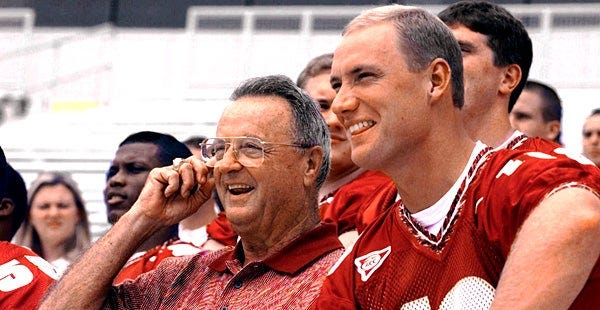
Paul Blake, the team’s quarterback played by Scott Bakula, is 34 years old, but has remaining eligibility because life events got in the way of him playing college ball after a standout Texas high school career (more on that later). The presence of a fully grown man roaming the dorm hallways and sitting in classrooms is a punchline throughout the movie, but just nine years after the film came out, 28-year-old Chris Weinke won the Heisman Trophy at Florida State with a visibly receding hairline. Another 28 year old, Brandon Weeden, had Oklahoma State on the verge of a national championship in 2011 (Weeden and Weinke arrived at college in their mid-20s following professional baseball careers). In 2009, 61-year-old Tom Thompson became the oldest football player in NCAA history when he suited up for Austin College, a Division III school in Texas.

It was presented as inconceivable that the Armadillos turned to Lucy Draper, played by Kathy Ireland, to be the team’s kicker late in the season. While Draper, if she were real, would have made history, it took only six more years after the movie was released for kicker Liz Heaston at NAIA Willamette University to become the first woman to play and score in a college football game. By 2003, Katie Hnida became the first FBS player to do so.

There are many catalysts for progress and innovation in this world. Sometimes, that force is an early 90s sports comedy.

There’s no way this team would have lasted a full season

Due to Elias’ outrageous academic eligibility requirements, Texas State was forced to compete with just 17 players. Rather than having designated offensive and defensive players, the Armadillos have to play what’s known as “Ironman Football,” in which the vast majority of the roster has to play on both sides of the ball.

It adds that much more to Texas State’s underdog bona fides, but there’s a problem with it – there’s no chance they would have been able to make it through the entire season with enough players to field a team.

Playing on offense and defense takes an immense physical and mental toll on anyone who tries it while heightening the risk of injury in an already violent sport. It’s why so few people even try it and why those who do, like Travis Hunter, are so extraordinary. The Aramadillos were…well, not that, as assistant coach Wally “Rig” Riggendorf noted when he referred to them as a “bunch of daisies.” As the team’s quarterback, and being in his mid-30s, Blake didn’t play defense, meaning Texas State had 16 players competing on offense and defense, giving them just five subs at a given moment. When you see the slight build or less-than-stellar conditioning of many of its players, it’s impossible to believe, even in a movie, that they could have walked that delicate tightrope for 11 games.

Schools would have cheated to help out Paul Blake

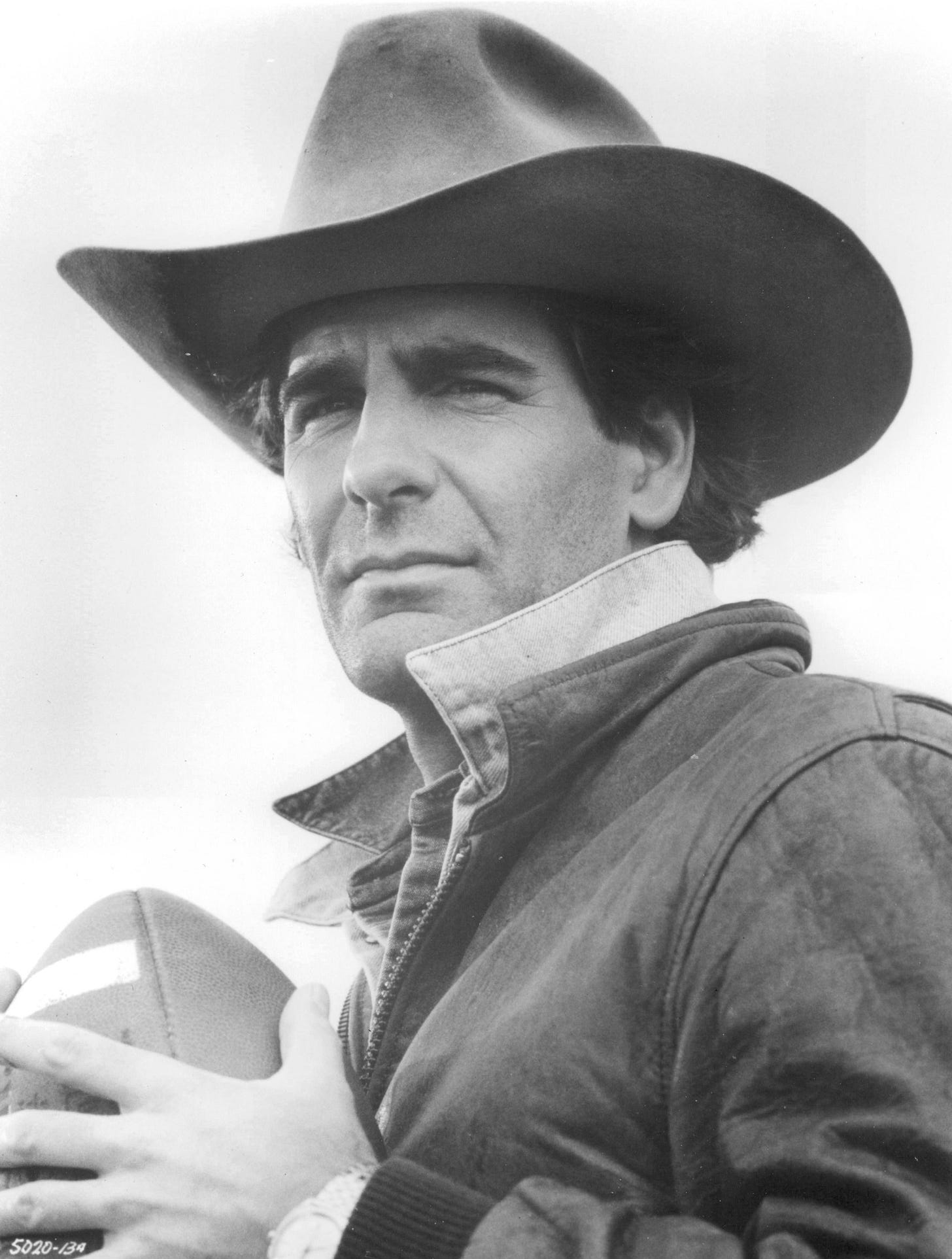
Necessary Roughness (1991) - Scott Bakula as Paul Blake - IMDb

As the movie detailed, Blake was a Texas high-school legend who was committed to play at USC before his father died and Blake, feeling an overbearing sense of responsibility to help out his loved ones, elected not to go to college so that he could take over the family farm. Because of that, he had four years of college eligibility remaining, which made it possible for him to be a 34-year-old freshman.

It’s a touching origin story, but do we really think that in the lawless world of college football recruiting in the mid-1970s that some school out there wouldn’t step in and, for lack of a better term, take care of things for him? Rather than have Blake sacrifice his athletic career, they could hire someone – perhaps a wealthy alum or another high-powered individual connected to the program – to temporarily assume control of the family farm so that for at least the next four years, they could rack up wins with a star quarterback who had the peace of mind knowing that his family back in Texas was being taken care of.

Considering that Marcus Dupree was offered $250,000 a year by one school and an oil well by another during his recruitment in the 1980s, it’s really not that far-fetched.

A national champion would never play in that stadium

As mentioned earlier, the movie was primarily filmed on the campus of the University of North Texas, which meant that Fouts Field, the Mean Green’s now-former home venue, was used as the Armadillos’ stadium. At the time, it had a capacity of just 20,000, had two separate sections of stands rather than being in a bowl or even horseshoe shape, and had a track surrounding the field. I would say it was a glorified high-school stadium, but considering this is Texas we’re talking about, there were almost certainly prep venues in the state that were nicer than it.

Fouts Field - Wikipedia

It’s possible that this was one of the punishments imposed on Texas State after its slew of transgressions, similar to how SMU had to go from playing games at Texas Stadium to tiny Ownby Stadium on campus after the death penalty, but based on highlights shown at the beginning of the movie of the Armadillos’ recent achievements, I don’t think that was the case.

You’re in Texas. There really wasn’t a bigger, nicer stadium nearby to serve as Texas State’s fictional home?

They wouldn’t have tied Kansas

After losing by cartoonishly lopsided scores in their first seven games, the Armadillos get their first taste of success when they tie Kansas, 3-3, in a torrential downpour thanks to a last-second field goal from Draper.

While Kansas is historically a football laughingstock, the real-life Jayhawks were actually decent that year, going 6-5 to earn their first winning season in a decade. Even the wet, slippery conditions likely wouldn’t have negated all their advantages over Texas State. Of Kansas’ 845 offensive plays that season, 614 of them were rushes, meaning an offense that averaged nearly 30 points per game wouldn’t have been severely limited by all the rain.

Of course, the stalemate with the Jayhawks pales in comparison to what the Armadillos did next.

The final game was totally unrealistic

Necessary Roughness' Made Texas Football Into a Joke. But It Also Moved the  Chains. – Texas Monthly

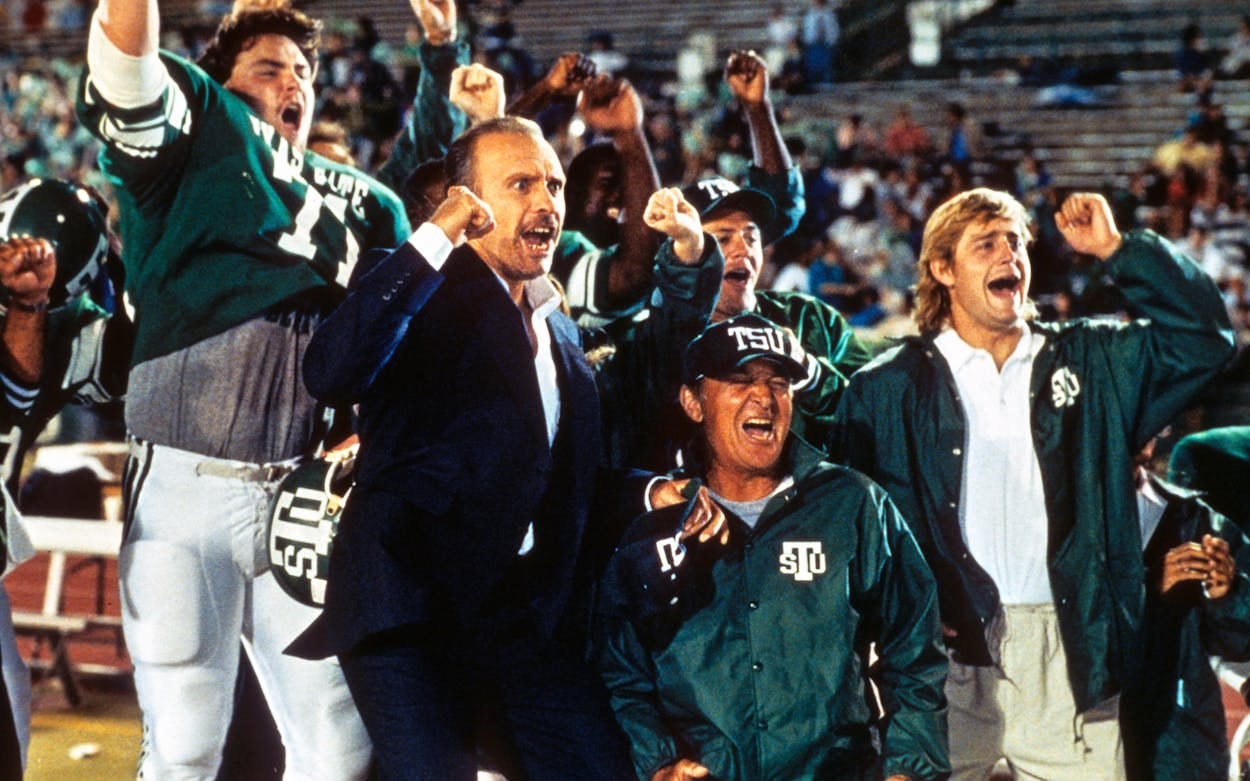
I realize that by saying this, I’m going against a time-honored sports movie trope where the protagonists see all of their struggles and hard work rewarded in a thrilling final game, when they pull off a stunning win over a vastly superior opponent. But a winless team suiting up only 17 non-special teams players wouldn’t have been able to hang with the No. 1 team in the country, much less rally from a 21-point deficit to beat them. There’s absolutely no way.

The 1989 SMU team that serves as their historical (and real) counterpart played the No. 1 team, falling to Notre Dame 59-6 in a game in which the Fighting Irish took delay-of-game penalties and, in one instance, stepped out of bounds instead of continuing to run forward for what would have been a sure touchdown in a rare act of mercy from Lou Holtz.

Even the winning play – in which Texas State, trailing by one with no time remaining, converts a fake extra point to win – would have drawn the suspicion of any semi-aware opponent after Blake gave several one-on-one pep talks with teammates as the Armadillos were lining up. You really think all this chatter’s happening for a routine kick?

Then again, maybe it was only fair that Texas State won after Harlan ‘Flat-top’ Meyers, Texas’ star defensive lineman, got away with being lined up offsides on every one of his seemingly 74 sacks.

It really took them that long to find a kicker?

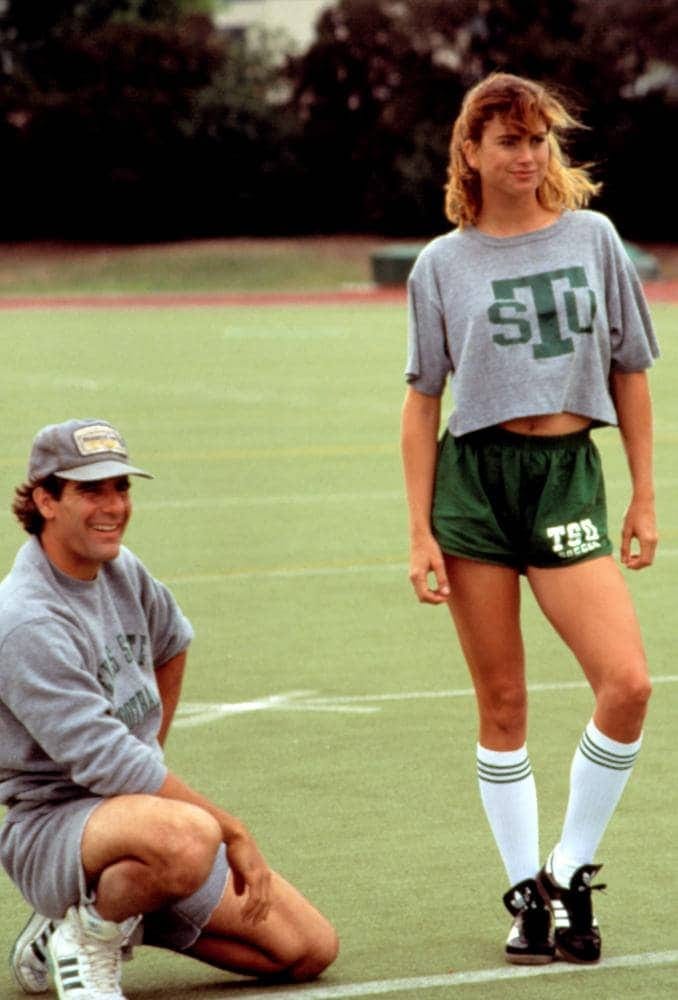
Kathy Ireland Props Necessary Roughness 1990-1991 TSU Soccer Shorts Cast  Movie Texas State University Uniform 90s - Etsy

Perhaps it was just wanting to avoid having the first-ever female college football player on their team, but it took Gennero until the eighth game of the season to add Draper to his roster as the kicker. Given that the Armadillos’ previous kicker couldn’t get the ball more than a couple of inches off the turf, it was a long-overdue move, though given how much they were losing by early on, a successful field goal here and there likely wouldn’t have made much of a difference.

Still, any football team struggling with its kicking game will turn to the school’s soccer program for a potential fix at placekicker or punter. It’s possible that the Armadillos didn’t do so because Texas State and North Texas, their two real-life equivalents, have never fielded a men’s soccer team, so the coaches only had the women’s team to turn to. But considering some of the lengths they were willing to go to when addressing other problem positions, it seems strange they waited until the season was nearly over before addressing a critical special teams role.

Most damningly, it denied us precious screentime with early 90s Kathy Ireland, which is a felony in some states.

02

Inside Commanders DC Daronte Jones' unusual coaching journey

SOURCE https://www.espn.com/nfl/story/_/id/49828234/washington-commanders-daronte-jones-2026-defense

ASHBURN, Va. -- The gale-force Chicago wind shook Daronte Jones' car and rattled his nerves. It did not blow the future Washington Commanders defensive coordinator off his path, but it made him question his life choices.

It was March 2002, nearly three weeks after Jones landed a job at Division III North Park University on the city's northwest side, and he was sleeping in a red 1988 Honda Prelude.

He endured a night that ended up steeling his resolve as winds reached 50 mph. At around 11 p.m., he called his aunt Lisa Simmons in Maryland.

"She picked up thinking it was an emergency, which it really wasn't, but it could have been, mentally," Jones said. "The car was rocking side to side.

"I remember calling home and naturally the family was like, 'Just come home. What are we doing?' That was a moment where you really had to think about how much you're willing to sacrifice, and is it worth it?"

Jones didn't go home.

That was the first decision in a long list of sacrifices the first-time NFL defensive coordinator had to make early in his coaching career. He lived out of his car for two months in Chicago. Then, in 2010, while a grad assistant at UCLA, he slept in the cornerbacks' meeting room for most of his year with the Bruins. Two years after that, as a University of Hawaii assistant, he slept in his office for a year before moving into an alumnus' pool house.

Along his journey -- often with his pet python, Goldie Gambino, living in his book bag -- he also coached high school for two years and nearly left the profession twice -- attending law school at one point, and applying to the U.S. Capitol Police at another in hopes of becoming a Federal Air Marshal. However, like on that frigid night in the Windy City, he always resolved to stick it out.

"It was like, 'Is it ever going to end?'" Jones told ESPN. "I was like, 'Maybe it's not for me.'"

The big breaks finally came, which have led Jones, who is a native of Anne Arundel County in Maryland, to Washington, where he has been entrusted with improving a defense that was arguably the worst in the NFL last season. His background could be a good match for the task ahead.

A turbulent start to his career helped him develop a deep appreciation for future opportunities -- and for finally reaching this point in his career. It taught him patience; it taught him humility.

"It's very easy to see when someone has been through it to get to where they're at," safety Jeremy Reaves said. "He went the route not a lot of people go for. How he is on the field is what you'd expect: the sense of urgency. He understands what an opportunity means. He understands opportunities are few and far between, so when you get one, you have to take advantage."

BEFORE ARRIVING IN Washington, Jones had held 14 different jobs during his coaching career, from Division II to Division I-AA, high school, the Canadian Football League to multiple Division I stops and stints with three NFL teams.

But one of the most formative roles isn't included on his résumé: North Park University.

Jones spent six months at the tiny school in 2002, but left before coaching a game.

When he arrived at North Park as a defensive assistant, Jones, fresh off a graduate assistant role at Lenoir-Rhyne University in Hickory, North Carolina, was told he could sleep on a couch in an apartment with other coaches. Jones didn't trust the couch, which, he said, had looked like it had been pulled off the street -- so he slept in his Prelude.

He spent his first two months at the school sleeping in the car. He kept a suitcase in his locker but other clothes in the Honda -- along with his nearly 3-foot pet Albino Burmese python. Jones said he would park his car near the facility in a different spot each night. On cold nights, he said he'd crack the windows for airflow, turn on the heat and try to stay warm.

Simmons often lent him money when she could. But she said Jones told her, "'I'll just work it out; I'll stay in the car.' He said, 'All I need you to do is call me and wake me up.' So I would get up early and call him, 'Daronte, it's time to get up.' We really wanted things to work out for him, and he was willing to make the sacrifice. We would support him the best we could."

Simmons never wavered. Every morning at 4 a.m., Jones would receive a call from his aunt, then head to the facility to shower before others arrived.

Throughout this time, Jones said he had been telling the other coaches on staff he was living in a hotel. When some found out he wasn't, they offered him the pantry in their apartment, which was on the porch and attached to the kitchen with screens that needed fixing. Jones said the room was full of boxes and was so narrow, his double mattress couldn't lie flat -- it was curled on the outside because it wouldn't fit.

His grandfather told him how to fix and seal the screens, and Jones bought a space heater to keep him and Goldie Gambino comfortable. "I'd sleep in jeans, sweats, a hoodie, leather jacket to stay warm," Jones said. "But it was better than the car."

Four months later, he accepted a restricted earnings job at Nicholls State. Though the opportunity at North Park might have seemed to be a waste, having never coached a game for the Vikings, the sacrifices Jones made in Chicago became a key theme throughout the rest of his journey.

JONES NEARLY DROPPED out of coaching -- twice.

The first time occurred in 2004 when he was 25 and coaching defense at Jeanerette High School in New Iberia, Louisiana. It was his first year at Jeanerette but second year coaching high school in Louisiana. Jones had given himself a deadline: become a college Division 1 position coach by age 26 or quit.

He took the LSAT with plans to attend Southern University's law school with an Omega Psi Phi fraternity brother. Then, Mike Lynn, who was Jones' former position coach at Morgan State, where he played offensive line, became the head coach at Bowie State. Their connection led to a job offer. But Jones said he wasn't sure that he wanted to accept. He could continue teaching in high school, then attend law school classes at night.

Zeb Simon, Jones' boss at Jeanerette, told him it was a no-brainer and issued him an ultimatum.

"I'm going to give you a choice," Simon said. "Either you go or I'm going to fire you.'"

Jones went.

"It took me about a couple weeks to make that decision," he said.

Five seasons into his stint with the Bulldogs as assistant head coach and defensive coordinator -- the last of which saw his defense ranked No. 1 in Division II -- Jones reached another crossroads. The move to Division I wasn't happening. So, after the 2009 season, he applied for a job with the U.S. Capitol Police, hoping to become a Federal Air Marshal. He had received an offer, and they were in the process of doing a background check when UCLA called.

"Maybe it's time for me to look at something else because now I'm in my 30s, and I was like: 'I've got to do something,'" Jones said he was thinking at the time.

The Bruins offered him a graduate assistant's job. It meant going from a salary of $64,000 a year to $1,000 per month while living in the Los Angeles area. He first consulted Damon Wilson, his boss in 2009 at Bowie State, about the UCLA opportunity. But it was longtime advisor Lional Vital, who spent part of four seasons in the NFL and also served as a scout and executive for 30 years, who convinced him.

"You've already been homeless," Vital told him.

Unable to afford the cost of living in Southern California, Jones made his "home" in the UCLA cornerbacks' meeting room, where he spent most of the year sleeping on an air mattress alongside another graduate assistant, Chris Polizzi -- now Iowa's special teams coordinator -- who slept on a futon. The arrangement disappointed Wilson.

"He felt like I shouldn't have to do that," Jones said of his UCLA living conditions. "'You've accomplished some things in your coaching career at Division II level. You shouldn't have to go from there back to [when] you were 20-something years old.' In my mind, it was like I'll take a couple steps back to go a couple steps forward."

Jones spent the next year as the defensive backs coach for the Montreal Alouettes before being hired to coach the secondary at the University of Hawaii, where he slept in his office the first year before moving into an alumnus' pool house for his final two seasons on the islands.

"Hawaii had no money," said Norm Chow, Hawaii's head coach at the time. "I [told him] it doesn't pay well and it's expensive to live there. But he wanted to go. He made it work."

As he had at North Park, Jones never let his living circumstances get in the way of opportunity.

"Perseverance is the best word that describes him," said Morgan State coach Damon Wilson, Jones' boss at Bowie State. "He's had to endure a lot of things to get to where he is."

THE COMMANDERS HAVE felt the results of Jones' experiences. Commanders coach Dan Quinn said he has sat in on meetings run by Jones, listening to him ask questions of his position coaches -- "What could have been done better in this scenario?" -- almost like a teacher.

"When you go through difficult circumstances, there's a resiliency that gets developed," Quinn said. "And one of the other things I love about him, there's not one step that he's missed in the coaching journey. He's got remarkable teaching; he's got perspective."

Jones' players, such as Reaves, see it, too.

All of which is why, at his introductory news conference in February, he took a moment to reflect on his road to D.C. -- not the big-time stops, such as being the defensive coordinator for a season at LSU; nor did he go right to any of his three NFL stints (Dolphins, Bengals and Vikings) before Washington.

"If you think back to sleeping in the car at 23, it's different than sleeping in the car at 33," Jones said, "which I experienced both of those to try to strive to be where I'm today. So, perseverance and then trusting in God."

He ditched the Prelude years ago. He now drives a 2020 Porsche 911 and lives in McLean, Virginia, a wealthy suburb of Washington, D.C. But that's not what motivates him, nor is it how he measures success. He once was a lowly defensive assistant sleeping in his car; now he's here.

His experiences along the way have helped him appreciate any success he has had, while knowing perhaps the reason he's in this job now is because of what the path that brought him there revealed about himself.

"You have to pay your dues, and no one tells you what those dues look like," he said at his news conference, "but when you're out there and you want something that you want to accomplish, what's holding you back? You have to choose your hard.

"So, it's either the hards of failures or the hards of success. I'm sleeping in my car, and it's hard. I can have it the easy way, right? And now I got to face the hard of 'How do I handle success if it comes too early?' You've got to pick your battles."

03

what is going on with ceiling fans

SOURCE https://mcmansionhell.com/post/829127919552151552/what-is-going-on-with-ceiling-fans

what is going on with ceiling fans

Sometimes new design phenomena slip past even those of us who are most in tune with the happenings of the built environment. Such is the case with whatever the hell is going on with commercial ceiling fan design. Being a member of the renting class, a ceiling fan is something that is beyond my scope of purchase. All that aside, when I found myself trying to find inspiration for how to update the one in my apartment (which has very hideous lighting elements) what I saw genuinely shook me to my core.

BEHOLD:

image

“Fandeliers!” “LED Sculptural Lighting Modern Fan!” Big Ass Fans rip-offs prone to decapitating the poor denizens of your living room!“ See them: ceiling mounted light with fan (sure!) Ceiling mounted fan with LED element (sure!). Blades made of plastic, shades made of plastic, bodies made out of metal, wrought iron, and plastic made to look like metal and wrought iron! You name it, it’s there! Chaos, it seems, reigns in fanville.

Of course, like anyone these days, before beginning my analysis of the "fan situation” I had to do my due diligence and ascertain whether these fans are, in fact, AI fans. Confusing and perhaps deceptive depictions of scale tend to point one in that direction. However, while the rooms are certainly AI generated, product reviews (yes, these have been purchased!) tell me that the fans are not! To my astonishment, in the years since the pandemic (who knows how many – as I said, I am late to the phenomenon and most of the products listed are new as of last year) the ceiling fan as a genre of architectural detail has been completely torn asunder and remade.

In some ways, this was inevitable. Even before the widespread development of integrated LED lighting fixtures, the remarkable rise of direct to consumer furniture production a la Wayfair or Amazon that took place more than a decade ago has led to an unfathomable proliferation of products, each of which becomes its own algorithmic nugget against which other products are measured and in whose image they are later modified based on those results. Hence why there are so many fans that appear to be cousins of one another.

While outfits like IKEA revolutionized furniture mass production through creating simple and interchangeable parts thus lowering prices at the production level, Wayfair et al have done the opposite by eliminating the labor of the storefront and instead rely entirely on cheap production overseas and the preexisting logistics networks that effortlessly bring fan atrocities directly to our doors. (One of the middlemen this approach eschews is the marketing guy that tells you, hey, that’s an ugly fan.)

Meanwhile, LED light fixtures – which most of these are – allow for new degrees of design flexibility, much of which are “sculptural” in nature. Without the “problem” of the light bulb to solve, light could be diffused in all matter of tubes, shafts, and curlicues. As with any new development, there are tasteful ways of using it, and there are…not tasteful ways of using it. These fixtures are also revolutionary in that they are extremely cheap in the short run – many of these fans cost under $200 – but expensive in the long rung, as the LEDs usually cannot be replaced, causing the whole apparatus to be thrown away.

These humble materialist paeans however do not explain the sheer insanity (one could say the infanity) of the situation at hand. Hybridizations abound. For example, one can say that there is such thing as a “fandelier” – a chandelier with a fan in it, and its dialectical opponent: a fan with a chandelier attached to it. (Perhaps a chandefan?)

image

Here we see an archetypal fandelier (Rosdorf Park Presnell Dimmable Crystal Ceiling Fan with LED Lights and Remote Control™ - $169 on Wayfair.) In this example, the blades – a cheap plastic – are retractable, and come up above the chandelier. This is not standard, however. Often the opposite is true – they are embedded in the base of the fixture itself. Meanwhile, a chandefan:

image

A cousin of the fandelier – and the most common form of Neo-Fan – is the flush mounted ceiling fan. Imagine if your landlord special circular downlight had a fan in it! Wouldn’t that be so awesome!

image

As you can tell, the fan in this light is pathetically small – basically only about a foot in diameter. However, I suppose a tiny fan fitted 10 feet above the sweltering user is better than nothing? Who doesn’t love an imitation of a stale and inadequate breeze on a day that is desperate for relief from the sun? Maybe your landlord might even let you have one, if he’s nice?

This brings us to another of the “flush fans” – the “border” fan, i.e. a normal fan that for some reason has a border around it. This is pushing the previous categories to their limits. What is fan and what is light become ever less entangled and yet remain inseparable…

image

By the way, there is a subset of this fan that can only be described as:

image

Honestly of all the fans here, this is the one I see getting the most play. I want to make so many jokes about being on the computer here, however I will move on. You can make them yourself.

Alright, now we are getting into Weird territory. First up: Weird Blades. This is self explanatory.

image

Physics limits how weird one can get with the blade thing. A strange unforeseen circumstance of this is that in order to get the big, dramatic, sculptural look of an unorthodox blade, designers have resigned themselves to doing something that is borderline diabolical which is to simply put one of those tiny plastic fans under what looks like a much bigger and more impressive fan that does not move because it is not a fan:

image

As you can see, some of these fans are not fanlike at all. Perhaps soon, the word ‘fan’ will enter a period of semantic shift in which it only begins to mean 'person who is really normal online about Taylor Swift.’ If a gaggle of five circles can be a fan, when does it end?

The liberating (I guess) thing about all this is that the fan itself has become an appendage, an unfinished thought. Because it is transparent, it can be applied wherever and to whatever one wants. It refuses the concept of integration - a key element of design thinking - in lieu of concealment, and even then, it is not very successful. Perhaps juxtaposition is the right word? The fan and the thing-that-becomes-a-fan. Where will it end?

I wound up looking at over one hundred ceiling fans for this small blog post, and I’m sure you’re all wondering which one is my favorite. I have to say it’s the “Hanke 36.22” 6- Speed Dimmable Reversible Ceiling Fan With Led Lights And Remote Control" ($167)

image

At any rate, of these new fans I don’t think I can say I am one!!!

If you like this post and want more like it, support McMansion Hell on Patreon for as little as $1/month for access to great bonus content including a discord server, extra posts, and livestreams. (Don’t worry! This doesn’t adjust for inflation! Now’s the perfect time to join!) By the way: new subscribers can buy a year of McMansion Hell for just $12!

Not into recurring payments? Try the tip jar! (I would seriously appreciate any and all tips because I am in the process of moving house!)

P.S. - I am sorry for the long hiatus! I finally did something about my mental health, and now I am much better!

04

The Extension Era

SOURCE https://forevertheshow.substack.com/p/the-extension-era

Welcome to April. Welcome to extension season.

I do not have a wild theory on the reasoning behind these extensions being signed faster than NBA coaches are getting fired, but I wanted to take a shot at explaining the why in this piece. Let’s get right into it.

Since Opening Day, we've witnessed a flurry of long-term commitments:

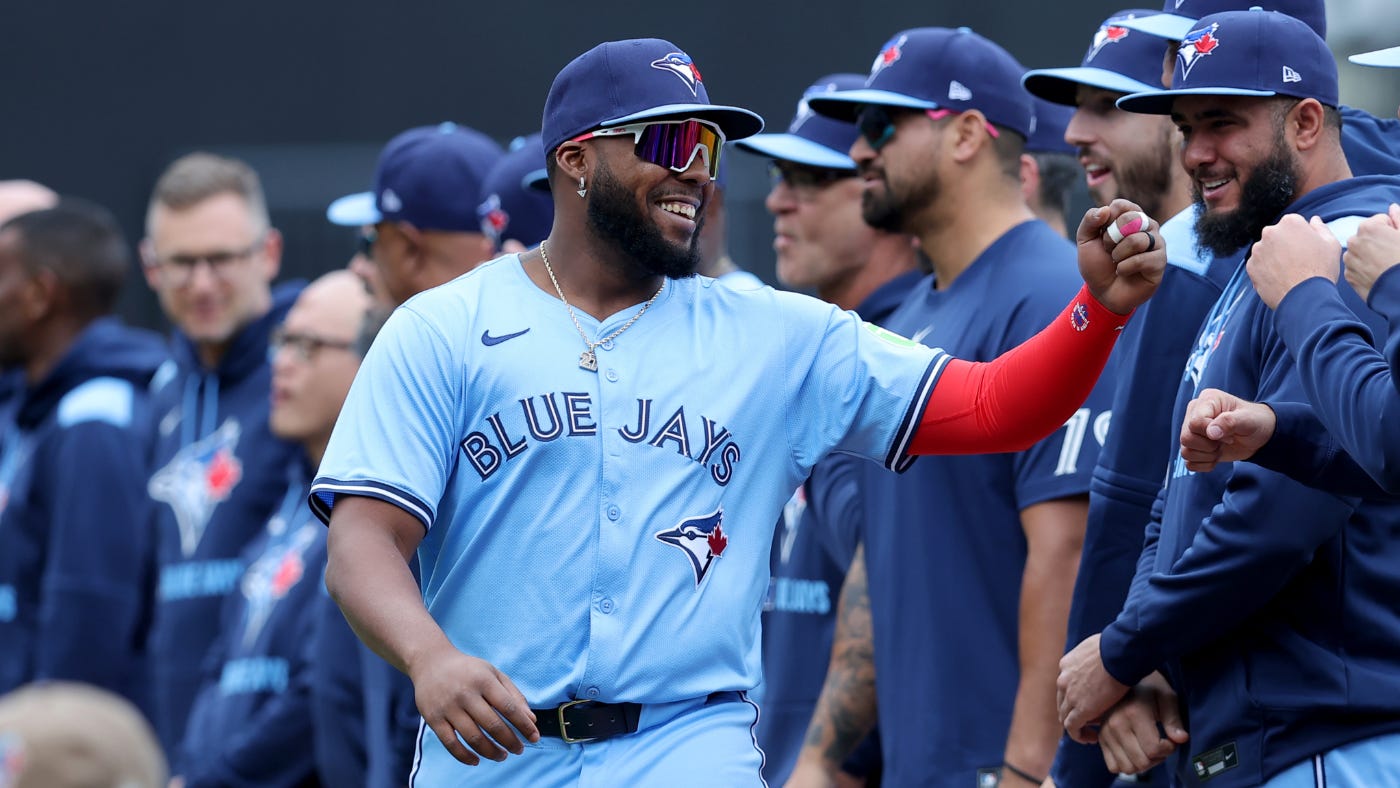
  • Vlad Guerrero Jr., Blue Jays: 14 years, $500 million (2nd largest contract in MLB history behind Soto, with Ohtani's present value under $500M)
  • Garrett Crochet, Red Sox: 6 years, $170 million
  • Jackson Merrill, Padres: 9 years, $135 million with a club option
  • Ketel Marte, Diamondbacks: 6 years, $116.5 million with a player option
  • Kristian Campbell, Red Sox: 8 years, $60 million with two club options
  • Brandon Pfaadt, Diamondbacks: 5 years, $45 million with a club option

This follows deals signed just before the season started:

  • Tanner Bibee, Guardians: 5 years, $48 million
  • Cal Raleigh, Mariners: 6 years, $105 million

What happened to the sacred "no negotiating during the season?" A phrase agents gleefully throw around. As Mark Feinsand reported, one NL executive explained: "I wouldn't view these as 'in-season' deals. Clearly both of them started during Spring Training and they got close enough that both sides decided to give it a small amount of additional time."

But that rationale only partially explains what we're witnessing. Crochet and Vladdy both explicitly set Opening Day deadlines for negotiations before ultimately signing extensions in the young season. Three major factors are driving this trend: the looming CBA expiration, a self-reinforcing cycle affecting free agency, and the strategic positioning for future media rights deals.

1. The CBA Shadow

The current MLB Collective Bargaining Agreement expires in December 2026. MLBPA executive director Tony Clark has already forecasted a lockout. More tellingly, Commissioner Rob Manfred made the bizarre statement that a lockout would be "actually a positive" — a comment that reveals the challenging road ahead.

This looming uncertainty creates powerful incentives for all parties involved.

1A. Player Perspective: Show Me The Money…Now

For players, the prospect of a 2026-27 lockout means potential lost income and an uncertain future. Signing extensions now is essentially grabbing guaranteed money while it's available.

The numbers tell the story:

  • Garrett Crochet: $4 million signing bonus plus $24 million in 2026
  • Jackson Merrill: $10 million signing bonus
  • Brandon Pfaadt: $2 million signing bonus
  • Kristian Campbell: $2 million signing bonus
  • Vlad Guerrero Jr.: $325 million signing bonus (65% of his total contract), paid as a lump sum annually at the beginning of each season

The financial calculations are clear. Crochet, even with a Cy Young-caliber season, was looking at maybe $15 million through arbitration in 2026. His extension instead guarantees $28 million before the potential lockout begins. For Merrill, who would have been earning close to league minimum in 2025 and 2026, his first major arbitration payday wouldn't have arrived until after the lockout. Now he has $10 million guaranteed as a signing bonus.

Vlad Guerrero Jr. contract: Explaining what $325M signing bonus means for  Blue Jays, a possible work stoppage - CBSSports.com

Vladdy's structure is particularly savvy. Signing bonuses are allocated to an athlete's state of residence. Guerrero lives in Florida, which has no state income tax. So he presumably avoids paying state tax on that $325 million bonus — generating millions in savings.

The other benefit? Signing bonuses aren't contingent on playing. Guerrero gets paid even if MLB cancels games due to a work stoppage or for some other reason, like a pandemic.

No one can predict what baseball's economic structure will look like in the next CBA. Will there be a salary cap? Limits on contract length? Changes to service time requirements? These next two years might represent the final opportunity for players to negotiate contracts in baseball's relatively unrestricted market.

Some have suggested players are eager to get extensions done prior to the new CBA to ensure their contracts are "grandfathered in" rather than negotiating during their prime years under new guidelines and restrictions.

1B. Teams Playing the Long Game

From the team perspective, it's straightforward: these extensions represent smart business. The primary advantage is financial — locking up talented young players through their prime years at values below projected market rates.

The Padres' deal with Merrill demonstrates this perfectly. They'll pay him approximately $20 million per year for his age 27-31 seasons. Based on current trends and assuming continued development, Merrill would likely command $30+ million annually on the open market by 2029. In a world where inflation keeps driving up contract values, he might reach $50 million annually. San Diego has essentially secured cost certainty at what projects to be a substantial discount. Here’s Padres GM AJ Preller explaining trying to scout Jackson Merrill while remaining incognito:

Vladdy's extension shows another angle. The Blue Jays have struck out on big-name free agents the past two offseasons (Ohtani, Soto, and Sasaki to name a few), so getting a deal done with their homegrown star was imperative. The price tag towards the end of those 14 years will likely be seen as a bad contract — much like Albert Pujols' or Miguel Cabrera's were — but the Blue Jays know that. They're paying for his prime years to build a contender around him.

The earlier an extension gets done, the more team-friendly it looks if the player meets or exceeds expectations. Jackson Chourio signed his extension before his MLB debut — a deal that can reach $142.5 million over 10 years. Chourio had an incredible rookie season and is off to a hot start in 2025. He's only 21, and the Brewers will reap the benefits through his age-29 season, when he'll re-enter the market for the back half of his prime years. A $14.25 million AAV is an absolute steal for someone of Chourio's talent.

1C. The New Player Development Paradigm

These extensions also reflect evolving approaches to player development and evaluation. Teams are increasingly confident in their ability to identify talent early and project future performance. Advanced analytics, improved physical development, and more sophisticated mental training have all contributed to teams' willingness to make earlier commitments.

Image

The Red Sox extension for Kristian Campbell after just 28 major league at-bats represents perhaps the most extreme example. Campbell was a compensatory fourth-round pick in 2023 they received after Xander Bogaerts departed for the Padres. Campbell wasn't a top-ranked prospect but rose from low-A ball to finish 2024 in AAA before securing an opening day roster spot.

Boston is effectively betting on their evaluation and development system rather than waiting for extended major league performance to confirm Campbell's value. This shift challenges conventional wisdom about player assessment timelines and reflects growing organizational confidence in projecting performance from limited samples. Jeff Passan’s recent article provides great insight on the Red Sox trust and reliance in their player development system.

For players, this new paradigm creates opportunities to secure life-changing money earlier in their careers, even before they've established themselves at the MLB level. For teams, it represents a calculated risk with potentially enormous upside.

2. The Self-Fulfilling Prophecy

What makes this trend particularly fascinating is how it reinforces itself. Every time a young player signs a long-term extension, future free agent classes become incrementally weaker, creating a ripple effect throughout the league.

Teams recognize that if they don't secure their own talent, two problems emerge:

  • When those players eventually reach free agency, competition for their services will be more intense due to fewer alternatives

  • Replacing departed talent becomes more difficult when the free agent pool is thinner.

This has significant implications for players who haven't been extended early. Take Kyle Tucker — the Astros traded him this offseason as he approaches free agency after the 2025 season. One reason they couldn't reach an agreement: Tucker is 28-year old…he’s in his prime now. The front half of a hypothetical extension would cover the back half of his prime years, but if Tucker wants a deal that runs until he's 40 (like Guerrero Jr. just got), the tail end would likely be a sunk cost for the Astros, especially given Tucker's injury history. Instead, he'll hit the open market this winter where the Yankees, Mets, incumbent Cubs, and others will line up with bids potentially reaching Vladdy money in that $500M range.

The Orioles present another case study. Their once-stacked farm system is now an MLB roster filled with former top prospects who will reach free agency around the same time. They chose not to extend Gunnar Henderson and Adley Rutschman early. The opposite approach to the Braves who locked up their young core of Acuña, Albies, Riley, Harris, Olson, and Murphy early in their careers. We'll see how it plays out for Baltimore, but I can make an educated guess: expensive players if they stay, angry fans if they leave.

The Orioles are not alone in their choice to hold off on locking up their young talent. Pirates fans have scrutinized ownership for failing to reach an extension agreement with Paul Skenes. Elly De La Cruz and the Reds are in the same boat. Maybe not having an extension in place explains why this trio of young studs seized the opportunity to be featured as cover athletes on MLB The Show 25 and the $ that come with it.

MLB The Show 25 cover athletes: Paul Skenes, Gunnar Henderson, Elly De La  Cruz

Nonetheless, the Orioles, Pirates, and Reds are all franchises that have historically ranked in the bottom half of the league in payroll. I’m sure these GMs would love to have extensions in place for their young talent, but they are powerless without their ownerships’ blessing.

3. The Media Rights Game Changer

MLB's current media rights deals expire after the 2027 season, with negotiations likely beginning after the 2026 CBA resolution. This timing is significant.

The NBA just secured an enormous 11-year, $76 billion media rights package with Disney (ESPN/ABC), Comcast (NBC/Peacock), and Amazon (Prime Video). MLB will naturally look to leverage similar market dynamics for its next agreements.

One compelling selling point MLB can offer is stability and market consistency. Unlike the NBA, where stars frequently change teams (what I call "star empowerment" because "player empowerment" suggests role players have any power), MLB can point to stars committed to specific markets long-term.

This creates valuable continuity for broadcasters: Ohtani and Betts in LA, Judge with the Yankees, Soto with the Mets, and Crochet, Campbell, and Devers with the Red Sox. Even smaller markets can showcase committed stars: Tatis and Merrill with the Padres, Carroll with the Diamondbacks, Chourio with the Brewers, Butler with the Athletics, and now Vladdy with the Blue Jays.

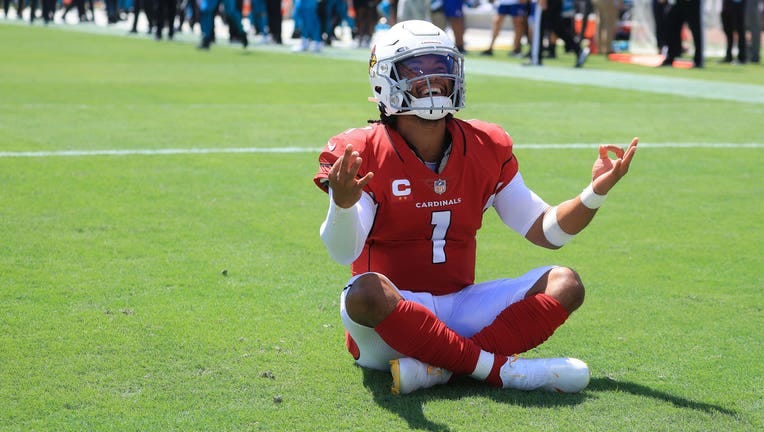
This model resembles the NFL, where franchise quarterbacks are city fixtures. If a team hits on a QB in the draft, he's likely a mainstay for 10-15 years. Patrick Mahomes, Josh Allen, and Lamar Jackson are obvious examples, but even lower-tier QBs like Kyler Murray or Tua Tagovailoa get long leashes as franchise QBs. This stability creates stronger local fan bases and more reliable viewership — factors media companies value when committing billions.

Arizona Cardinals, QB Kyler Murray agree to contract extension | FOX 10  Phoenix

The contrast with the NBA is stark. Would anyone confidently predict Anthony Edwards remaining with Minnesota for the next decade? What about lower tier stars like LaMelo Ball with Charlotte or Trae Young with Atlanta? The volatility of NBA rosters creates marketing challenges that MLB can position itself to avoid.

With the extension trend, MLB can make a compelling case to media partners that investments in specific market broadcasts will maintain long-term value, as star players remain with their teams throughout the duration of these massive media contracts.

What It All Means: Baseball's New Future

This extension trend is reshaping baseball's future in real-time, creating a new paradigm that balances risk, reward, and relationships between players and franchises.

For fans, it means more stability and continuity. The emotional connection between fans and players strengthens when there's an expectation of long-term association with a franchise. This builds deeper community ties and potentially increases engagement.

For the competitive landscape, these extensions might widen the gap between wealthy organizations (ie: good owners) that can afford (ie: want) extension risks and those that cannot (ie: don’t want). While extensions represent cost savings compared to free agent contracts, they still require substantial financial commitments owners have to sign off on.

For players collectively, the trend raises important questions about revenue distribution. If more prime years are captured in pre-free agency extensions (even at higher rates than traditional arbitration), does this reduce the overall percentage of revenue going to players? The MLBPA will watch closely.

For baseball as a business, the extension era signals a move toward greater predictability — a quality that helps the sport navigate an increasingly competitive entertainment landscape. The ability to market stars in consistent team contexts provides valuable continuity for building and maintaining audience engagement.

These three factors — CBA uncertainty, the self-reinforcing extension cycle, and media rights positioning — are collectively driving baseball toward a future that looks more like the NFL's model of team-player relationships than the NBA's free-flowing talent movement.

Baseball will continue after the 2026-27 CBA negotiations, regardless of how contentious they become. What remains uncertain is the economic framework that will govern the sport. These extensions represent calculated responses to that uncertainty by both players and teams.

In a sport often criticized for being too wedded to tradition, this evolution represents positive innovation in how baseball approaches its most important asset — the players who make the game special. As we watch the 2025 season unfold, these extensions will serve as markers of a significant shift in baseball's business model — one that will define the sport for the next decade and beyond.

05

Birth of Unix

SOURCE https://itsfoss.com/birth-of-unix/

Warp Terminal

Sometimes it feels like Unix has been around forever, at least to users who have used Linux, or BSD in any form for a decade or more now.

Its ideals laid the groundwork for Linux, and it underpins macOS. A modern version (FreeBSD) is used on thousands of servers while Linux rules the server space along with the super computer industry.

Even though the original form of it is a history, it remains a significant development to help start Linux and more.

But initially, it had a rocky start and had to be developed in secret.

Punch Cards and Multics

Back in the days when computers took up whole rooms, the main method of using computers was the punch card interface. Computers didn't come with an operating system, they had a programming language built into them. If you wanted to run a program, you had to use a device to enter your program and the data on a series of punch cards.

According to an interview with Brian Kernighan, one of the Unix creators, "So if you had a 1,000-line program, you would have 1,000 cards. There were no screens, no interactive output. You gave your cards to the computer operator and waited for your printout that was the result of your program."

At the time, all text output from these computers was capitalized. Kernighan wrote an application to handle the formatting of his thesis. "And so thesis was basically three boxes of cards, 6,000 cards in each box, probably weighed 10, 12 pounds, five kilograms. And so you’d take these three boxes, 1,000 cards of which the first half of the first box was the program and then the remaining 5,000 cards was the thesis. And you would take those three boxes and you’d hand them to the operator. And an hour or two or three later back would come a printed version of thesis again."
Needless to say, this makes modern thesis writing seem effortless, right?

In the late 1950s, AT&T, Massachusetts Institute of Technology, and General Electric created a project to revolutionize computing and push it beyond the punch card.

The project was named Multics or “Multiplexed Information and Computing Service”. According to the paper that laid out the plans for the project, there were nine major goals:

  • Convenient remote terminal use.
  • Continuous operation analogous to power & telephone services.
  • A wide range of system configurations, changeable without system or user program reorganization.
  • A high reliability internal file system.
  • Support for selective information sharing.
  • Hierarchical structures of information for system administration and decentralization of user activities.
  • Support for a wide range of applications.
  • Support for multiple programming environments & human interfaces.
  • The ability to evolve the system with changes in technology and in user aspirations.

Multics would be a time-sharing computer, instead of relying on punch cards. This means that users could log into the system via a terminal and use it for an allotted period of time. This would turn the computer from a system administered by a high priest class (Steven Levy mentioned this concept in his book Hackers.) to something that could be accessed by anyone with the necessary knowledge.

The project was very ambitious. Unfortunately, turning ideas into reality takes time. Bell Labs withdrew from the project in 1969. They had joined the project to get a time-sharing operating system for their employees, but there had been little progress.

The lessons learned from Multics eventually helped in the creation of Unix, more on that below.

To Space Beyond

Multicians/ A team installing GE 645 mainframe in Paris

The Bell engineers who had worked on Multics (including Ken Thompson and Dennis Ritchie) were left without an operating system, but tons of ideas. In the last days of their involvement in the Multics, they had started writing an operating system on a GE-645 mainframe. But then the project ended, and they no longer needed the mainframe.

They lobbied their bosses to buy a mini-computer to start their own operating system project but were denied. They continued to work on the project in secret. Often they would get together and discuss what they would want in an operating system and sketch out ideas for the architecture.

During this time, Thompson started working on a little side project. He wrote a game for the GE-645 named Space Travel. The game "simulated all the major bodies in the solar system along with a spaceship that could fly around them".
Unfortunately, it was expensive to run on the mainframe. Each game cost $75 to play. So, Thompson went looking for a different, cheaper computer to use. He discovered a PDP-7 mini-computer left over from a previous project. He rewrote the game to run on the PDP-7.

Wikipedia

In the summer of 1969, Thompson's wife took their newborn son to visit her parents. Thompson took advantage of this time and newly learned programming skills to start writing an operating system for the PDP-7. Since he saw this new project as a cut-down version of Multics, he named it “Un-multiplexed Information and Computing Service," or Unics. It was eventually changed to Unix.

Other Bell Labs employees joined the project. The team quickly ran into limitations with the hardware itself. The PDP-7 was in its early stages, so they had to figure out how to get their hands on a newer computer. They knew that their bosses would never buy a new system because "lab's management wasn't about to allow any more research on operating systems."

At the time, Bell Labs produced lots of patents. According to Kernighan, "typically one or two a day at that point." It was time-consuming to create applications for those patents because the formatting required by the government was very specific.
At the time, there were no commercial word processing programs capable of handling the formatting. The Unix group offered to write a program for the patent department that would run on a shiny new PDP-11. They also promised to have it done before any commercial software would be available to do the same. Of course, they failed to mention that they would need to write an operating system for the software to run on.

Their bosses agreed to the proposal and placed an order for a PDP-11 in May 1970. The computer arrived quickly, but it took six months for the drives to arrive.

Wikipedia

In the meantime, the team continued to write Unix on the PDP-7, making it the first platform where the first version of Unix developed. Once the PDP-11 was up and running, the team ported what they had to the new system. In short order, the new patent application software was unveiled to the patent department. It was a hit. The management was so pleased with the results, they bought the Unix team their own PDP-11.

Growing and Legal Problems

Amazon

With a more powerful computer at their command, work on Unix continued. In 1971, the team released its first official manual: The UNIX Programmer's Manual. The operating system was officially debuted to the world via a paper presented at the 1973 symposium of the Association for Computing Machinery. This was followed by a flood of requests for copies.

This brought up new issues. AT&T, the company that financed Bell Labs, couldn't sell an operating system. In 1956, AT&T was forced by the US government to agree to a consent decree.
This consent decree prohibited AT&T from "selling products not directly related to telephones and telecommunications, in return for its legal monopoly status in running the country's long-distance phone service." The solution was to release "the Unix source code under license to anyone who asked, charging only a nominal fee".

The consent decree also prohibited AT&T from providing tech support. So, the code was essentially available as-is. This led to the creation of the first user groups as Unix adopters banded together to provide mutual assistance.

C Programming, The Necessary Catalyst

The creation of the C programming language by Dennis Ritchie at Bell Labs helped Unix make progress with its future versions, and indirectly influenced the ability to create BSD and Linux.

And, now, we have many programming languages, operating systems, including several variants of Linux, BSD, and Unix-like operating systems as well.

If this helped you, consider supporting It's FOSS

It's FOSS has been helping people use Linux for the past 14 years. Help us stay independent from big tech. Become a Plus member, enjoy ad-free reading and get 5 eBooks.

06

The Age of the Hyperpundit

SOURCE https://www.peoplevsalgorithms.com/p/the-age-of-the-hyperpundit

POD 130: Hyperpunditry

This week we dig into the spread of hyperpunditry and why the Information Space rewards those who confidently switch lanes with abandon. Plus: AI’s bottoms-up adoption curve, Anonymous Banker on golf media’s strength and the crazy life of sea turtles. Out Friday AM. Listen. Watch

PVA CONVERSATION

Ezra Klein walks into the lion’s den…

He is outnumbered, but leans on his book-smart confidence and podcast cool. Facing down the All-In squad — Sacks is debate-club pugnacious, Chamath always well briefed, Jason scrambling to maintain control and credibility — and flanked by Larry Summers as his lone ideological wingman. Ezra, ever self-aware, carefully positions himself: "I defer to Larry on the markets. I'm more of a connoisseur of arguments."

It’s a clever line. Self effacing, a bit smug. But it also raises the question: why was he there at all?

An important social obligation to balance debate? The last stop on a long podcast-heavy Abundance book tour? Or just to show up — to play the game?

The game, increasingly, is performance.

Experts used to pick a lane. Walt Mossberg covered tech. He built authority through focus — you trusted his take because he mastered the domain. That model is lost in the Information Space.

In its place: the hyperpundit — platform-native polymaths with hot takes on everything from Gaza to AI to trade to TikTok. Their authority doesn’t come from specialization. It comes from presence. From volume, charisma, and the ability to synthesize just enough to sound smart — on podcasts, on panels, in a thread.

Kara Swisher was a tenacious tech beat reporter, she now operates more like a high-output public intellectual. She debates billionaires, spars with senators, and toggles between insider and antagonist depending on the day. Her marketing professor co-host Scott Galloway, also a leading hyperpundit, just interviewed the Canadian Prime Minister on the Prof G pod. It is not uncommon for hyperpundits to hold court with world leaders. Fragmentation away from legacy media sources accelerates.

RODE Ultimate Podcast Kit - Black

Ultimate Podcast Kitfrom Rode, $2347

Debates, as an age old format twist, are also in vogue, not to resolve, but to reverberate.

The Joe Rogan Experience episode with Dave Smith and Douglas Murray wasn’t really a debate about trusting experts. It was a performance of ideological posture. Smith played the insurgent comic, challenging institutional failure with sharp skepticism: “Let everyone talk,” he insisted, casting open discourse as a democratic necessity. Murray pushed back as the articulate institutionalist dissenter, warning that “not everyone deserves the mic” — a call to preserve standards and resist the casual platforming of dangerous or unserious ideas.

And Rogan? He floated between them — not judging, just hosting — a vibe curator more than a moderator. No winner. No verdict. Just a rolling clash of sensibilities, content with just enough friction to travel.

That’s the thing: debates today are structured to circulate. They produce shareable moments, prompt downstream discourse, and give everyone involved a reason to repost the clip. They work because they generate engagement, not clarity.

The latest genre entry? Fox Nation’s What Did I Miss?, where four contestants return from three months in isolation to guess which news stories are real for a $50,000 prize. It’s The Truman Show meets The New York Post meets Jeopardy! Infotainment engineered for engagement.

But the structure is familiar. Like podcasts, panels, and pseudo-debates, the content is just a prompt — a way to get the audience to react, share, take sides. Participation is the point.

Even appearing together is a strategic choice. Taylor Lorenz questioned why Gavin Newsom would have Steve Bannon on his podcast.

What’s the upside? Friction is the play. Inflating your brand value is the prize. Debate becomes distribution.

So why did Ezra show up?

Klein’s cameo isn’t a stunt; it’s a blueprint. Every serious podcaster now must do ‘mic‑share diplomacy’ or risk being siloed in their own echo chamber. In 2025, the premium lies in cross-pollination, not one‑way preaching. And democrats have taken note of how an interlinked right wing media network anchored in podcasts has slowly eaten away at mainstream media influence. If you can't beat em…

Maybe there’s even something hopeful here. Maybe the podcast era’s unexpected virtue is a renewal of bipartisan dialogue. Or at least the performative ritual of it.

After all, in the hyperpundit age. You don’t need to win the argument. You just need to exist inside it.

Brian… You’ve become hyperpundits in your own right. How does it feel?

BRIAN: We live in a golden age for Statler and Waldorf. I don’t bemoan this. At the end of a podcast discussion I did with Janice Min today, she mentioned how media is built on nostalgia. We pine for simpler times when we should be moving forward

Statler and Waldorf earrings Earrings made with LEGO Minifigures, $44 Etsy

The marketplace of ideas and information has been ruthlessly deregulated. And like any deregulation, it has led to greater supply (choice), more diversity and more uneven experiences. My view from The Rebooting:

“The expert class can either complain or compete. The marketplace of ideas doesn’t reward credentials. It rewards perceived authenticity, preternatural confidence, and the ability to perform.”

Algorithmic feeds and the chaos of the Information Space create the necessary conditions for hyperpunditry to be a sensible choice. It’s like running for president: There’s no downside. So why not have Stephen A as our first hyperpundit president?

ANONYMOUS BANKER

AI’s unintentional expansion

News surfaced this week that OpenAI is in talks to acquire Windsurf, a coding-focused app, reportedly for as much as $3 billion. While that price tag might raise eyebrows, the transaction rationale likely goes beyond the current product; it’s about the team, the tech, and the acceleration of OpenAI’s broader ambitions.

In AI, speed to market can translate to billions in value creation. Every month of lead time compounds into a defensible advantage. Windsurf may give OpenAI both a product wedge and a team that is aligned with deploying sophisticated code-generation agents faster and more effectively.

But the larger trend may be more significant: We’re entering a phase where the foundational models are becoming powerful enough to subsume the “wrappers” (the verticalized apps and tools built on top of LLM APIs). Users may soon find that core models, optimally tuned based on historical interactions and frictionless access to company data via Google Drive and Microsoft 365, outperform purpose-built solutions in valuable domains like investment banking, law, medicine, and more.

That raises a deeper question: What will create sustainable value in vertical AI? It likely won’t be thin wrappers or short-term arbitrage plays. Instead, defensibility may come from access to proprietary data, distribution within hard-to-reach professional networks, domain-specific relationships that can’t be commoditized (like monetization partnerships), or integrations into legacy systems. Or maybe it’s something we haven’t seen yet, a new form of institutional trust (given a green light by regulators) or a model fine-tuned on real-world decision outcomes. Either way, it’s early innings.

Etc…

Good Podcast of the week: Palmer Lucky on Tetragrammaton with Rick Rubin
Palmer has a lot to say. Rick doesn’t get in the way. He asks good questions without judgement.

Good long tweet of the week: Andrej Karpathy on AI as democratizing technology. (X). An excerpt:

But at least at this moment in time, we find ourselves in a unique and unprecedented situation in the history of technology. If you go back through various sci-fi you'll see that very few would have predicted that the AI revolution would feature this progression. It was supposed to be a top secret government megabrain project wielded by the generals, not ChatGPT appearing basically overnight and for free on a device already in everyone's pocket. Remember that William Gibson quote "The future is already here, it's just not evenly distributed"? Surprise - the future is already here, and it is shockingly distributed. Power to the people. Personally, I love it.

Good Product: The caruncle.

9 incredible facts about green sea turtles | WWF Australia

The sea turtles are laying eggs in Miami. Early each summer, females haul ashore to lay dozens of eggs on sandy beaches. A few months later, tiny hatchlings use a temporary egg‑tooth, called a caruncle, to cut through their shells and scramble to the sea. They then spend years drifting on ocean currents—often circumnavigating entire basins—before returning as large adults. Remarkably, these turtles imprint on the Earth’s magnetic field signature of their natal beach, and decades later they navigate back within yards of the very spot where they were born.

07

The End of Sierra as We Knew It, Part 2: The Scandal

SOURCE https://www.filfre.net/2025/04/the-end-of-sierra-as-we-knew-it-part-2-the-scandal/

That’s the challenge: giving the public a formula they know and feel comfortable with, but making it different from anything they’ve seen or experienced before.

— Roberta Williams

This article tells part of the story of

Sierra On-Line.

Although Ken Williams left his office at Sierra On-Line for the last time on November 1, 1997, his wife Roberta Williams stayed on for another year, working on the eighth entry in her iconic King’s Quest series. King’s Quest: Mask of Eternity turned into the most protracted and tortured project of her long career.

Roberta had long since fallen into a pattern of alternating new King’s Quest games with other, original creations. Thus after Phantasmagoria shipped in the summer of 1995, it was time for her to begin to sculpt a King’s Quest VIII. Yet she was unusually slow to get going in earnest this time around; perhaps she was feeling some of the same sense of exhaustion that her husband was struggling with in a very different professional context. She tinkered with ideas for the better part of a year, during which the fateful acquisition of Sierra by CUC came to pass. By the time a team was finally assembled around her to make King’s Quest: Mask of Eternity in mid-1996, Sierra’s day-to-day operations were teetering on the cusp of enormous changes, not the least of which would be Ken Williams’s dramatically circumscribed authority. To further punctuate the sense of a new era in the offing, Mask of Eternity was to be the first King’s Quest game ever not to be made in Oakhurst, California; this one would come out of the new offices in Bellevue, Washington. Most members of the team assigned to it were new as well, with the most prominent exception being producer Mark Seibert, who had filled the same role on the hugely successful King’s Quest VII: The Princeless Bride and Phantasmagoria.

By this point, the lack of any subsequent point-and-click adventure games that had sold in similar numbers to Phantasmagoria, from Sierra or anyone else, was sufficient to raise concerns about the genre’s health in any thoughtful observer of the state of the industry. Roberta Williams apparently was such an observer, for it was she herself who decided to make Mask of Eternity different from all of the King’s Quest games that had come before, in order to better meet the desires of contemporary gamers as she understood them. Using Mark Seibert, who had played a lot more of the recent popular non-adventure games than she had, as something of a spirit guide to the new normal, she conceived a King’s Quest that would run in a real-time 3D engine, combining her usual focus on storytelling and puzzle-solving with some action elements. The broader goal would be to create a dynamic living world full of emergent potential, rather than another collection of set-piece puzzles linked together by semi-interactive conversations and non-interactive cutscenes. “We didn’t want to make it so you go here and solve a puzzle, then go there to solve a puzzle, then go to a puzzle somewhere else,” she told an early journalist on the scene. “What we really wanted to bring was that sense of going on an adventure, of going on a quest. It’s not just a word in the title. We want you to feel like you’re really doing it.”

Taken in the abstract, her understanding of what she needed to do in order to keep King’s Quest relevant wasn’t by any means completely misguided. Yet circumstances almost immediately began to militate against it cohering into a solid, playable game. SCI, the venerable adventure engine that had powered the last four King’s Quest games and Phantasmagoria, along with dozens of other products from Sierra, was totally unsuited for this one. To replace it, the team wound up borrowing a 3D engine that had been developed by Sierra’s subsidiary Dynamix with flight simulators in mind. They never were able to fully wrestle it into a form suitable for this application; the finished game remains a festival of jank, sporting walls that you can literally walk right through if you hit them just right.

Roberta Williams felt her own authority being gradually undermined as the new order at Sierra, now merely one part of the software arm of CUC, became a fact of life. In the past, she had enjoyed privileges that were granted to none of Sierra’s other designers — such were the benefits of sleeping with the boss, as she herself sometimes joked. She had worked from home most days, emailing her design documents to the people entrusted with implementing them and then supervising their labor only loosely from afar. But she now found that her ability to set her own working hours and location and even to make fundamental decisions about her own game was waning in tandem with her husband’s fading star. “Suddenly finding that she was expected to build another bestselling King’s Quest game, but that the developers didn’t really have to do what she said, was something Roberta had never had to face,” writes Ken in his memoir. “There were days when she would come home crying.”

In the last week of 1996, Blizzard Entertainment, that rising star of the CUC software arm, shipped Diablo to instant, smashing success. A decree came down from above to make Mask of Eternity more like Diablo, by adding extensive monster-killing and other CRPG-like elements to the design. Roberta Williams was utterly out of her depth. Increasingly, she felt like a third wheel on her own bicycle. And yet there was no other confident and empowered voice and vision to replace hers, just a babble of opinions — hers among them, of course — trying to arrive at some sort of consensus on every new question that came up. Whatever his other faults as an administrator and organizer, Ken Williams had never allowed this to happen. His rule had always been that there was one lead designer on each project, and that person called the shots. If the lead designer “wanted something done, whether the team agreed or not, it didn’t matter. It’s her game and her career on the line.” Now, though, this philosophy no longer held sway at Sierra, even as there was no coherent alternative one to take its place.

So, the Mask of Eternity team bumbled along with no clear ship date in sight, more a mob of wayward peasants than a well-honed army. In the meantime, there were more big changes at the corporate level: as we learned in the last article, the merger of CUC with HFS was announced in May of 1997. It was to be consummated that December, with the conjoined corporation taking the name of “Cendant,” from the Latin root that has given us the verb “to ascend” in English. The name was chosen by Walter Forbes, reflecting the conceit of a culture-vulture sophisticate in which he so loved to cloak himself. For his part, Henry Silverman of HFS, who was all about facts and figures and bottom lines, thought one name was as good as another, as long as his marketing people told him it would pass muster on Wall Street.

Well before the merger was completed, there were signs that this shotgun marriage of opposites was going to be a more challenging relationship than either had anticipated. Silverman ran a tight, focused ship, while Forbes’s board of directors and senior managers were, as Ken Williams had experienced firsthand, more inclined to discuss their golf handicaps than matters of vital interest to the company. “They were like children playing at business,” says one of Silverman’s top lieutenants of his counterparts from CUC. Growing concerned about the overall competence level and work ethic of Forbes himself, Silverman suggested to him in November of 1997, before the merger was even completed, that it might be best if he, Silverman, stayed on a little longer as CEO instead of turning over that position on January 1, 2000, as stipulated in the merger contract.

This was not music to Forbes’s ears. He had already been complaining for a while about Silverman’s high-handed style — about the way he was treating CUC as if it was being bought rather than being an equal partner in a merger — and he didn’t even deign to reply to this latest proof of his allegations. The relationship between the two executives grew so poisonous that Silverman hired a private detective to investigate rumors of womanizing and sexual harassment on Forbes’s part, hoping to find some leverage to use against him. Much to his disappointment, the detective failed to dig up enough actionable dirt.

Again, it should be remembered that all of this jockeying was taking place before the merger had even come off. Given the warning signs that were blinking red everywhere by November, one does wonder why Henry Silverman went through with the deal. The best answer anyone has come up with is that he was a creature of the stock market right down to his bones, and both companies’ stock prices had been sent soaring by the news of the merger. To call it off now would cause the stock to crater just as quickly.

So, the marriage was consummated on schedule, with Henry Silverman as the first CEO of the new Cendant Corporation. By virtue of his job title, he ought to have had access to every aspect of the former CUC’s operations and finances. Yet he ran into a baffling resistance from Forbes’s middle managers whenever he tried to dig beneath the surface. When he called on Forbes directly to intercede and get him the numbers he wanted, Forbes said blithely that he would prefer to preserve the “financial-reporting autonomy” of his half of the company. Silverman, whose temper could be volcanic, had to expend great effort to keep it under control now. He explained to his new chairman of the board, as clearly and calmly as he could, that that wasn’t how a merger worked. Forbes seemed to accept this. And yet at the end of February, more than two months after the merger had ostensibly been effected, Silverman still had no clear figures on his desk. His accountants were now telling him that, if these didn’t surface soon, they would be unable to make a legally mandated filing with the Securities and Exchange Commission. Silverman would have to be a far less perceptive businessman than he was not to smell a rat of considerable proportions.

On March 6, 1998, he dispatched his chief accounting officer Scott Forbes — no relation to Walter — from Cendant’s new headquarters in Manhattan to CUC’s old ones in Stamford, Connecticut. The accountant’s orders were to get the numbers he needed by any means necessary, even if it required getting Silverman himself to come onto the speakerphone and threaten somebody’s job. He met with E. Kirk Shelton, Walter Forbes’s right-hand man. Caving at last, Shelton sheepishly explained that there was a little problem — only a little one, mind you — with the former CUC’s books. Its actual revenues during its last year had come in about $165 million under the figures it had reported. While Scott Forbes was still shaking his head at this piece of news, wondering if he had heard correctly, Shelton rushed to add that the problem was easily fixable, by reporting equity from the merger as operating revenue. “We want you to help us figure out how to creatively do this,” said Shelton, as if committing accounting fraud was just another day at the office — which to him it was, as would soon become all too clear.

Henry Silverman was predictably livid when Scott Forbes told him what had just transpired in Connecticut. He tried to contact Walter Forbes, but learned that that gentleman of leisure was on vacation in Hawaii and wasn’t receiving calls. Walter did eventually deign to send an email in response to the CEO’s increasingly furious queries, saying that they would get together and sort everything out when he came home in a few weeks. Like Shelton, he seemed to believe that the discovery of a $165 million shortfall was no big deal — or else he had made a strategic decision to act as if it was.

Not realizing that he would soon be wishing that $165 million was the full extent of the discrepancy in CUC’s books, Silverman said nothing publicly, hoping this could all still be swept under the rug as the mere teething problems that always accompany big mergers, even as he privately vowed to be rid of Walter Forbes by hook or by crook. “I can’t have people working with me that lie to me!” he raged.

Rather belying his own attempt to treat CUC’s accounting irregularities as No Big Deal, Walter Forbes, upon his return from Hawaii, refused to meet with Silverman at the headquarters of the company that they supposedly ran together. Instead he insisted that Silverman and his closest lieutenants talk with him and his on neutral ground, in a Manhattan hotel suite. This meeting took place on April 1, which must have struck Silverman as an appropriate date, seeing how Forbes had fooled him into merging their companies. Brushing off all of Forbes’s efforts at preliminary light conversation, Silverman got straight to the point — or rather to the ultimatum. He was prepared, he said, to look for a way to keep CUC’s shortfall from becoming public and placing Forbes in serious legal jeopardy. He would do this not for Forbes’s sake — for Forbes, he made it clear, he had nothing but contempt — but for that of Cendant’s employees and shareholders. As a condition, though, Forbes, Skelton, and the rest of the old CUC inner circle would have to open their books to him at long last — full transparency across the board. Then they would need to leave the company, just as soon as the necessary severance contracts and press releases could be crafted. According to most reports of the meeting, Forbes and his people agreed to this.

Having vented his rage on these eminently deserving targets, Silverman left the hotel suite feeling cautiously optimistic. The shortfall was ugly, but it shouldn’t be enough to sink the business as a whole. And the upshot of the whole affair was that he would get Walter Forbes and rest of the CUC amateurs out of his hair once and for all. Silverman ordered his accountants to conduct a thorough audit of CUC’s books, to provide him at last with that which he had been seeking for so long, the same thing that Ken Williams had sought much more lackadaisically before him: a proper picture of what exactly CUC did, how it did it, and where its money was coming from and going to. He gave them two weeks.

The day of reckoning was April 15, 1998. Silverman might have suspected the worst when he saw that his own people had brought two mid-level CUC accountants with them, and insisted that they give the presentation, as if afraid of becoming collateral damage of the CEO’s temper. Their fear was thoroughly understandable. For what was revealed on that day was a tale of fraud on a scale literally unprecedented in the history of American business. Over the past three years alone, CUC had conjured out of thin air more than half a billion dollars in revenue that had never actually existed in the real world. To Walter Forbes, business had been a shell game. Now you see it, now you don’t.

CUC’s long tradition of financial malfeasance had apparently begun, as these things so often do, with dubious short-term measures that were intended merely to grease the wheels of the company’s legitimate operations as they passed from a slow-moving present to a doubtless supersonic future. Already before the end of the 1980s, CUC had taken to booking pledged membership fees — fees that would be realized only if the members in question didn’t cancel, which they frequently did — as guaranteed revenues at the start of each fiscal year. More and more such schemes came into play as Walter Forbes and his cronies fell further and further down the slippery slope of fraud. When a new fiscal year began, they would figure out how much money they needed to have made during the last one to slightly outperform Wall Street’s expectations, then fiddle with the books appropriately. Jerry Bowerman of Sierra, in other words, had been onto something when he pointed out to Ken Williams how weirdly consistent CUC’s revenue growth had been for years and years. “That’s categorically impossible,” he had said. “Does not happen.”

Except, that is, in the case of fraud. The scope of the malfeasance was breathtaking, permeating every layer of the company, as later described by the forensic accountant Ron Rimkus.

According to later testimony by the company and the SEC, CUC managers would analyze the difference between actual financial results and the estimates put out by Wall Street analysts at the end of each quarter. They would then target specific aspects of the business to adjust in order to inflate earnings. After determining the best areas to change, the managers would then instruct others in the company hierarchy to adjust the various accounts — thus creating a false income statement and balance sheet. Their methods included under-funding reserves, accelerating recognition of revenues, deferring expenses, and drawing money from a merger account to boost income. After lower-level managers made the accounting changes to the financials, the cycle would be completed by adjusting the top line of quarterly changes and, subsequently, making back-dated journal entries at the division level to get the general ledger to balance. CUC’s leadership was able to hide the irregularities through misrepresented accounting entries, often moving certain transactions off the books. For a company of this size to maintain two sets of books requires a widespread internal effort to produce the second set of books so the company can present a blend of truth and fiction to the auditor without getting caught.

Eventually, CUC started to run out of internal revenue streams to which it could apply its portfolio of tricks. It was at this point that Walter Forbes began aggressively buying up other companies, among them Sierra On-Line and Davidson and Associates. These transactions were always conducted in stocks, never cash. The fraud that followed depended on the concept of the “merger reserve,” meaning the cash profits and assets that the acquired company brought with it into the new relationship. CUC reported this reserve as operating income for the parent company. In order to keep the hamster wheel spinning, of course, CUC had to keep buying more companies with the funny money it had “earned” from its last round of acquisitions. Underneath his unruffled exterior, Walter Forbes had been paddling as furiously as a duck on a placid pond.

But there had to come an end point, when neither the internal shenanigans nor the acquisitions could continue to paper over the discrepancy between the money CUC said it was making and the money it was really making. This limit point was looming by 1997. And this was what had set Walter Forbes down at a table with Henry Silverman, to negotiate a merger on a whole different scale from the acquisitions he had carried out to date. That said, it’s hard to identify what his real endgame in all of this actually was. He had to know that the fraud would come to light soon after the merger was consummated, and even he could hardly have been delusional enough to believe that Silverman would be willing and able to cover it up and let bygones be bygones. We can only conclude that chicanery had become such a way of life that the deal was worth it to him just to keep the wheel spinning for a few more months. When you get down to it, everything he and his people had done before negotiating the merger had been equally short-term. It was just a question of surviving and continuing to play the rich and successful businessman for today. Tomorrow could be dealt with when it came.

For once, even Henry Silverman was rendered speechless when he was told all of this about the man to whom he had shackled himself. After he picked his jaw up off the floor of his office, his analytical mind went to work. He knew right away that there could be no attempt to hide, minimize, or excuse this fraud; to do so would be to run the risk that the legal authorities would suspect that he and his people were also complicit in it in one way or another. The only way to save Cendant, and with it his own reputation, was to get out in front of the scandal before it broke on its own. He prepared a press release, to be sent out just after the markets closed on that very day. It spoke vaguely of “accounting irregularities” that had been perpetrated by “certain members of the former CUC management,” then announced matter-of-factly that the latter company’s earnings for 1997 would have to be adjusted — reduced, that is — by $165 million immediately, with more such adjustments very likely to come later. Having fired off this bombshell, Henry Silverman went home to get a good night’s sleep, knowing the storm that would break over his head when the next day’s trading began.

The tempest was as violent as he had anticipated, if not worse. Almost 110 million Cendant shares were traded that day, setting a Wall Street record. The stock price plunged from $36 to $19, reducing the company’s market cap by $14 billion. The first three shareholder lawsuits had already been filed before the trading day was over. In the weeks that followed, Cendant adjusted the figure of $165 million to $260 million in missing revenue for 1997 alone, with yet more years full of “irregularities” still craving investigation. Within six months, the stock price would be down to $9, the shareholder lawsuits numbering more than 70.

With characteristic brazenness, Walter Forbes contended that he had known nothing of the fraud committed on his watch — a claim of innocence that was, even if believed, as damning in its way as a confession, what with the degree of incompetence and negligence it would have to reveal. Nevertheless, forgetting what had been discussed in that Manhattan hotel suite on April 1, he fought to stay on as the current chairman of the board and the CEO in waiting of Cendant. He urged stonewalling opacity to the rest of the board as an alternative to Silverman’s strategy of transparency. The ruthless Wall Street money man thus found himself cast in the unwonted role of Cendant’s voice of conscience. “To urge me, as you seem to do, to not properly portray accurate information about our businesses,” wrote Silverman to Forbes in a letter (“I had difficulty looking at him” face to face, he admits), “appears to be of similar ilk to the conduct that brought us to this situation. I will not do that.”

Silverman didn’t manage to force Forbes out once and for all until July of 1998. When Forbes did leave, he took with him ten members of his board (good riddance, thought Silverman!) and a $47.5 million severance check. Whatever the long-term future held for Walter Forbes, he would have no problem continuing to enjoy his current lifestyle for the time being.

While Forbes was doing so, Henry Silverman rolled up his sleeves and set to work repairing the damage the disastrous merger had done to his own, legitimately profitable company. It was a daunting task, but it would prove not to be an impossible one. Hewing still to his strategy of powering through the heart of scandal so as to put it behind him as quickly as possible, Silverman agreed to shell out $2.83 billion in December of 1999 to settle the various shareholder lawsuits. The fact that Cendant, the name now associated with the biggest accounting scandal in American business history, was almost unknown to the American public in any other context, being hidden behind a welter of other brand names that they did know well, was an immeasurable aid to its survival; few consumers made any mental connection to the scandal when they booked a room at a Days Inn or rented a car from Avis. Indeed, most of those rental-car, hotel, and real-estate franchises which Cendant administered were still doing pretty darn well out there in the real world. For all of its difficulties, then, Cendant still had real money coming in, enough to offset the missing funny money of CUC over the long arc of time. It would survive and even expand its franchising reach well into the new millennium. In 2005, it voluntarily broke itself up into four separate companies to better service its increasingly diverse portfolio of brands. Henry Silverman, the first, last, and only CEO of Cendant, walked away from that culmination of fifteen years of work with a cool $250 million. Seen from this perspective, the CUC merger seemed like little more than a bump in the road.

As for Walter Forbes: the pace of criminal law for white-collar offenders like him is regrettably slow in the United States, but, in some cases at least, some form of justice is served in the end. After eight years of legal wrangling, he was convicted of conspiracy to defraud and two counts of submitting false reports to the Securities and Exchange Commission in October of 2006. (E. Kirk Shelton had been found guilty of a similar collection of charges a year earlier.) Forbes was sentenced to twelve years in prison and $3.28 billion in fines and restitution — fines which, needless to say, nobody expected him to ever be able to pay. By the time he was released from prison in July of 2018, the financial scandal that had made him and CUC infamous for a while had been all but forgotten, eclipsed by even bigger ones like the collapse of Enron and the machinations of Bernie Madoff. As far as I know, he is still alive today. If you asked the current 82-year-old Walter Forbes about his history, and if he happened to be in an honest mood when you did so, perhaps he would tell you that his halcyon decades as a jet-setting titan of industry were worth the twelve years of his life he had had to spend in prison to pay for them. He booked his revenue well ahead of his debt to society, just the way CUC always did it.


The infamous merger between CUC and HFS was actually a brilliant stroke of luck for the former Sierra On-line. For if that deal hadn’t gone through, CUC would almost certainly have crashed and burned at some point during late 1997 or early 1998, with no Henry Silverman to hand to clean up the mess. Blizzard Entertainment was doing so well by then that someone would probably have found a way to scoop it out of the wreckage, but Sierra, which could boast of no similar run of recent hits — Ken Williams’s parting gift to his old company of Half-Life wouldn’t be released until November of 1998 — might very well have been permanently buried under the rubble.

As it was, Silverman had no long-term interest in maintaining the software arm of Cendant. For him, games studios and publishers were a distraction from Cendant’s core business, to be unloaded as quickly as possible. To accomplish this, he replaced the rather clueless Chris McLeod — yet another legacy of Walter Forbes whom he couldn’t be rid of fast enough — with a well-respected games-industry executive named David Grenewetzki, whose last job had been with the publisher Accolade. While Blizzard was obviously doing just fine as it was, Grenewetzki’s brief when it came to Sierra and the rest of the software arm was to trim the fat, to finish and ship whatever was reasonably far along and worth the effort, and to cancel whatever was not, all in order to make this superfluous part of Cendant look as attractive as possible to potential buyers. If he did a good enough job that a buyer wanted to keep him on afterward, more power to him.

By this point, King’s Quest: Mask of Eternity had been dawdling along without any firm sense of direction for some eighteen months. Grenewetzki ordered Roberta Williams, Mark Siebert, and the rest of their unruly crew to kick it into gear and get the game done in time for Christmas, assigning them a new set of minders to settle their disputes and make sure they met their milestones. These were effective enough: the game shipped on November 24, 1998. Roberta Williams was largely missing in action during the last few months, choosing to join her husband on a vacation to France while the rest of the team was crunching.

Playing the game today puts me in mind of Douglas Adams’s description of an aye-aye lemur: “a very strange-looking creature that seems to have been assembled from bits of other animals.” Or perhaps the old joke about a camel being a horse that was designed by a committee is more apropos. Collaboration, feedback, and testing are of incalculable importance in any kind of game development, mind you; in fact, I would argue that one of the biggest problems with virtually all of Roberta Williams’s earlier games was that she didn’t engage in enough of these things. Yet a game also needs to have a firm sense of its own identity, which usually translates into having a decisive final arbiter in charge of it. Mask of Eternity all too clearly didn’t have that; neither Roberta nor anyone else was allowed to fill that role. In the absence of an empowered lead designer, Mask of Eternity became a game of bits, a collection of disparate parts that clash more often than they gel.

This strange-looking digital creature that was assembled from bits of other popular games sports the acrobatic challenges of Tomb Raider, the ultra-violent action of DOOM and Quake, the CRPG-lite trappings of Diablo, and even from time to time the puzzle-solving of a traditional King’s Quest, all of it implemented more or less badly. The floating camera is an especial pain, requiring constant fiddly adjustments that break up whatever sense of flow the rest of the game permits you to establish. The writing veers all over the place, from Roberta Williams’s trademark fairy-tale whimsy to adolescent gross-out humor that wouldn’t have felt out of place in Duke Nukem 3D. The dialog is delivered for some reason in a pseudo-Shakespearian diction, all “thee” and “thou” and “by your leave, milady,” read by dulcet-toned British voice actors who clearly have no idea what the characters they’re playing are on about and don’t much care. The game is very hard to connect with King’s Quest at all for long periods, until someone seems suddenly to remember the name on the box and throws in a few gratuitous references to King Grahame’s earlier adventures or the history of Castle Daventry. I’m not the best person to wax outraged over all the ways that Mask of Eternity betrays its lineage, given that I’m the farthest thing from a hardcore fan of King’s Quest in general. Yet even I can see why so many gamers who are much more invested in the series than I am consider this, its final official entry prior to a brief-lived and almost equally underwhelming 2015 revival, such an insult to everything that came before.

As is the case with so many such Frankenstein’s monsters, it’s hard to figure out just whom Mask of Eternity was supposed to be for. The series’s usual pool of players — who tended to skew younger and to include more women and girls than was the norm even for the adventure genre in general — would be put off the first time they punched a monster in the face and saw its head fly off in a shower of blood and gore. And yet the demographic that enjoyed more violent and visceral games would be equally put off by the harsh reality that Mask of Eternity just wasn’t a very good action game long before they came across the first convoluted adventure-style puzzle to cement their indifference. You can’t be all things to all people — especially not with all-around execution as poor as this.

If anything, reviewers were kinder to the game than it deserved. Computer Gaming World magazine gave it four out of five stars, whilst admitting that it “required an open mind” and that “the old-school puzzles may frustrate newbies, while the veterans may be annoyed at the jumping and the combat.”1 The website GameSpot called it “enjoyable” but “occasionally maddening”: “Sierra should be applauded for trying something new, even if its reach somewhat exceeds its grasp.”

But gamers weren’t buying such prevarications, and didn’t buy many copies of Mask of Eternity. Its commercial failure killed the longest-running series in the adventure genre as dead as one of its pixelated goblins. It marked the final nail in the coffin as well of Roberta Williams’s tenure as the “Queen of Adventure Games.” She wouldn’t design another game for a quarter of a century. The times, they were a-changing.
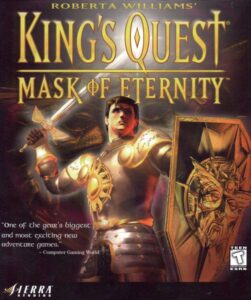
Sierra’s decision to drop the Roman numeral from the eighth King’s Quest game is indicative of the confused, have-your-cake-and-eat-it-too quality of all of its messaging around Mask of Eternity. The logic was that the new generation of gamers Sierra was hoping to attract would be intimidated by its being the eighth game in a series, might even feel they shouldn’t bother with it if they hadn’t played the previous seven. But then, if you are so concerned about reaching these people, why call it a King’s Quest game at all? The only cachet that brand might have held for most of them was the negative cachet of the “kiddie games” their moms or sisters used to play.
Mask of Eternity’s hero Connor looks like he could break Sir Grahame or any of the other protagonists from the first seven King’s Quest games in two without straining his tree-trunk-sized arms.
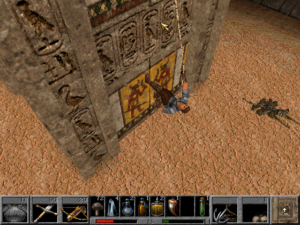
This level — err, area — is Egyptian-themed. What does this have to do with King’s Quest? Beats me… but Stargate SG-1 was popular on television at the time. Got to tick those boxes…
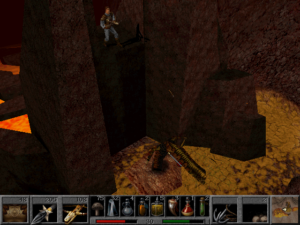
“Oh, great, another jumping challenge! I love those, especially with these extra clunky controls!” said no player of Mask of Eternity ever.


Did you enjoy this article? If so, please think about pitching in to help me make many more like it. You can pledge any amount you like.

 

Sources: The books Not All Fairy Tales Have Happy Endings: The Rise and Fall of Sierra On-Line by Ken Williams, Financial Shenanigans: How to Detect Accounting Gimmicks & Fraud in Financial Reports by Howard Schilit, Stay Awhile and Listen, Book II: Heaven, Hell, and Secret Cow Levels by David L. Craddock, Gamers at Work: Stories Behind the Games People Play by Morgan Ramsay, and Last Chance to See by Douglas Adams and Mark Carwardine. Wired of November 1997; New York Times of May 27 1997, July 4 1998, July 5 1998, and June 16 2000; Wall Street Journal of July 29 1998; Fortune of November 1998; Next Generation of June 1997; Sierra’s customer magazine InterAction of Fall 1996, Holiday 1996, and Fall 1997; Computer Gaming World of April 1999.

Online sources include “How Sierra was Captured, Then Killed, by a Massive Accounting Fraud” by Duncan Fyfe at Vice, Ron Rimkus’s analysis of the CUC/Cendant debacle for the CFA Institute, “A Pathological Probe of a Pool of Pervasive Perversion” by Abraham J. Briloff of Baruch College, Forbes’s report of Walter Forbes’s sentencing, and the vintage GameSpot review of King’s Quest: Mask of Eternity.

I also made use of the materials held in the Sierra archive at the Strong Museum of Play.

Where to Get It: King’s Quest: Mask of Eternity is available as a digital purchase at GOG.com, packaged together with the more fondly remembered King’s Quest VII: The Princeless Bride.


Footnotes

  • Reviewer Thierry Nguyen seemed not to have played any game since the early 1980s. “If you wanted to pull a switch in an earlier game,” he wrote, “you probably would have typed, ‘push box,’ then ‘get on box,’ and finally ‘pull switch.’ Here, you have to literally push the box, jump on top of it, and look up to pull the switch.” What a revelation!
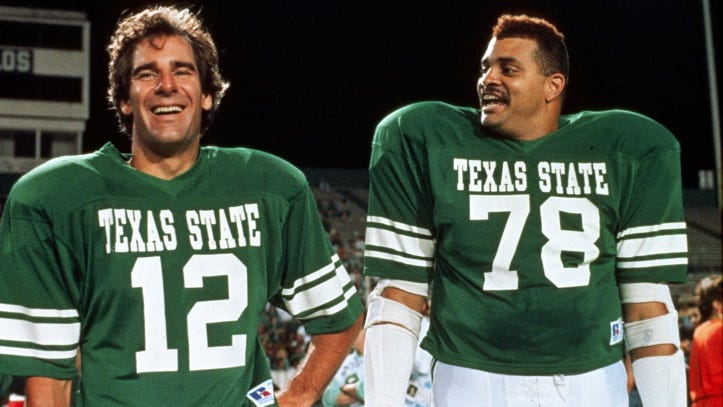
08

the gen z resilience drought

SOURCE https://jordanstacey.substack.com/p/the-gen-z-resilience-drought?selection=c32a7615-6224-435d-8f7d-b2b633add5c9

Resilience is a complicated word. It feels inherently aggressive and gaslighty. For many it conjurs images such as that of an emotionally repressed father that never sheds a tear, or a bitter high school teacher that won’t take “mental health stuff” as an excuse for late homework. But, I think herein lies the problem. Whilst previous generations may have had an unhealthy excess of resilience, the pendulum has swung so far that current generations have landed in deficiency. “Resilience” has indeed been weaponised against victims of the system for centuries, but resilience itself is not bad.

Too much resilience, that is never advocating for yourself or demanding autonomy, is traumatising. It has produced a generation (Gen X) that is teeming with emotionally unregulated parents that cannot keep up with the pendulum. This emotional dysregulation has left a mess in its wake. A mess of exasperated children (Millenials/Gen Z) that carry the burden of healing generational trauma and ignorance. However, much as we roll our eyes at their subbornness and confusion, it isn’t wholly unwarranted. When individual autonomy becomes a blanket aversion to doing hard things and experiencing the discomfort that comes with struggle and growth it is, in my opinion, a resilience deficiency. Life isn’t meant to be constantly laborious, but it isn’t meant to be easy. The assumption that it is meant to be easy will make it feel laborious. When boundary setting and self-advocacy goes so far that we develop an allergy to the chaos of human existence, we have lost our resilience. We have become unregulated in the opposite sense.

Let’s start with “neurodivergence” and minorly othered white people

The tweet above went viral and I believe it’s because the bulletproof defence of “but I have ADHD” is exhausting. It’s not that ADHD is not a real problem, it’s that having problems does not absolve you from responsiblity. When are you asking too much of someone, and when are you asking someone to reasonably sacrifice their comfort? To be there for you even though they are not without hardship? An impossible question.

Before you throw hands, I am speaking from experience. I have been diagnosed with over 10 chronic illnesses, have sensory issues up the wazoo and fit perfectly into the category of minorly othered (also queer) white person. Yes, I see these things as minor otherness. The conversation of white people and autism is an essay in and of itself, but what it comes down to is entitlement to comfort. It’s a hard conversation to navigate because the lines are blurry. Neurodivergence is a very encompassing word. When is it concerning high needs disability, and when is it mild executive dysfunction? Someone can say they are “non verbal” just because they don’t feel like talking. Someone can sayt that they are “overstimulated” because they are not comfortable. Pain and suffering are hard to quantify.

All I know is that minorly othered white people seem to be the most demanding of having their needs met of any othered group. Are people with “low needs” (not sure how else to say it) neurodivergence entitled to having their needs met and examined? Of course. Should we demand systematic change in response to changing needs? Of course. But the assumptions that a) those that don’t wear their hardship or otherness on their sleeve don’t also experience discomfort, and b) to live in total comfort at all times is a human right are problematic.

Very few of us get ideal conditions

When I became suddenly very ill at 17 and experienced serious hardship for the first time, I demanded pity. I embodied the identity of a sufferer as I was too young to see that to be misunderstood and overestimated is better than to be pitied. Pity was freeing. Nobody asked anything of me. In fact, I lost all of my friends. In defence of my teenage self, I didn’t know any better. Now, when I open up about my “struggles” with my health both past and present, I don’t enjoy being met with pity. Empathy and sympathy are natural human responses, I understand this, but I always find myself saying “it’s just life”. Because it IS just life. It doesn’t even begin to outweigh my privilege. I don’t say this as a martyr. Too much resilience is harmful and I have advocated for myself and restructured my life as best as I can. But I see no point in pausing my life in want of perfection.

Two things can be true at once. We can advocate for ourselves and sacrifice for others. We can both demand change to alleviate our suffering, and adapt to what is for others. I can answer my phone at 2am because my friend needs me even though I am tired from work and chronically fatigued. I’ll sleep more the next night and skip my yoga class. It is not perfect. It is uncomfortable at times. Sometimes I have to say no, of course. But we cannot wait for ideal conditions to be there for each other. Societal change is birthed from uncomfortable togetherness.

“I’m not made for this world” — nor is it made for you (or many of us)

Look at it this way — your problems are not necessarily your fault, but they are unfortunately your responsibility. Nobody expects you to walk if you were born without legs. If, however, you want to get from A to B and you only have one leg due to a freak helicopter accident, you have two choices. You can sit at point A and demand that anyone who wants to be in community with you come join you. You can wait until the systems around you hear you and carry you to point B. Or, you can hop. The people who really love you will even hop with you at times. You may hop slower for your slower friends too, but they don’t demand it of you. Community isn’t about demands, it’s about empathy and selflessness. One could say that nobody should have to hop. Hopping is exhausting. Yes, this is true. But why yell from point A when you can yell on your way to point B? I know this analogy will not make sense to everyone, but stick with me.

What I find the most frustrating is when people see someone move from A to B and B to C and assume that they must have two healthy legs, for why are they in motion? As someone who has been limping along for a while now, I never assume this, yet people assume it of me. This is the result of the resilience drought. Those that expect comfort cannot fathom those that continue in discomfort.

I mean, of course you’re lonely if you choose comfort over connection

I fear that many young people (my 17-year-old self included) in the throes of executive dysfunction, fists in the air saying “fuck capitalism”, are demanding change that they aren’t willing to contribute to. Community requires sacrifice to your autonomy. Revolution requires sacrificing comfort. If you aren’t willing to go outside of your comfort bubble for someone, no government-mandated third spaces are going to magically gift you with a sense of community. If you can’t do some research on world events here, or go to a protest there, no instagram repost is going to illicit change. The tricky part is quantifying what is discomfort and what is unbearable suffering, for we all have varying levels of resilience and capacity. When do we set a boundary, and when do we sacrifice our energy? I’m not at all sure, but I have some ideas.

Listening to someone talk about their problems even though you also have problems is not suffering. That is the mild discomfort that simply comes with being a friend. That is not a time to set a boundary (unless it happens constantly, duh). Picking someone up from the airport even though you have to wake up at 5am instead of 8am and have plans that weekend is mild discomfort. Your communal work place having bright lights that make you uneasy due to mild sensory issues is, I fear, mild discomfort. The thing about mild discomfort is not that you can never address it, it’s that you are not entitled to be without it in all situations. Especially communal ones.

I am not saying that we should not set boundaries. I am not saying that we should not advocate for ourselves. I am not saying that we should all hop along in silence and demand nothing from the systems in power or from those around us. There is always someone hopping behind us that needs our voice. What I am saying, is that there is a wave of intolerance to discomfort that is stifling political action and perpetuating individualism. If you genuinely value your autonomy over community, you are free to “protect your peace” as you please. If you genuinely value your own comfort over social change, you are free to pursue it. Again, if you are disabled to a point where you can only talk the talk and are unable to even hop the walk, this does not apply to you. If you are tired of hopping, that is also okay. But we must not give ourselves so much grace that we infantalise ourselves as a generation. Too much resilience - too much hopping - is truly harmful. You don’t want to break your good leg. However, giving yourself too much grace is self abandonment. Only you can truly know what this balance is for yourself, so explore it. Be real with yourself. Swing the pendulum of your own resilience and see what happens.

Executive dysfunction or laziness?

Last year I read a book called Stolen Focus by Johann Hari about ADHD, excutive dysfunction and the epidemic of lost attention. If you’re picking up anything I’ve been putting down, I highly recommend reading it. In this book, he talks about how many scientists believe that ADHD and executive dysfunction is as environmental as it is genetic. That is, a chaotic and stressful childhood leaves you on edge, dysregulated and with attention issues. If you must always pay attention to your surroundings for your own safety, how are you supposed to focus deeply and calmly on the task at hand? Makes sense, then, why (genetics aside) we are so unmotivated as a generation. Our parents were stressed and overworked and more and more kids are growing up with screens - the metropolis of chaos and dysregulation.

What I find curious about learning this, is that my parents did have insanely difficult and chaotic childhoods, but don’t seem to struggle remotely with executive dysfunction. When I put off paying a fine or booking an appointment because “I just can’t bring myself to do it” my parents can’t even begin to understand. I’ve discussed this with my friends and it seems that my parents and my friends parents, emotionally dysregulated and traumatised as they may be, somehow have their shit together. The parking fines are instantly attended to and the dentist is booked as soon as the tooth ache appears.

It comes back to the pendulum. When you should do something, it’s easy to get in the habit of not doing it. When you must do something, this tendency goes under the radar. In other words, the era of convenience perpetuates executive dysfunction. My parents may very well have the same genetic and environmental predispositions as me, but with the modern acceptance of executive dysfunction comes the erasure of laziness as a concept. This is a good thing, as it comes hand-in-hand with critiquing hustle culture and capitalism. However, it goes to show that resilience brings with it a level of discipline that younger generations are struggling to maintain. I asked my mum about this and she basically said with a giggle “if we had this many demands we would have just been sent down the mines”. Obviously, things have changed for the better. However, the ever increasing death of drive and discipline is concerning.

Please, take this with a grain of salt. If you think what I am saying is ableist, you are missing my point. We cannot complain about capitalism and call it a day. We must be in as much motion as we can muster.

The pendulum will be flung back if we are not careful

We shouldn’t have to hop and the systems are flawed and unfair. However, we should be asking ourselves if we underestimate our capacity purely because we are no longer forced to overestimate it. The resilience drought has played a necessary part in the balancing of the scales, but I feel it may be time to find our centre. We don’t have time to wait until we are comfortable to move. We never really did have time, but now more than ever it is imperative that we begin to once again favour community and action over peace and autonomy. The political repurcussions of the resilience drought are complex, but let’s just say that people like Donald Trump and Elon Musk are preying on those that are exhausted and desperate for the pendulum to move back. I promise you, it will not rest in the middle if they are the ones left to push it.

Take care of yourself, but don’t forget to challenge yourself xx

09

John Oliver is (Still) Part of the Problem

SOURCE https://freddiedeboer.substack.com/p/yes-john-oliver-is-a-symbol-of-why

My first novel is available for preorder. You can find links to do so here. It’s good.

I get it: nominating John Oliver as a symbol of liberalism’s failures was well-worn territory a decade ago. This argument has already been made, all the ideological fruit plucked. And the broader debate about liberal condescension as a profound political advantage for the right has percolated in its current form since the 2016 election and in a more general sense for longer than any of us have been alive. I hate to fight yesterday’s war, and I hate to bore you with arguments that have already been made. But at some point, when you see liberals share the same videos week after week of an annoying British man sneering down a camera lens to tell you how stupid everyone else is, you do have to ask if the American left-of-center has any sense at all of how much their project has been damaged by their reputation for patronizing self-righteousness. If the Trump era has proven anything, it’s just how wildly sensitive voters are to the perception that someone somewhere is judging them. That level of sensitivity to vague slights is stupid and the grievance usually disingenuous, but that’s politics, baby. And Oliver is such a pitch-perfect caricature of progressive self-regard - snarky, aloof, judgmental, incurious - that I sometimes wonder if his show is a brilliant op pulled off by the Heritage Foundation.

Take this latest episode of Last Week Tonight, about trans athletes in women’s sports. On substance, Oliver and I hardly disagree on trans issues at all. I too support trans rights and trans identities, I too think people should be able to use bathrooms consistent with their gender expression, I too think medical decisions about trans children should be made by those children, their parents, and their doctors. About the specific issue of trans women in sports, I confess that my default stance at this point is exhaustion; it’s just such an incredibly small bore issue, of relevance to a tiny minority of trans people, that I struggle to see it as something worthy of expending great political resources. This is particularly true given that the public genuinely is not on our side here. Hell, 45% of Democrats say that trans athletes should be “required to compete on teams that match their sex at birth.” One of the great weaknesses of contemporary liberalism is the absolute inability to take an L on any issue; scroll around on BlueSky and you’ll find, for example, vast throngs of progressives who are completely unwilling to admit that mass immigration of unskilled labor into the United States is deeply unpopular. I think the left’s control of our arts, culture, and ideas industries have left too many of us thinking that we can’t lose a culture war. But in the broad sense, we currently are.

In the beginning of the episode, Oliver plays around with a “Why are conservatives so obsessed with this minor issue?” approach, but of course that question goes both ways. It’s just not clear to me that the juice is worth the squeeze. It sucks to put what’s possible in front of what’s right, but that’s the heart of politics. Oliver points out that the women’s sports issue is being used as a wedge to attack trans rights more broadly, but again this logic goes the other way as well; if there’s such backlash concerning this particular issue, of practical relevance to a tiny number of trans people, shouldn’t we consider whether prioritizing it in our messaging is what’s best?

Still, were it up to me, would I allow trans girls and women to participate in women’s sports? Sure, yes. If we saw some sort of domination by trans athletes in those spaces, we could have a hard conversation about it. The reality is that we haven’t seen anything like that, so this is currently a controversy in search of a problem. But then, I’m a wild-eyed lefty who’s been exposed to people from sexual and gender minorities my entire life, and most people in this country are not. Which means supporters of trans rights have to do something that John Oliver trains them not to do: actually engage, argue, persuade, act in general as if there’s work to be done and that we can’t simply sit around feeling superior, chuckling to ourselves on our $15/month premium cable channel. The “gender critical” cohort has been making steady gains for years. What position are you in, exactly, to act as though their views can be so gleefully dismissed? Oliver describes trans rights as under assault, nation-wide. If that’s so, then this precisely the worst time to treat those rights as self-evidently correct and worthy of protection. You can’t have it both ways: if this is a crisis, you have to hustle and fight like it’s a crisis. You can’t expect to joke your way out of it.