Weekly Reading — 2026-08-08

Roberto Hernández

https://sabr.org/bioproj/person/roberto-hernandez/
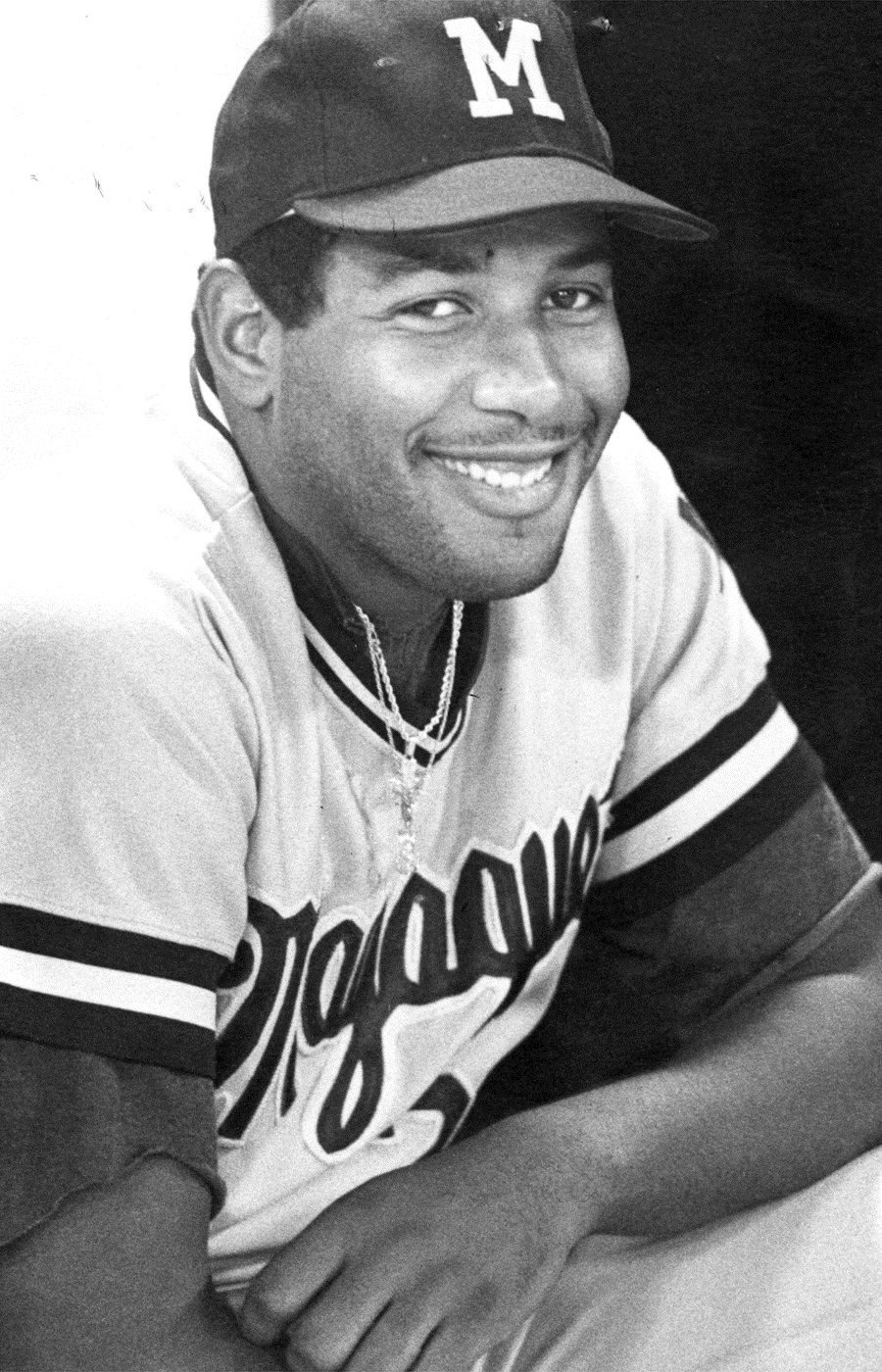
“As a reliever, you’ve got to have amnesia. Not only with the bad days, but with the good days. You may get them out one, two, three today, but you’ve got to forget about it immediately, because that may not happen tomorrow.” — Roberto Hernandez, 20071

“(In the 1989 Instructional League), Roberto (Hernandez) and (pitching coach) Rick Peterson worked hard like the rest of the staff always did under ‘Pete’ but, Roberto really took it a step further than most guys and made himself ‘figure it out.’ Obviously, he did, overcoming a life-threatening injury and going on to pitch for 20 years in the bigs. I love Roberto’s whole story because it’s a great one — from PR to NYC to Storrs and S.C. He did whatever it took — and was great friend and teammate along the way.

“To this day, he has always been the guy I tell people about when they ask me ‘who was the toughest guy to catch?’ Not from that day in the bullpen (when I first caught him in the Instructional League in 1989) but in games at both the minor- and major-league level when his stuff was just beginning to really explode early in his career. His fastball took off in all directions and his split was both hard and late-breaking. He threw heavy, heavy balls that could ruin your thumb if you caught it wrong, he was deceptive but what I respected the most about him was he never made excuses and was accountable.” — Matt Merullo, October 1, 2016.


Roberto Hernandez was born in Santurce, Puerto Rico, on November 11, 1964.

When he was 2 years old, his family — parents, two brothers and two sisters — moved to New York City. He grew up a Mets fan and, at age 16, even had a tryout at Shea Stadium. They wouldn’t be calling him back until more than 20 years had elapsed. As a catcher, he followed Thurman Munson of the Yankees and cried when he heard the news of Munson’s untimely death in a plane crash. Roberto was 14 years old at the time. After three years at Chelsea High School in New York, he received a scholarship to attend New Hampton High School in New Hampshire. Due to poor grades, he had to repeat his junior year, but he worked on his grades as well as his form as a catcher, and completed his secondary studies during the 1983-84 academic year.2

After high school, Hernandez went to the University of Connecticut. Although he was a pitcher in his professional career, the talented Hernandez was mostly positioned behind the plate at Connecticut in 1985. During the spring of 1985, Connecticut played a series of games in the Carolinas. Future teammate Matt Merullo remembers their first encounter: “I met Berto when he came to play UNC with the UConn baseball team. He was a freshman like me and was their starting catcher. I was DHing that day and during one at-bat, he started talking to me and I immediately liked him. I paid close attention to him and wondered what UConn was doing with him back there. He looked out of place and was young. He caught fine and had good energy but he was so tall and lanky that it took a while for him to release the ball. But when he did, it was a bazooka. Guys would be safe by a mile then have to get out of the way of a bullet.”

Hernandez starred in the first game of the Big East tournament against Georgetown. He slammed a two-run homer early on and in the 10th inning, with the game tied, really showed his mettle. He had been victimized by the Hoya running game, and three stolen bases were taken at this expense. However, in the top of the 10th, he gunned down Georgetown’s Glen Bruckner. In the bottom of the inning, he singled and was on board when Mike Pingree homered as UConn won its first game in the tourney, 11-9.3

After the 1985 season, Connecticut coach Andy Baylock was able to find Hernandez a place in the Valley League in Virginia. It was in this summer league that he pitched regularly for the first time, striking out 14 batters in his first start. He attracted the interest of college scouts and before long had a scholarship offer from the University of South Carolina at Aiken. Connecticut was not in a position to offer Hernandez significant scholarship money, and after getting approval from the UConn athletic director, Hernandez transferred to Aiken.

In 1986 at Aiken, he pitched regularly and he took a 9-2 record into the NAIA tournament in Lewiston, Idaho. When not pitching, he was the team’s designated hitter, and on May 11, 1986, he had three homers as Aiken won the district championship, and homered as his school won the regional playoffs to advance to the NAIA tournament. For the season, he wound up batting .315 with a team-high 18 homers. In the tournament, he extended his pitching record to 10-2 with a four-hit, 9-2 win over St. Francis of Joliet, Illinois, as his team finished in third place. He finished the season with 97 strikeouts in 94 innings pitched.

That season, his path once again crossed with that of Merullo. Merullo remembered, “The next fall (1985) I was jogging in the outfield just before a game against USC-Aiken and their starting pitcher was also jogging prior to his mound warm-up. We got close to each other in shallow center and I recognized him as that catcher from UConn. We had a big smile for each other and I knew he was excited to put the shinguards away and use that cannon on the mound. Being from a scouting background, I knew he had made the right career move. He just looked the part out there and the velocity was obvious without any gun. I really don’t recall that game, just meeting him again in the most unlikely place … but it made sense.”

Baseball America rated Hernandez as the 19th best player in the country going into the 1986 draft. He was the number-one draft pick (16th overall) of the California Angels in 1986 and was signed by Al Goldis.

Injuries plagued Hernandez during his first two minor-league seasons, and in 1988 he was 9-10 with a 3.17 ERA for Quad Cities in the Class-A Midwest League. He was off to a slow start in 1989 at Midland in the Double-A Texas League. After registering a disappointing 2-7 record at Midland, he was demoted to Palm Springs in the Class-A California League and eventually that season, the Angels lost interest. However, Chicago White Sox general manager Larry Himes had received positive reports on Hernandez. On August 4, the Angels traded him to the White Sox. Hernandez finished the season at South Bend in the Midwest League. The following season, he was back in Double-A, this time with Birmingham in the Southern League.

It was in the Instructional League that Hernandez once again he crossed paths with Merullo.

Matt remembered:

“Now it’s the fall of ’89, Instructional League in Sarasota. I made my debut with Chicago that April, was sent down when Fisk came back and suffered a broken hand that caused me to miss a lot of playing time. I was set to go to winter ball in the Dominican Republic after tuning up some in Florida. The new GM in Chicago was Larry Himes. He was another former catcher, turned scout then GM and had been with the Angels. He makes a deal for Roberto, who hadn’t done much in the minors but was a good ‘project.’ Roberto shows up in Instructs and just so happens to throw his first bullpen session for ‘the brass’ with me catching him. I squatted down and caught sinkers and tailing fastballs with about six guys standing behind Roberto watching every move like they were biting into gold to see if it was real. They didn’t like what they had sunk their teeth into. There wasn’t much on the ball and the delivery was way out of sync.

“Then our pitching coach, Rick Peterson, steps in and asks him to come to a set position on the mound, stare at my catcher’s mitt then ‘close your eyes and make the pitch.’ I called ‘Time out! What? You wanna catch him?’ The first pitch hissed through the air harder than anything he’d thrown, only it was off the corner of the bullpen fence about six feet to my upper left. I learned a lot that day. It was the first time I ever caught a pitcher with his eyes closed. The first of many. It was like putting a train back on the tracks. Roberto’s body was going one way and his arm was making up for it by throwing a strike with no power behind it. I didn’t even try to catch the ball but I noticed it had real life on it. It literally took off. The brass behind Peterson scratched their heads in both frustration and amazement as they witnessed a huge velocity jump in a matter of minutes. Peterson got Roberto to feel where his momentum was going and Roberto started making the adjustment to get his body under control and moving in the right direction. He was still a project of sorts but he was on his way. By the next year, he was in Double-A Birmingham and again I was catching him. I had a knee injury in winter ball that forced me back on the depth chart and I found myself playing with two kids named Frank Thomas and Robin Ventura in a league where I was an all-star two years before!”

Hernandez was invited to spring training with the White Sox in 1991, and did well. He was not sent down until the final week of spring training when Chicago decided to go with Brian Drahman as the 10th and final member of the mound staff.4

In 1991 Hernandez began the season at Triple-A Vancouver (Pacific Coast League) and posted a 4-1 record in seven starts. As early as spring training, he had felt numbness in his right hand. In June he sought medical help, and a doctor in Vancouver determined that Hernandez had blood clots. Surgery was performed by Dr. James Yao on June 4 to transfer veins from his inner thigh to his right forearm. “I was under the knife for 10½ hours one day and five hours the next. That’s the hardest thing I’ve ever had to do in my life. I had to go back under the next day because it did not take. The vein they took out of my leg and implanted in my arm did not take. It opened up and I was bleeding internally. It felt like I was on fire.”5 Although the doctor in Vancouver told him that he would never pitch again, Dr. Yao was more encouraging, saying that his chances were 50-50. Hernandez’s rehabilitation started in late June and bordered on the miraculous. He resumed pitching in July, throwing six innings in a Rookie League game in Sarasota. He then posted a 2-1 record with a 1.99 ERA in four starts at Birmingham. The key to his success was developing a slider in lieu of a curveball that had been described as “big and sloppy” by White Sox minor-league pitching coordinator Dewey Robinson.6

Late in the 1991 season Hernandez was summoned to Chicago and made his major-league debut on September 2, starting and pitching seven innings as the White Sox defeated Kansas City, 5-1. That evening the press box was full, as Bo Jackson was returning to action after surgery. Hernandez allowed only one hit and struck out four. He was simply spectacular, retiring the first 16 batters he faced and taking a no-hitter into the seventh inning before it was broken up by Bill Pecota. “At the time, I was kind of ticked. If I was going to give it up, I was going to give it up to George Brett or Danny Tartabull,” Hernandez said.7 Reflecting back on his surgery he said, “The doctors said I couldn’t come back, but I have a strong will to compete. I’ve been through a lot so I take nothing for granted.”8

His next two starts were not successful. He was knocked out in the second inning on September 7 and the third inning five days later. He spent the balance of the season in the bullpen and had no decisions after his win on September 2. His ERA ballooned to 7.80 by the end of the season.

In the offseason, Hernandez pitched winter ball for Mayaguez, Puerto Rico, which won the Caribbean World Series.

The move to the bullpen was permanent. In early May of 1992, he was sent back to Vancouver.  Working exclusively in relief, he went 3-3 with a 2.61 ERA before returning to the White Sox in June. On June 21 against Detroit, Alex Fernandez started for Chicago and was done in by a five-run fourth inning.  Hernandez came into the game with his team trailing 5-1, one out, and a runner on first. Hernandez stopped the bleeding and pitched through the eighth inning.  By the time he left the game, the White Sox had scored five runs to take a 6-5 lead. In his 4⅔ innings Hernandez struck out seven batters and allowed only one hit as he got his second career win. Opposing manager Sparky Anderson said, “I didn’t know that kid, but he’s got a great arm.” White Sox catcher Ron Karkovice said, “I knew he felt good out there. He was throwing all three pitches (fastball, slider, and forkball) for strikes.”9 

Manager Gene Lamont had a deep bullpen in 1992 and three pitchers, Bobby Thigpen, Scott Radinsky, and Hernandez, each had more than 10 saves. By season’s end, however, Hernandez had assumed the role of closer, finishing the last 15 games in which he appeared, saving nine and winning two. Knowing that his role could change day by day, he was philosophical: “It doesn’t matter who closes, we just pull for each other. Whatever role they want to use me in is fine with me.”10 From the All-Star break through Labor Day, he was 3-2 and converted five of eight save opportunities, posting a 1.44 ERA in 31⅓ innings. “I’m just having fun out there,” Hernandez said. “I’m getting ahead of hitters. Before this year and earlier in the year, I was having trouble throwing strikes and getting ahead of people.”11

Hernandez finished the season at 7-3 with 12 saves and his ERA of 1.65 was the best on the team. In 38 games from June 21 through the end of the season, his ERA was 1.53, and he struck out 63 batters in 64⅔ innings. The White Sox were in third place down the stretch and were within 6½ games of the lead when Hernandez got his eighth save on September 9. They were unable to get any closer and finished 10 games behind the first-place Oakland A’s. Hernandez was selected as the White Sox Rookie of the Year and received the Bill Veeck Newcomer Award from the Chicago Baseball Writers Association.

The next season, the White Sox won their division and advanced to postseason play for the first time in 10 years. Hernandez was a key. Manager Gene Lamont said, “He’s unfazed by the big situations. Everybody knew he had the stuff to do it. But you never really know how someone will react when you make him the (closer). Everybody can’t do it. You never know how situations will get to a guy. If he fails, how will he do next time? Every time he’s failed, he’s done fine.”12 For the 1993 season, Hernandez was in 70 games and recorded 38 saves. In the League Championship Series, which Chicago lost in six games to Toronto, Hernandez pitched in four games and was not scored on. He earned the save in Game Four as the White Sox evened the series, but Chicago lost the final two games and was eliminated.

Over the next four seasons, Hernandez became one of the preeminent closers in the league. But on occasion the road was bumpy. In the strike-shortened 1994 season, he temporarily lost his closer role when he blew consecutive saves on June 15 and 17, and was ineffective in a White Sox loss on June 20. His ERA stood at 7.33. After the three poor outings, Hernandez said, “I have to find where I was prior to this madness. It’s like everything that could happen has happened. The thing I have to do is forget about what happened and try to start over.”13 And start over he did. After missing eight games, he returned to action. In his remaining 19 appearances, his ERA was 1.74 as he saved seven games and posted a 3-1 record. For the year, his won-lost record was 4-4, but his ERA, due to the June debacle, skyrocketed to 4.91. He saved 14 games but blew six other opportunities. Twice he was taken off the hook as the White Sox came back to win.

In 1995, although Hernandez registered 32 saves, there were 10 blown saves, four during his second June swoon in as many seasons. To maintain a high strikeout ratio and be effective, he needed to spot his fastball and be effective with his breaking pitches. His 84 strikeouts in 59⅔ innings gave him a career high and all-time White Sox reliever record of 12.7 strikeouts per nine innings pitched. The record stood for 16 years until broken by Sergio Santos in 2011. Hernandez learned not to carry over a poor performance to the next day. “It’s hard for me to live with myself (after a blown save). You see your teammates go out there, battle for eight innings, and then I come in in the ninth and blow that game. I’ve learned to put it behind me for that day, but it doesn’t change the fact that I let him down.”14

In 1996 Hernandez increased his save total to 38, was named to the All-Star team for the first time, and finished sixth in the Cy Young Award voting. After blowing a save on Opening Day, he reeled off 20 consecutive saves (and one win) during 27 appearances where his ERA was 0.59. At the end of this stretch the White Sox had a 41-23 record and were within a half-game of the division-leading Indians. In his first All-Star Game appearance, he pitched a scoreless eighth inning. But his notoriety from that game had little to do with his pitching. While posing tor the team picture before the game, the platform tilted and the next thing anyone knew, Hernandez’s forearm had come into contract with the nose of Cal Ripken Jr., the guy with (at the time) 2,239 consecutive games. Ripken’s nose was bloody and broken, and “Robbie (Alomar) and Brady (Anderson) offered to get me a bodyguard when I got to Baltimore.”15 Ripken, all bandaged up, was able to start the game and later continue his streak.

On the verge of his becoming a free agent after the 1997 season, the White Sox sold Hernandez to the San Francisco Giants for the stretch drive. At the time of the trade, he was 5-1 with a 2.44 ERA and 161 career saves. After a 1996 season during which he had 38 saves and a 1.91 ERA, Hernandez had seen his salary jump to $4.62 million. But with free agency looming, the White Sox was not sure if they could keep Hernandez in the fold.

When the White Sox traded Hernandez to the Giants, he joined a contender, serving as setup man for closer Rod Beck, as the Giants won the NL West. After six years in the American League, National League audiences got to see his fastball, which was sometimes clocked at more than 100 mph. One of his victims, Todd Hundley of the Mets, said, “This guy was throwing BB’s. I don’t see anyone throwing harder than this guy.”16

Down the stretch, when Beck became erratic, Hernandez was pressed into service as the closer. On September 17, he pitched two innings to get the save against Los Angeles as the Giants pulled to within a game of the division-leading Los Angeles Dodgers. Two days later, against San Diego, he preserved the lead as the Giants, who had moved into the division lead the night before, maintained their one-game lead. On September 24 Hernandez gained his fifth win since joining the Giants. He entered the game against Colorado with the score tied 3-3 and pitched the final two innings as the Giants broke the tie and won 4-3, reducing the magic number to two. In his last appearance of the regular season, Hernandez was back in the role of setup man, pitching the eighth inning and turning over the ball to Beck as the Giants clinched the division. 

Many of the Giants players had come from other organizations and Hernandez, during the stretch run, remarked, “We are a team of outcasts.” Of his role, Hernandez said, “Some situations are better for (Beck), some are better for me. I’m comfortable in the position I’m in. I’m a rover from the sixth inning until the ninth. I don’t consider it a sacrifice. I call it being a team player.”17

In 28 games with San Francisco, Hernandez went 5-2 with four saves (bringing him to 31 for the season), nine holds, and a 2.48 ERA. But in the postseason, he had little success. In Game One he entered the contest with the score tied. There were none out and two runners on base in the ninth inning. After getting two outs, he yielded a walk-off single to Florida’s Edgar Renteria. In Game Two he again entered the game in the ninth inning but was unable to record an out as the Marlins fashioned two singles, a walk, and a stolen base into the game-winning run in a 7-6 victory. In the decisive third game, he entered with his team trailing 4-2 in the eighth inning and was charged with two runs as the Giants were eliminated, 6-2.

Hernandez’s time with the Giants was short. After the season, he became a free agent and signed with the Tampa Bay Devil Rays, who were new in the American League in 1998. He set a personal high with 43 saves in 1999, blowing only four for the 69-93 Rays, and saved 101 games over three years. In 1999, he was named to the All-Star team for the second time. But despite his efforts, the Rays were years away from success, and it was time for him to move on.

Before the 2001 season there was a three-team trade involving Kansas City, Oakland, and Tampa Bay sent Hernandez to Kansas City. He toiled in Kansas City in 2001 and 2002 and racked up 54 saves, making him the first Latin player to achieve 300 saves. When he recorded number 300 on May 25, 2002, he became the 15th major leaguer to accomplish the feat. The Royals, like the Devil Rays, were not a contender and if Hernandez was to return to the postseason, it would be with another team.

That other team wound up being the Atlanta Braves. Hernandez was once again a free agent after the 2002 season and he signed with the Braves, where he became a setup man. In 2003, he appeared in the postseason for the third time. He pitched a scoreless ninth inning as the Braves lost the opener of the Division Series to the Cubs. After the Braves lost in five games to the Cubs, it was “a bad taste walking off the field, packing up, and knowing there aren’t more games.”18

Over the next three years, Hernandez made this way the Phillies (2004) and the Mets (2005). With the Mets in 2005, reunited with coach Rick Peterson, the then 40-year-old went 8-6 with four saves and an ERA of 2.58 while appearing in a team-leading 67 games. In 2006, after beginning the season with the Pirates and recording his last save, he was traded back to the Mets and returned to the postseason for the fourth time.

By that point, Hernandez was no longer a closer, but embraced his newfound role as set-up man and elder statesman. “I do miss closing, but I’ve learned to replace the satisfaction I got from that with trying to help get the lead to the closer, and also talking to and helping the young kids in the bullpen,” he said.19

How much longer would Hernandez pitch? He signed with the Cleveland Indians before the 2007 season, and that spring said, “It’s inevitable that I will have to retire some time. I’d love to play until I’m 50. [He was 42 at the time.] I may not make it, but I’m having a hell of a time trying.”20

In June 2007, when the 42-year-old Hernandez was released by the Indians, his place was secure. He was 11th in career saves with 326 and had appeared in 988 games. Was there anything left in his arm that would propel him to 1,000 career appearances. The Los Angeles Dodgers thought so and signed him on July 6. He pitched in 22 games and became one of 16 pitchers, as of 2016, to have appeared in more than 1,000 games. With the Dodgers, he was 0-2. He pitched for the last time (number 1,010) on September 25 against Colorado. He allowed three hits and a pair of runs, but he struck out his last batter, Troy Tulowitzki. It was the 945th strikeout in Hernandez’s career, and gave him a strikeout rate of 7.939 per nine innings.

Hernandez has been married to his wife, Yvonne, since his early days in the minor leagues. They have three children.

During his career and into his retirement, Hernandez was involved in his community in New York and was honored as a “Good Guy in Sports” by The Sporting News from 2000 through 2002. In his retirement, he stayed active in a number of projects, including Gloves for Kids and Project Warmth.

Just before retiring, Hernandez spoke of his resolve outside of baseball: “I think that as an athlete and coming up from New York City, and living a life as an inner-city kid, there’s a lot of things you want, but you can’t have your you can’t reach. We try to help as many people as we can, athletically or economically. Like a mentor basically. Like a concerned parent, because I have three kids of my own.”21

Last revised: August 1, 2018


This biography is included in “Puerto Rico and Baseball: 60 Biographies” (SABR, 2017), edited by Bill Nowlin and Edwin Fernández.


Sources

In addition to the sources included in the Notes, the author used Baseball-Reference.com, the Roberto Hernandez player file at the National Baseball Hall of Fame, and the following:

Gay, Nancy. “Artful Reliever Graces Giants,” San Francisco Chronicle, August 21, 1997: B1.

Greenville (South Carolina) News.

Interviews:

Andy Baylock — October 10, 2016.

Matt Merullo — October 1, 2016.


Notes

1 Jim Ingraham, “Hernandez Getting Better with Age,” Lorain (Ohio) Morning Call, March 15, 2007: C4

2 Tyler Kepner, “Saving the Best for Next to Last: Roberto Hernandez Now Calls the Eighth Inning His Domain,” New York Times, May 20, 2005: D2.

3 George Smith, Hartford Courant, May 18, 1985: C5.

4 “Hernandez Looking to Crack White Sox’ Starting Rotation,” Southern Illinoisan (Carbondale, Illinois), March 8, 1992: 22.

5 Murray Chass, “After Aneurysm Surgery, There’s Reason for Hope,” New York Times, May 24, 1996: B13.

6 Alan Solomon, “Changeover Sure Changed Hernandez,” Chicago Tribune, September 3, 1991: B9.

7 Solomon, “Hernandez’s 1-Hit Debut Is Royal Dazzler,” Chicago Tribune, September 3, 1991: B1.

8 Joe Mooshil, “Hernandez Pitches Three-Hitter in Debut,” Salina (Kansas) Journal, September 3, 1991: 9.

9 Solomon, “Sox Talk About Winning — and Do It,” Chicago Tribune, June 22, 1992: B3.

10  Dave Van Dyck, “Chicago White Sox,” The Sporting News, August 17, 1992: 39.

11  Solomon, “Healthy Arm Hernandez’s Idea of Happiness,” Chicago Tribune, September 4, 1992: B12.

12  Joe Illuzzi, “Chisox Count on Hernandez,” New York Post, September 3, 1993.

13  Van Dyck, “Chicago White Sox,” The Sporting News, June 27, 1994: 34.

14  Jerome Holtzman, “Sox’s Hernandez Ready to Mix It Up to Straighten Out,” Chicago Tribune, March 24, 1996.

15  Thomas Boswell, “A Little Break but Still No Bend,” Washington Post, July 10, 1996: C1.

16  Jonathan Mayo, “Hernandez Is One Giant Pickup,” New York Post, August 27, 1997.

17  Steve Marantz, “Harmonic Convergence,” The Sporting News, September 29, 1997: 31-32.

18  Todd Zalecki, “Putting It All in Words: A New Phils’ Reliever Can Always Find Pleasure in Talkin’ Baseball,” Philadelphia Inquirer, February 21, 2004: E7.

19  Ingraham.

20  Ibid.

21  Jayson Addcox, “Hernandez Makes Saves, On, Off Field,” MLB.com, August 6, 2007.
Society for American Baseball Research

https://sabr.org/bioproj/person/juan-guzman/

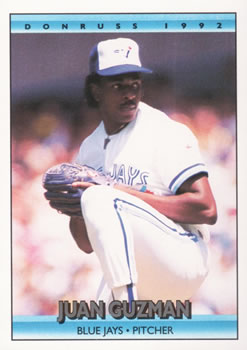
Juan Guzman (TRADING CARD DB)A right-handed starter with a wicked slider, Juan Guzmán pitched parts of 10 seasons (1991-2000) for the Blue Jays, Orioles, Reds and Devil Rays. During his first three big-league seasons, he compiled a record of 40-11 while helping Toronto to three straight playoff appearances, including two World Series titles. The Dominican Republic native posted a 5-1 post-season record, was an All-Star in 1992, and won the American League ERA title in 1996.

Juan Andres Guzmán Correa was born on October 28, 1966, in Santo Domingo to Daniel and Francis Guzmán, who had four other children: Daniel, Roberto, Raúl and Nancy.1 The family lived in a home without indoor plumbing in Manoguayabo, a poor sector in the western part of the capital city.2 The elder Daniel was a building contractor. Juan assisted his father with carpentry, leaving little time for baseball, so long-distance running was his first favorite sport.3 When Juan did play baseball, he was initially an outfielder, but converted to pitching in his early teens because his local team was shorthanded. “Also, I couldn’t hit anything,” he joked. “But, yeah, we needed another pitcher.”4 The main hurler was his friend and fellow Liceo Las Américas student, Ramón Martínez. “When we used to play in the neighborhood every Saturday and Sunday, [Ramón] would always start the first game, and I’d start the second game,” Guzmán recalled.5 “Nobody can really teach you to be a pitcher. They can only help you to become a better pitcher. But that first time I picked up the ball, it felt . . . natural.”6

In the early 1980s Guzmán attended a Toronto Blue Jays tryout camp organized by scout Epy Guerrero. “I was too young. I was 14 or 15 years old,” Guzmán said. “I was throwing hard, 84-85 miles an hour. Epy told me I had a good arm and all that stuff but that I was too young to leave the island.”7 A few years later, Dodgers scout Ralph Avila was organizing two national teams of Dominican amateurs and asked for recommendations from a clubhouse worker with the Tigres del Licey winter league club. The clubbie named his neighborhood teammates, Martínez and Guzmán. “Ramón was a really skinny kid and Juan was a husky kid,” Avila recalled. Impressed by Martínez’s control and breaking ball, Avila moved him to a club headed for the 1984 Summer Olympics in Los Angeles, where baseball was a demonstration sport, and signed him shortly afterwards. The rawer Guzmán joined the team bound for the youth championships in Kindersley, Saskatchewan, where he played for Alfredo Griffin’s uncle alongside two of George Bell’s brothers.8 After returning home, Guzmán’s work at the Dodgers camp in Campo Las Palmas convinced Los Angeles to sign him, too.9 “My parents were worried. They wanted me to continue to go to school,” he said. “Finally, they said, ‘Do what you want to do.’ I could sign this contract and I could try to have a career. I could always go back to school, but maybe I could not go back to baseball.”10 Guzmán signed for a $4,000 bonus.11

Working primarily as relievers, Guzmán, 18, and Martínez, 17, combined for a 9-2 record for the Dodgers’ sub-.500 Rookie-level Gulf Coast League affiliate in 1985. Though Guzmán led the club in wins (5) and saves (4) in 21 appearances (three starts), his 3.86 ERA was worse than league average and more than a run-per-game higher than his friend’s. “Ramón was always the better pitcher, the more natural pitcher. I had to learn, make mistakes, get help,” Guzmán said.12 “He helped me to learn pitches.”13 In Guzmán’s 42 innings, he uncorked 15 wild pitches to lead the circuit.

In 1986, Guzmán threw 16 more wild pitches to lead the Single-A Florida State League. Overall, he was 10-9 with a 3.49 ERA in 24 starts (26 games) and led the Vero Beach Dodgers in victories and strikeouts. Alejandro Peña, Guzman’s childhood hero, joined Vero Beach in May and made four appearances on a rehab assignment.14

Guzmán spent 1987 with the Bakersfield Dodgers in the Single-A California League. He struck out 113 batters in 110 innings but walked 84 and finished 5-6 with a 4.75 ERA in 21 starts (plus one relief appearance). He was pitching in the Instructional League on September 22 when a coach told him that he’d been traded to Toronto for infielder Mike Sharperson. “We felt [Guzmán] was several years away and would have to acquire command, always an unknown,” explained Los Angeles GM Fred Claire.15 “The file on him was always ‘good arm, good person.’ There was never a negative report on him in any way.”16 Guzmán said, “I was surprised because the Dodgers told me that I was one of the best prospects that they had.”17

Also surprised were the Blue Jays, who had believed they could pick between two prospects and intended to select shortstop José Offerman. “We wanted Offerman and thought we had the choice,” Toronto GM Pat Gillick confirmed in 1991. “In the end, Fred insisted it was his choice and gave us Guzmán. I wasn’t happy.”18 If Gillick wasn’t pleased, Guzmán was, at least initially. “A lot of my friends were playing in the Blue Jay organization,” he explained. “But I was disappointed when they told me I was going to be a reliever. That toned everything down.”19

In 1988, Guzmán led the Knoxville Blue Jays with 46 appearances (two starts) and posted a 2.36 ERA in the Double-A Southern League. He walked 60 in 84 innings but permitted only 52 hits. In the Dominican League that winter, he started 11 of his 12 appearances for the Tigres del Licey. Although his record was only 3-5, he posted a solid 2.84 ERA and the manager, Dodgers’ coach Joe Ferguson, told him, “Wow, I don’t know how they let you go.”20 Guzmán joined the circuit champion Leones del Escogido for the Caribbean Series in Mazatlán, Mexico, where he earned the Dominican Republic’s only victory and was clocked at 97-mph.21

The Blue Jays promoted him to the Triple-A International League in 1989 but continued to use him out of the bullpen. Appearing in 14 games for the Syracuse Chiefs, Guzmán walked 30 batters in 20 ⅓ innings. “He had two or three different release points,” recalled pitching instructor Galen Cisco.22 “He’d bounce pitches 10 feet in front of the plate. He’d sail two or three over the back screen and that was about 10 foot high.”23 Following a June demotion to Knoxville, Guzmán was 1-4 with a 6.23 ERA in 22 outings (eight starts), still averaging more than one walk per inning. “I needed innings to develop. As a reliever I was getting one inning, two innings, then I might not pitch for a week. I couldn’t get my control going. I couldn’t get my mechanics consistent,” Guzmán explained.24 He was dropped from Toronto’s 40-man roster and later confessed, “There was a time when I thought I was going to quit baseball.”25

That winter, Guzmán reached out to Avila, who told him he was opening his shoulder too soon and overthrowing. Back at Knoxville in 1990, pitching coach John Poloni encouraged him to speed up his deliberate tempo and develop better balance in his delivery. Guzmán appealed to Knoxville manager John Stearns, recalling, “I told him, ‘I’m not a reliever. If there’s any chance I can be a starter, please give me a chance’.”26 By year end, 21 of Guzmán’s 37 appearances were starts and he went 11-9 with a 4.24 ERA. Despite leading the team in victories, he was left off the 40-man roster again after leading a third league in wild pitches. Any team could have drafted him for $50,000, but none did. “I was upset with everybody,” he said. “They didn’t think I was good enough to play in the big leagues.”27 For Licey, Guzmán went 7-1 with a 1.69 ERA in nine starts (10 games) to win Pitcher of the Year honors. In five playoff games, he was 3-0, 1.71, including a complete game win in the finals to help Licey win the championship. In February 1991, he helped the Dominican Republic win the Caribbean Series (called “Winterball 1” that year) in Miami.

Guzmán began 1991 in Triple-A Syracuse and impressed Chiefs’ skipper Bob Bailor while starting 11 of his 12 appearances. “The guy is driven, and he just goes about his business,” Bailor said.28 Though Guzmán was only 4-5 with a 4.03 ERA, he was leading the International League with 67 strikeouts in 67 innings when the Blue Jays called him up to replace Dave Stieb, who’d gone onto the disabled list with back problems.29

On June 7, Guzmán started in Baltimore and struck out five Orioles –including Cal Ripken— in the first three innings of his debut. But he was knocked out in the fifth and lost, 6-4. Eight days later in Toronto, the Orioles beat him again. On June 22, however, Guzmán earned his first big-league victory by hurling seven shutout innings of three-hit ball against the Indians, striking out six and walking two. Next time out, he pitched into the eighth to defeat the Twins, 1-0, He went on to win 10 straight decisions, breaking Stieb’s Blue Jays record.30 It was also the longest winning streak by a rookie in 28 years.31 Five of Guzmán’s wins came in September and, by the time he lost his last outing to finish 10-3 with a 2.99 ERA in 23 starts, Toronto had clinched the AL East. “I always thought I could make it, but never in my dreams did I think it would turn out like this,” he confessed. “I think the Lord has been with me.”32

“I’ve never seen [Guzmán] unnerved,” said Blue Jays’ catcher Pat Borders. “The guy’s a rock that way.”33 In the ALCS against the Twins, Guzmán pitched Game Two in front of 54,816 at the Metrodome. “At least the fans weren’t throwing anything at me like they do sometimes in the Dominican,” he said.34 He walked two of the first three hitters but settled down to earn Toronto’s only victory in the best-of-seven series with 5 ⅔ innings of four-hit work. “He’s effectively wild,” observed Minnesota manager Tom Kelly. “Just wild enough to be real good.”35 Guzmán finished second to Twins’ second baseman Chuck Knoblauch in AL Rookie of the Year voting and claimed The Sporting News’ honor as the circuit’s top freshman pitcher. “I just have good concentration. When you can control your mind, you can do anything. I wasn’t always this way – gradually I found it out for myself,” Guzmán said.36 “I’ve always worked very, very hard. It’s finally paying off.”37

One key to Guzmán’s success was the late-breaking slider he developed in 1990 after scrapping his curveball. “Juan Guzmán has the most unusual slider I’ve ever seen,” remarked broadcaster and former pitcher Jim Kaat. “It goes down so sharply that I thought it was a split-finger.” Guzmán held it like the curve with a finger across a seam. Throwing overhand, he would turn his wrist just before releasing the ball to achieve an effect that he described as being between that of a cut fastball and slider. “I only throw it when I can get a strikeout. I really like to throw it out of the strike zone and try to get the hitter to swing,” he said.38 His repertoire also included a three-finger changeup.39 His mid-90s fastball was there all along. The Blue Jays asked Guzmán to take it easy in winter ball, but sellout crowds turned out to see his lone regular-season start and three playoff outings for Licey.40

In 1992, Guzmán won 11 of his first 12 decisions and finished the first half 11-2 with an AL-leading 2.11 ERA and 122 strikeouts. At the All-Star Game in San Diego, he struck out the first two batters he faced —Ryne Sandberg and Benito Santiago— and completed a scoreless inning by popping up Barry Bonds after loading the bases. Guzmán missed most of August because his shoulder felt sore when he threw sliders and changeups.41 He returned and helped propel Toronto back to the postseason, completing a 16-5, 2.64 campaign by one-hitting the Tigers over eight shutout innings to earn the AL East clinching victory on the season’s final day. In 180 ⅔ innings, Guzmán permitted only six home runs, the circuit’s stingiest rate. “I think anyone will tell you, when he’s healthy he’s the best pitcher in the American League,” remarked Detroit manager Sparky Anderson.42

Guzmán beat the Athletics twice in the ALCS, winning Game Three in Oakland and Game Six at SkyDome to secure the Blue Jays’ first-ever pennant. With the World Series even after two contests in Atlanta, Guzmán dueled southpaw Steve Avery in Game Three and held the Braves to two runs (one earned) over eight innings before departing with the score tied, 2-2. He received a no-decision when Toronto prevailed in the bottom of the ninth. Guzmán’s potential Game Seven start became unnecessary when the Blue Jays triumphed, four games to two.

In spring training 1993, a bout with the flu cost Guzmán precious preseason innings which affected his feel for the release point on his changeup throughout the season.43 His ERA climbed to 3.99 and he threw 26 wild pitches to set an AL record.44 Nevertheless, he tossed his first major-league shutout against the Royals on April 29 and notched the first of his four career 11-strikeout games against the Athletics on June 5. By season’s end, Guzmán had worked a personal-best 221 innings and posted a 14-3 record to lead the American League with an .824 winning percentage as the Blue Jays won a third consecutive division title.

Toronto’s rotation included veteran stars like Jack Morris and Dave Stewart, plus 19-game winner Pat Hentgen, but manager Cito Gaston opted to pitch Guzmán –winner of his last seven decisions– in the 1993 ALCS opener against the White Sox at Comiskey Park. “Juan has been our ace since he came to the big leagues,” said second baseman Roberto Alomar.45 Guzmán walked a career-worst eight, but defeated that season’s Cy Young Award winner, Jack McDowell, 7-3. With the series deadlocked at two games apiece, he hurled seven innings of three-hit, one-run ball to beat McDowell again in Game Five. After the Blue Jays clinched another pennant, Guzmán faced the Phillies’ Curt Schilling in the World Series opener. In five innings, he allowed four runs and received a no-decision in a contest that Toronto won, 8-5. With a chance to deliver the Blue Jays’ second consecutive championship in Game Five at Veterans Stadium, Guzmán held Philadelphia to two runs (one earned) over seven innings but suffered his first-ever postseason loss as Schilling tossed a shutout to keep the home team alive. Toronto eventually prevailed in six games.

Guzmán was the Blue Jays’ Opening Day pitcher in 1994 and defeated Chicago’s McDowell. Although his pitch counts were always high due to his lofty strikeout and walks totals, the issue became more problematic as he nibbled around the corners. “That doesn’t drive me crazy, but it does make me worry for him and his career,” remarked Gaston after a May 16 start in which the pitcher needed 105 pitches to labor through only 5 ⅓ innings.46 Guzmán’s 25 starts tied for the league lead, but he needed a 6-2 finish to complete the strike-shortened season with a 12-11 record. During a year in which the overall AL ERA climbed from 4.32 to 4.80, Guzmán’s figure soared over 5.00 to stay in April and wound up at 5.32. “I just didn’t have my good velocity. My changeup is my third pitch, my slider is my second, my fastball is my best pitch,” he explained. “I didn’t have my best pitch.”47

While Guzmán had always been a fitness fanatic –running stadium steps for an hour every non-pitching day, for example– he added more pounds and repetitions to his offseason weight workouts in an effort to gain strength.48 Though Guzmán didn’t pitch winter ball for the third straight year, Ramón Martínez told reporters about a star-studded softball team in Santo Domingo. “I play first base,” Martinez said. “[Marlins’ prospect Quilvio Veras] plays second, [Expos’ outfielder] Moisés Alou plays center field, Juan Guzmán is the designated hitter and [Montreal pitcher] Pedro [Martínez plays second or DH.”49

Back on the mound in 1995, Guzmán endured a nightmarish season. His ERA was 9.78 in four starts when he was placed on the disabled list May 21 with a muscle imbalance in his throwing shoulder. He returned to the DL in August with soreness in his right armpit. His lost five consecutive starts upon returning to extend his personal losing streak to nine in a row, matching Jeff Byrd’s 1977 Blue Jays’ record for futility by a right-handed pitcher.50 Despite winning in Boston and allowing only one earned run over 15 innings in his last two starts, Guzmán finished the season with an ugly 4-14 record and 6.32 ERA. Since Toronto couldn’t slash his $2.8 million salary by more than 20-percent, it seemed unlikely that they would tender him a 1996 contract. However, in December, the club relented and guaranteed a one-year deal for $2.24 million. “We feel there’s some unfinished business that Juan has as a Blue Jay,” explained GM Gord Ash.51

For the first time in four winters, Guzmán pitched for Licey, making two regular-season starts. After posting a 0.50 ERA in 18 playoff innings, he joined the champion Águilas Cibaeñas for the Caribbean Series in Santo Domingo. The Dominican squad disappointed in front of their home fans, but Guzmán looked sharp in a seven-inning, three-hit no-decision against Mexico.52 In spring training 1996, he changed his uniform number from 66 to 57. “I changed a lot of things, not only my number. I changed a lot of personal problems that I cannot explain to anybody,” he said. “I’m going to be a new me this year.”53

Guzmán looked like his old self in April, claiming AL Pitcher of the Month honors after going 3-1 with a 1.88 ERA. His record briefly slipped below .500 in mid-June following his return from a 15-day disabled list stint for a strained pectoral muscle, but he soon righted himself.54 Heading into his scheduled September 7 start at Yankee Stadium, Guzmán was 11-8 and walking fewer batters than ever. His 3:1 strikeout-to-walk ratio led the American League, as did his 2.93 ERA, 1.124 WHIP and 7.6 hits allowed per-nine-innings. He was hospitalized that day after experiencing chest pains, however, and missed the remainder of the season following an emergency appendectomy.55

The Blue Jays rewarded Guzmán with a two-year contract worth $9.5 million, with a third-year vesting option based on innings pitched.56 He made his final five appearances for Licey that winter, three in the playoffs. Over parts of eight seasons with the Tigres, he was 10-7 with a 2.57 ERA in 37 games (27 starts), plus 6-1, 1.73 in 16 playoff outings (15 starts).

In winning his first two starts of 1997, Guzmán looked strong, but he allowed a career-worst four home runs in Texas before April was over and left two May starts early with shoulder soreness and arm fatigue. Then he broke the thumb on his pitching hand fielding a grounder on May 28 and went on the disabled list for a month.57 After Guzmán failed to survive five innings in three of four starts when he returned –including another four-homer debacle– he returned to the DL on July 16 with a shoulder strain. He pitched a total of four innings in two August rehab starts in Single-A before undergoing season-ending surgery to remove bone spurs and repair a torn labrum.58

Guzmán’s ERA was over 5.00 until after the All-Star Break in 1998 and he lost 12 of his first 16 decisions. He was healthy enough to make all his starts, however, and improved as the season progressed. On July 30, for example, he beat the Rangers by hurling the first eight innings of a 1-0 victory in what proved to be the last appearance of his Toronto career. After enduring four straight losing seasons, the once mighty Blue Jays were under .500 again and dealt Guzmán to the Orioles for fellow Dominican Nerio Rodríguez and minor-leaguer Shannon Carter the next day at the trading deadline.

Former Toronto second baseman Roberto Alomar helped Guzmán win his Baltimore debut with a leadoff home run and starting an inning-ending double play. “I’ll keep saying it, Robbie’s the best player I ever played with,” Guzmán said. In 11 starts for the Orioles, Guzmán was 4-4 with a 4.24 ERA to finish 10-16 overall. While that record earned him a share of the AL lead in losses, he triggered the 1999 option on his contract by exceeding 200 innings pitched for the first time in five years.59

On June 12, 1999, during an interleague contest in Atlanta, Guzmán –a career .118 hitter– stroked an RBI single off Kevin Millwood for his first big-league hit. Seven weeks later, he was dealt at the trade deadline for the second straight year. Guzmán was 5-9 with a 4.18 ERA in 21 starts when the sub-.500 Orioles swapped him to the Reds for future closer B.J. Ryan and minor-leaguer Jacobo Sequea. In a dozen National League appearances, Guzmán went 6-3 with a 3.03 ERA to help Cincinnati win 96 games –the franchise’s best result in a 35-year span from 1977-2011. The Reds missed the playoffs, however. After finishing one game behind the Astros in the NL Central, Cincinnati lost a one-game tiebreaker to the Mets for the league’s lone wild card spot.

That offseason, Guzmán became a free agent and signed a two-year, $12 million deal with the Tampa Bay Devil Rays in January.60 His debut for his new team proved to be the last game of his major league career. After Guzmán surrendered eight runs in 1 ⅔ innings to the Cleveland Indians on April 7, 2000, he was placed on the disabled list with tendinitis. He worked a total of 20 innings over four rehab starts with three different Tampa Bay minor-league affiliates before undergoing rotator cuff surgery in July.61 In 2001, Guzmán made a dozen minor-league starts before retiring. His 10-year major league career ended with a 91-79 record and 4.08 ERA in 240 starts, plus a 5-1, 2.44 mark in eight postseason games. In 2012, he was inducted into the Dominican Republic’s Hall of Fame.62

By the mid-1990s, Guzmán had started baseball, softball, basketball and volleyball leagues in Santo Domingo, providing outlets for thousands of Dominican youngsters. His off-field life, however, largely remained a mystery even to his teammates. “I don’t like to mix my personal life with baseball,” Guzmán explained. “I can’t tell you a lot except that he’s a very private person,” Cito Gaston once said. “If you find anything out, let me know.”63 Although the 1992 Blue Jays media guide listed Guzmán’s wife name as Anita, the Globe and Mail reporter who asked about her wrote, “Guzmán says he’s single and that baseball is his whole life.”64 According to a 1996 Ottawa Citizen article, Guzmán had two daughters.65 The 1999 Orioles Media Guide listed three children: Juan, Jr., Joanny and Kristy.66 In 2021, Guzmán’s own Facebook page listed a daughter, Rohana, and son, Marvin.67

In 1999, Guzmán became a Christian minister, which he described as a turning point in his life.68 Since at least 2004, he’s been married to the former Ana Delia Martínez. Ana is the sister of Juan’s longtime friends, former big-league pitchers Ramón and Pedro Martínez.69 As of 2021 they lived in Miami and focused on the Juan Guzmán Foundation. In addition to constructing the Juan Guzmán Sports Complex in the Dominican Republic, the foundation sought to fight hunger and poverty throughout Latin America.70

Last revised: June 9, 2021


Acknowledgments

This biography was reviewed by Eric Vickrey and David Bilmes and fact-checked by Kevin Larkin.


Sources

In addition to sources cited in the Notes, the author also consulted www.baseball-reference.com and www.retrosheet.org.

Dominican League statistics from https://stats.winterballdata.com/players?key=1738 (subscription service).


Notes

1 Juan Guzmán, Player Publicity Questionnaire, November 1, 1985.

2 Rosie DiManno, “The Great Juan,” Toronto Star, October 10, 1991: A1.

3 Larry Millson, “Guzmán Seeks Spot in Starting Rotation, But Still a Long Shot,” Globe and Mail (Toronto), February 24, 1989: A19.

4 Allan Ryan, “The Heat is On Young Guzmán in Encore Year,” Toronto Star, February 26, 1992: C1.

5 Joe Donnelly, “Worth Waiting For,” Newsday (New York, New York), October 9, 1991: 157.

6 DiManno, “The Great Juan.”

7 Neil MacCarl, “Juan Guzmán: From ‘Good Arm, Good Person’ to All-Star,” Globe and Mail, July 11, 1992: A16.

8 MacCarl, “Juan Guzmán: From ‘Good Arm, Good Person’ to All-Star.”

9 Steve Fainaru, “Guzmán Self-Made Overachiever,” Ottawa Citizen, October 2, 1991: C3.

10 DiManno, “The Great Juan.”

11 MacCarl, “Juan Guzmán: From ‘Good Arm, Good Person’ to All-Star.”

12 Ross Newhan, “Guzmán: Another Dodger Who Got Away,” Los Angeles Times, October 11, 1991: C6.

13 Millson, “Guzmán Seeks Spot in Starting Rotation, But Still a Long Shot.”

14 Juan Guzmán, 1993 Donruss Studio Baseball Card.

15 Newhan, “Guzmán: Another Dodger Who Got Away.”

16 MacCarl, “Juan Guzmán: From ‘Good Arm, Good Person’ to All-Star.”

17 Millson, “Guzmán Seeks Spot in Starting Rotation, But Still a Long Shot.”

18 Newhan, “Guzmán: Another Dodger Who Got Away.”

19 MacCarl, “Juan Guzmán: From ‘Good Arm, Good Person’ to All-Star.”

20 Millson, “Guzmán Seeks Spot in Starting Rotation, But Still a Long Shot.”

21 Millson, “Guzmán Seeks Spot in Starting Rotation, But Still a Long Shot.”

22 Bob Ryan, “Guzmán in Complete Control,” Boston Globe, October 10, 1991: 59.

23 Ryan, “The Heat is On Young Guzmán in Encore Year.”

24 MacCarl, “Juan Guzmán: From ‘Good Arm, Good Person’ to All-Star.”

25 Larry Millson, “Well-Rested Guzmán Faces Bosox in Opener,” Globe and Mail, August 4, 1995: C11.

26 MacCarl, “Juan Guzmán: From ‘Good Arm, Good Person’ to All-Star.”

27 DiManno, “The Great Juan.”

28 “Armed with a Work Ethic,” Windsor Star, July 13, 1992: C1.

29 Juan Guzmán, 1992 Donruss Baseball Card.

30 Juan Guzmán, 1992 Donruss Baseball Card.

31 Juan Guzmán, 1992 Upper Deck Team Heroes Holograms Baseball Card.

32 Newhan, “Guzmán: Another Dodger Who Got Away.”

33 Dave Perkins, “Bring Back Guzmán to Start in Fifth Game,” Toronto Star, 10/10/91: D1.

34 Newhan, “Guzmán: Another Dodger Who Got Away.”

35 DiManno, “The Great Juan.”

36 Chris Young, “Juan Guzmán’s Cool Under Fire,” Toronto Star, October 11, 1991: F3.

37 MacCarl, “Juan Guzmán: From ‘Good Arm, Good Person’ to All-Star.”

38 “Slider,” The Sporting News, July 11, 1994: 15.

39 Larry Millson, “Guzmán’s Pleased with Progress on Crucial Changeup,” Globe and Mail, March 19, 1994: A19.

40 Ryan, “The Heat is On Young Guzmán in Encore Year.”

41 “Sore-Shoulder Guzmán Put On DL,” Ottawa Citizen, August 6, 1992: C10.

42 “Jays Soaked in Joe,” Calgary Herald, October 4, 1992: E1.

43 Millson, “Guzmán’s Pleased with Progress on Crucial Changeup.”

44 1999 Baltimore Orioles Media Guide: 98.

45 Mike Downey, “Guzmán’s No-Look Class in the Stuff of Pennants,” Los Angeles Times, October 11, 1993: 1.

46 Steve Milton, “At Last, A Win; Even if it Only is Detroit,” Spectator (Hamilton, Ontario), May 17,1994: D3.

47 Mark Zwolinski, “Guzmán’s Fastball in Hopping Form in Exhibition Debut,” Toronto Star, April 16, 1995: B4.

48 Zwolinski, “Guzmán’s Fastball in Hopping Form in Exhibition Debut.”

49 Earl Bloom, “Final Hurdle to Martinez’s No-Hitter Wasn’t a Stranger,” Orange County Register, July 16, 1995: C12.

50 1999 Baltimore Orioles Media Guide: 98.

51 Mark Zwolinksi, “Guzmán Signs But ‘Penalty’ Cut to Cost $560,000,” Toronto Star, December 21, 1995: D5.

52 Larry Millson, “Guzmán Gives Jays Reason for Optimism,” Globe and Mail, February 9, 1996: C11.

53 Stephen Brunt, “New, Changed Guzmán Offers Jays Good News,” Globe and Mail, March 4, 1996: C8.

54 1999 Baltimore Orioles Media Guide: 98.

55 “Guzmán Expected to Miss Rest of Season,” Los Angeles Times, September 8, 1996: 11.

56 Rod Beaton, “Guzmán Re-signs with Jays For $9.5M, Two Years,” USA Today, November 14, 1996: C5.

57 1999 Baltimore Orioles Media Guide: 98.

58 “Guzmán Has Surgery on Right Shoulder,” Standard (St. Catharines, Ontario), September 12, 1997: C1.

59 Dave Buscema, “As O(s) Canada Refrain,” York (Pennsylvania) Daily Record, August 6, 1998: B1.

60 “Guzmán Gets $12 Million,” Times-Colonist (Victoria, British Columbia), January 9, 2000: D8.

61 “Guzmán to Have Surgery,” New York Times, June 26, 2000: D3.

62 “Lanzador Juan Guzmán Irá a Salón de la Fama,” Listín Diario (Dominican Republic), October 2, 2012, https://listíndiario.com/el-deporte/2012/10/02/249362/lanzador-juan-guzmán-ira-a-salon-de-la-fama (last accessed March 8, 2021).

63 Jim Byers, “Guzmán is Juan Mysterious Guy,” Ottawa Citizen, August 24, 1996: G3.

64 MacCarl, “Juan Guzmán: From ‘Good Arm, Good Person’ to All-Star.”

65 Byers, “Guzmán is Juan Mysterious Guy.”

66 1999 Baltimore Orioles Media Guide: 98.

67 Juan Guzmán, https://www.facebook.com/juan.guzmán.58760608/about_family_and_relationships (last accessed March 8, 2021).

68 Yamell Rossi Jesni, “Juan Guzmán, Con la Misión de Dios de Ayudar al Prójimo,” Diario Libre, November 18, 2017, https://www.diariolibre.com/deportes/beisbol/juan-guzmán-con-la-mision-de-dios-de-ayudar-al-projimo-YF8610735 (last accessed March 8, 2021).

69 Rose Marie Santana, “Pitcher Juan Guzmán: ‘Es Una Grave Tragedia lo Occurido a Big Papi ed RD,” Diario Digital (Dominican Republic), June 11, 2019, https://www.diariodigital.com.do/2019/06/11/pitcher-juan-guzmán-es-una-grave-tragedia-lo-ocurrido-a-big-papi-en-rd.html (last accessed March 8, 2021).

70 “Juan Guzmán Foundation,” https://www.juanguzmánfoundation.org/about-us/ (last accessed March 8, 2021).

Society for American Baseball Research

https://sabr.org/bioproj/person/chili-davis/

Baseball has yet to take firm hold in the island of Jamaica, even though it is surrounded by other nations with a strong tradition in the sport. As the 2018 season ended, four men of Jamaican birth have made it to the majors, all of whom learned the game in the United States. The first and most successful of these players was Charles “Chili” Davis, who hit 350 home runs for five teams from 1981 to 1999. That is still the seventh-highest career total for switch-hitters, behind Mickey Mantle, Eddie Murray, Chipper Jones, Carlos Beltrán, Mark Teixeira, and Lance Berkman.

Over his 19 seasons, Chili also earned a reputation as “smart, affable, and candid.”[1] He developed into a leader with a calming influence and a philosophical bent. A line of his has been quoted widely: “Growing old is mandatory; growing up is optional.” In addition, Davis has become a well-regarded hitting coach.

Charles Theodore Davis was born on January 17, 1960, in Jamaica’s capital city, Kingston. His parents were William and Jenny (Baux) Davis.[2] There were four other children in the family, three boys and one girl.[3]

The second and third Jamaican-born big-leaguers – Devon White and Rolando Roomes – both played cricket as young boys. (The fourth, pitcher Justin Masterson, moved when he was two years old and did not have Jamaican roots.[4]) Although it remains unconfirmed whether Davis also played cricket in his youth, it seems likely. At least one report showed him playing baseball’s relative in the Cayman Islands after his retirement.[5]

Yet while cricket was well entrenched in Jamaica, a British possession until 1962, baseball was visible — if only on the fringes. The first baseball game played on Jamaican soil took place in November 1905, between teams from the United States cruisers Denver and Yankee. The New York Times reported that “a large and enthusiastic crowd” watched the game.[6] The early 1930s saw baseball in vogue. Kingston’s newspaper, the Daily Gleaner, carried quite a few stories about club teams. In addition, the Jamaica Baseball Association was founded at this time; it remained sporadically visible thereafter. In the 1960s, future big-leaguer Wenty Ford came from his native Bahamas at least three times to play against Jamaican teams, as the Gleaner reported.[7]

When Bahamian cricket player André Rodgers came to the U.S. in the 1950s and made the majors, his success spurred baseball’s popularity in his homeland. The Bahamas sent five homegrown players to the majors between 1957 and 1983, plus quite a few more minor-leaguers. Yet despite the enduring success of Davis and Devon White, it didn’t turn out that way in Jamaica.

White, who was born almost three years after Davis, moved from Kingston to New York City at the age of nine. That was the first time he picked up a baseball bat and glove. Baseball was his fourth sport; growing up, Devon played cricket and soccer.[8] Rolando Roomes was also born in 1962. He too played cricket as a small boy with his brothers on the Army base in Kingston – but his family moved to Brooklyn in 1969, whereupon Roomes started to play stickball and baseball.[9]

The Davis family moved in 1970, after the dentist for whom mother Jenny worked transferred his practice.[10] They went not to New York but to Los Angeles. A 1991 story said, “His memories of the time are hazy, or at least that is the way Davis prefers to describe them. He says he recalls being lost briefly in the Miami airport, being teased because of his accent by the children in his new neighborhood and spending most of his first Little League season on the bench.”[11] Meanwhile, his parents supported the family as “factory workers pretty much.”[12]

“I played baseball when I came to the United States because I absolutely fell in love with that game,” Chili told Yankees Magazine in its November 2008 issue. “I’ve never fallen in love with anything else, I mean, besides my kids. It was so fascinating to me – a kid that grew up in Jamaica, that never played baseball, didn’t even hear of baseball, didn’t know who Babe Ruth, Hank Aaron, Willie Mays [were], none of those guys when I came to the States. And the first time I saw that game played, I went, ‘Wow, I want to do that.’” [13]

Chili got his nickname at the age of 12. As he told the story himself in 1982, “My dad gave me a haircut…and it wasn’t a very good one. When I went out of the house, my friends got on my case and said it looked like someone put a chili bowl over my head and cut around it.”[14] One friend in particular coined it, Shawn Shephard – a cousin of Shane Mack, Chili’s future teammate with the Minnesota Twins.[15] Although the “Bowl” part dropped away over time, “Chili” stuck for good. Davis himself wound up becoming a barber on the side. In 1985 he said, “I like playing with hair…it’s a hobby, I guess.”[16]

“I was pretty rebellious when I was younger,” Chili said in 1982. “I could’ve turned out to be a gangster or a drug addict if my family didn’t get on me. I got a lot of whippings. I guess they were worthwhile but I hated them at the time. I thought my parents were trying to kill me. I got whipped with belts, shoes, whatever. My uncle once beat me with a fan belt from a car.”[17]

Baseball helped keep him out of trouble. Davis played catcher, first at Fremont High School and then at Dorsey High, from which he graduated in 1977. At least ten other men have gone from Dorsey to the majors, including Sparky Anderson and the brothers René and Marcel Lachemann. Two other good African-American big-leaguers, Don Buford and Derrel Thomas, went there too.

In Chili’s youth, Los Angeles was still a mine of black baseball talent. High-school opponents included Darryl Strawberry (Crenshaw High) and Eric Davis (two years behind Chili at Fremont). George Genovese of the San Francisco Giants, whose brother Frank “Chick” Genovese was also a notable scout, was watching. The Giants drafted Davis in the 11th round of the June 1977 amateur draft. As Genovese recalled, though, he had a hard time convincing the Jamaican parents that their son could make money in baseball. They were skeptical about why a team would pay a bonus.[18]

With encouragement from Genovese, and the agreement of hitting coach Hank Sauer, the natural righty turned to switch-hitting for the first time in Instructional League that fall. He had wanted to try it at Dorsey, but his coach there did not want him experimenting while the team was doing well.[19] A 1997 feature added, “[Davis] quickly tired of seeing inside sliders from right-handed hitters. ‘So one day I went out and told Hank Sauer that I was going to switch hit. If I can’t hit it out from the left side, I’m not going to do it because I’m not going to be a singles hitter from one side and a power hitter from the other…I hit .343 that year in instructional ball. The first home run I hit left-handed was unbelievable. Boom!”[20]

Davis made it to the majors after two seasons in Class A ball and a third in Double A. He still caught a fair amount early on but made the transition to the outfield. Thanks to his torrid hitting in spring training 1981, he jumped from Shreveport to the San Francisco roster. Manager Frank Robinson said in 1983, “I liked Chili from the start because you could see he was a natural. I liked everything about him. He had all the tools and carried himself well. Before he played a major league game, I knew he was the best center fielder we had in camp. His arm was strong and accurate, and he did things instinctively. I had no doubts about him as a hitter, either, because being a switch-hitter is a tremendous advantage.”[21]

The rookie’s big-league debut came in the Giants’ second game of the ’81 season. It’s worth noting that men of Jamaican descent had probably appeared in the majors before – though they were born in other nations. In the 19th century, many Jamaicans went to Panama to work on the Canal, railroads, and banana plantations. Several Panamanian big-leaguers have had English surnames, though the families of some of these men may also have come from other British West Indian possessions such as Barbados.[22] Other players with one or more Jamaican grandparents followed Davis, such as David Green from Nicaragua and Aroldis Chapman from Cuba. Others may have preceded Chapman — for example, Tony Taylor‘s father was apparently Jamaican — since Cuba received nearly 100,000 immigrants from Jamaica between 1902 and 1925 alone.[23] One saying goes that for every Jamaican on the island, there’s another in a different country.

Chili appeared in eight games for San Francisco in April and early May before he was sent down. He spent the remainder of the 1981 season with Triple-A Phoenix (.350-19-75, with 40 stolen bases). Except for 10 more games with Phoenix in 1983 and injury rehab in 1998, he would never play in the minors again.

In the winter of 1981-82, Davis played winter ball in Puerto Rico, helping the Ponce Leones win the league championship. He returned for the 1983-84 season. Chili later told author Tom Van Hyning, chronicler of the Puerto Rican Winter League, “I had a lot of fun playing in Puerto Rico. I’ve been back during the holiday season to visit friends I made in Ponce.”[24] After that second season, though, it appears that he preferred to rest and relax during his off-seasons.

Davis came in fourth in the voting for National League Rookie of the Year in 1982. He said that year, “I was a star in high school and the minors. We played merely on talent.” He added that he had improved and matured with the help of the Giants’ patient coaches. “I’ve learned to play team baseball instead of individual baseball.”[25] Another prime influence was veteran second baseman Joe Morgan. In 1998, Morgan said, “Of all the guys in baseball I’ve quote, unquote ‘raised,’ the one I’m most proud of is Chili Davis.”[26]

Since San Francisco then had Jack Clark in right field, Chili played center field; as a result, he was saddled with comparisons to Willie Mays. He became a corner outfielder after the arrival of Dan Gladden. Ankle injuries (including one that needed surgery after his rookie year) also diminished what was originally good speed. In his early years, Davis batted leadoff frequently, but his stolen-base percentage was rather low. He struck out a fair amount, though not excessively by today’s standards, yet also developed a good eye for walks.

Although he had four homers in his first four games of 1983, the sophomore jinx bit Davis (.233-11-59). He was still hitting over .300 in mid-May but then went into a severe drought. Frank Robinson temporarily demoted him to Phoenix to try to snap him out of the slump.[27] The second half wasn’t much better, but Chili returned to form in 1984, becoming a National League All-Star. He was named to the NL squad again in 1986.

Chili credited hitting coach Tom McCraw, who was with the Giants from 1983 through 1985, for his approach at the plate. “Davis said that McCraw told him, ‘Never leave a fastball. You always look for the fastball. And if there are two strikes, go right back to the fastball and adjust to something else, because you can’t hit a fastball looking for a curveball, but you can hit a curveball looking for a fastball.’”[28]

Chili never liked playing the outfield in Candlestick Park, with all its unpredictable vortices of wind.[29] He also was not happy with the Giants’ general lack of success. The only time they got to the playoffs in his time there was 1987. In addition, that year he faced a major distraction: a palimony suit from the mother of his son, Charles T. Davis II. He later said that he felt like he’d overstayed his welcome.[30] As a result, Davis signed as a free agent with the California Angels following that season.

With the Angels, Davis remained a full-time outfielder in 1988 and 1989. He flanked his fellow Jamaican, center fielder Devon White, and stood godfather to White’s daughter. However, 1990 was the last time he got any significant time in the field. For the remainder of his career, he was almost exclusively a designated hitter.

The Angels didn’t make it to the playoffs in any of those three seasons, and so Chili joined the Minnesota Twins as a free agent in 1991. He won his first World Series ring that year. Star center fielder Kirby Puckett is remembered for saying ahead of Game Six, “Jump on board, boys! I’m going to carry us tonight.” Even so, looking at the whole season, “some Twins observers [said] Chili Davis was more valuable, and Puckett perpetuated that talk by saying Davis sometimes carried the club.”[31] In the Series, Chili hit .222 but connected for homers off Tom Glavine in Game Two and Alejandro Peña in Game Three.

Although he liked Minneapolis, the Midwestern cold didn’t agree with his Caribbean blood. After 1992, Davis tested the free-agent waters again. He returned to the Angels on a one-year deal but wound up there for four seasons altogether. He set a career high in RBIs with 112 in 1993 — but the strike year, 1994, was shaping up to be his best. When the season came to its premature end, Chili had 26 homers and 84 RBIs in 108 games. He followed up with a career-high .318 batting average in 1995, though that season also featured an unfortunate incident that cost him a $5,000 fine. The normally pleasant and even-tempered player went over to the stands and poked a fan in the face. The man said that he wasn’t even the one whose heckling had riled Davis. He filed suit in 1996, though lack of further stories suggests an out-of-court settlement.

Following the 1996 season, Anaheim (as the team was then known) traded Davis to Kansas City for Mike Bovee and Mark Gubicza. In his only season with the Royals, the 37-year-old vet set his career high with 30 home runs. He also drove in 90 runs for the sixth time, while setting a positive example for other players. Although Jay Bell had already been in the majors since 1986, and he too spent only 1997 in Kansas City, he later called Davis the player he had learned most from. The previous year, Angels teammate Tim Salmon said the same thing, noting of Chili, “He’s a true professional.”[32]

Yet again, though, Davis became a free agent. In December 1997, he signed with the New York Yankees. Owner George Steinbrenner admired Chili and wanted him on the team, calling him “a tremendous hitter and a tremendous influence in the clubhouse.”[33] In fact, as Derek Jeter observed, The Boss later put up a sign outside the clubhouse at the team’s spring training site, Legends Field. “[It] read, ‘Unless you’re the lead dog, the view never changes,’ which is a saying that Chili Davis used to have on his T-shirt.”[34] This was just one of many slogan-bearing T-shirts that “Chili Dawg” made up; the popular items had been a sideline of his since Minnesota.

“When I became a Yankee in ’98,” Davis recalled a decade later, “the mentoring was done. Here I am in a professional organization, with a history of winning, with a tradition of winning and with quality players that, even though they were young, were establishing themselves as prime players. I wish that the Yankees years as a player had been a lot longer than just two years. I wish that it had been a five-, six-, seven-, 10-year period to really experience that.” [35]

The Yankees had won the World Series in 1996, and with Davis aboard, they won the next two of their three consecutive World Championships. In the second game of the 1998 season, he injured his ankle while sliding into second at Anaheim. Surgery to repair a tendon was required, keeping him out of the New York lineup until mid-August. Yet Chili was optimistic, saying, “I’ve got one of those Jamaican bodies. Things usually heal right for us!”[36]

Indeed, when colon cancer sidelined Darryl Strawberry just ahead of the playoffs, Chili provided key hits and leadership.[37] That October, after a big game against Cleveland in the ALCS, he remarked, “There are certain things I can’t do, certain pitches I can’t hit. You stay away from them. You try to wait for pitches you can hit. The bat speed isn’t what it used to be. You make up for it by using your head, working counts, getting ahead in counts and getting pitches to hit and hitting them hard.”[38]

Davis enjoyed a solid last season with New York in 1999. He had spoken openly about retirement and wanted to be in top physical condition for his last run.[39] In addition to his production with the bat, Chili was still great at keeping the team loose. Ten years later, David Cone told a story about his perfect game of July 18, 1999.

“[In the fifth inning], Nobody was there to warm me up, so Chili grabbed a glove and squatted, with that big body of Chili’s. I was just lobbing it in there until [Joe] Girardi got out there. In between innings, Chili came to me and said: ‘You know, I used to catch in the minor leagues. I could catch your [stuff].’ Just something like that really made me laugh, and that’s all I needed. Chili was my guy.”[40]

Upon Davis’ retirement in December 1999, Yankees general manager Brian Cashman said, “Chili exemplifies character and class. He was a veteran leader who, along with his offensive skills, brought professionalism and competitiveness to the ballpark every day.”[41]

“I got to put on the pinstripes, I got to sit in the Yankee clubhouse, and I got to play as a Yankee,” Davis said. “And the thing that never left was the urgency to perform. You don’t get to wear this uniform and be a part of this here and not perform.”[42]

Five years later, Chili was on the Hall of Fame ballot. His career has received due consideration of whether it merited induction at Cooperstown, and though he was “one and done” after getting just three votes in 2005, his achievements were substantial. Perhaps his most interesting career stat is that he homered from each side of the plate in the same game 11 times. At the time he retired Davis was tied with Eddie Murray – the hitter he admired most[43] –at the top of this list.

Chili received consideration for a minor-league managing job with the Yankees in 2002 and was a rumored candidate to become hitting coach with the big club after the 2003 season. Instead, from 2003 through 2005, he was hitting coach with the Major League Baseball Australian Academy, tutoring students from France, Korea, Japan, China, New Zealand, and other nations along with fellow Yankee alumni Graeme Lloyd and Pat Kelly. He had first gone Down Under years before, since he always enjoyed traveling in the off-season. Along with Australia, another favorite spot was Bali.[44]

Chili then established Chili Davis Premier Baseball Club, a training facility in Peoria, Arizona (not far from his home). The desire to get involved with pro ball resurfaced, though, and he interviewed for several coaching positions. In October 2010, he became a hitting instructor for the Dodgers in the Arizona Instructional League. There was talk that he might become L.A.’s hitting coach.[45] He also received consideration as manager of the Pawtucket Red Sox, Boston’s top farm club; in January 2011, he became hitting coach for the PawSox.[46]

“My belief is that when you’re a good instructor, first and foremost, you have to get your students to believe that they can do the right things,” Davis said of his coaching work. “If they don’t believe they can be a good hitter, they’re not going to be. Eliminate the fear factor with them, the fear of striking out, the fear of making a mistake, and try to get them to go more toward trying to succeed.”[47]

Past the age of 50, Davis was still a single man. Back in 1996, he talked about this with Orange Coast magazine. “Years ago, Chili Davis made a wager with his teammate, Bill Laskey, on who would marry first. ‘Needless to say, I lost.’” He added, “I’m very leery because there are some women who just want to be Mrs. Chili Davis…Women express their feelings to me much faster than I do toward them.”[48] Another relationship in the early 2000s had unhappy repercussions. Following lurid allegations in civil court, the jury ruled in April 2006 that Davis had to pay $350,000 for various claims.[49] Counter-actions related to the woman’s dealings with the house they had shared dragged on for years.

Chili continued to feel a connection to his native land and other Jamaican-born players. One was Andrew “Dee” Dixon, who played in the minors from 1986 to 1990, as well as Mexico and Venezuela. Dixon moved to Poughkeepsie, New York at age ten and learned baseball a couple of years later after the neighborhood kids teased him. The Giants made the speedy outfielder their 17th-round draft choice in 1986, and he became good friends with Davis. Another was Goefrey (pronounced GOFF-ree) Tomlinson, who moved to Texas at age 11 and went to the University of Houston. Goef became the fourth-round pick of the Royals in 1997; “Davis helped bring Tomlinson into the Royals’ fold.”[50] The outfielder reached Triple A in 2000 and remained in indie-league ball as late as 2011.

Efforts to plant baseball more deeply in Jamaica itself have continued. One such movement started in 1991, when two men from the Toronto area started the Jamaican Youth Baseball Camp. They received backing from the International Baseball Association, and the New York Mets also donated equipment.[51] It’s notable that Devon White was then the starting center fielder for the Toronto Blue Jays. One of the camp’s founders, Leon Taylor, came from Kingston. In 2007 he was an associate scout for the Pittsburgh Pirates.[52] He later became an international consultant for the Los Angeles Dodgers and continued to develop baseball in Jamaica, as well as other places including Bermuda.[53]  As of 2013 he was the hitting coach for the Oakland A’s.

On another front, Andrew Dixon helped achieve a milestone. In March 2010, Major League Baseball’s manager of international baseball operations for Latin America, Renaldo Peralta, joined Sport Minister Olivia Grange in announcing MLB’s offer to assist in building a baseball field at the Trelawny Multi-Purpose Stadium on the island’s north shore, east of Montego Bay. Peralta said, “We’re most certain that it won’t be our last time here. The support from the Jamaican Government brings excitement. We want to totally help develop the game and present the youths of Jamaica with new opportunities.”[54]

Dixon said in April 2010, “Baseball is not part of Jamaican culture but it’s similar to cricket. All I say is as a Jamaican we can learn any sport. There is no stopping us once we put our minds to it.” Andrew hasn’t spoken with his friend Chili Davis in some time, but given Chili’s international mindset, conceivably he may yet lend his prominent name and professional skills. He takes pride in Jamaica, and vice versa. It would surely mean a great deal to him and the nation to see a Jamaican-raised player make it to the top.

Davis served as hitting coach for the Oakland A’s for three seasons from 2012 through 2014. He then occupied that same role for the Boston Red Sox from 2015 through 2017 and for the Chicago Cubs in 2018. In November 2018, the New York Mets named him their hitting coach. He remained in that position until being relieved on May 3, 2021. To date, Davis has not returned to hte majors.

First published in January 2011. Last updated on August 6, 2023.

Thanks to Andrew Dixon.

Sources

www.baseball-reference.com

www.retrosheet.org

www.thebaseballcube.com

www.newspaperarchive.com

www.jamaicanbaseball.com

www.andrewdixonfoundation.org

Yankees Magazine, Volume 29, No. 8, November 2008


[1] Curry, Jack. “Designated, Dominant, Delightful: It’s Davis.” New York Times, April 27, 1999.

[2] Evers, John L. “Chili Davis.” Entry in Latino and African American Athletes Today (David L. Porter, editor). Westport, Connecticut: Greenwood Press, 2004: 71.

[3] “Words flow easily – but infrequently – from Chili Davis.” Minneapolis Star-Tribune, October 6, 1991.

[4] Miguel, Tim. “Long Journey Brings Masterson To San Diego State.” CBS College Sports website, February 23, 2006 (http://www.cstv.com/sports/m-basebl/stories/022306act.html). Justin’s father was serving for three years as Dean of Students at Jamaica Theological Seminary, where he had once been a foreign exchange student. “My Interview With Justin Masterson, Part I.” Sox1fan.com website, February 16, 2009.

[5] Brush, Daniel J., David Horne and Marc CB Maxwell. Major League Baseball: An Interactive Guide to the World of Sports. New York, NY: Savas Beatie LLC, 2009: 175.

[6] “First Baseball Game in Jamaica.” New York Times, November 3, 1905.

[7] For detail, see Wenty Ford’s biography on the SABR BioProject.

[8] Penner, Mike. “The Project.” Los Angeles Times, March 16, 1987: Sports-6. DiManno, Rosie. “Everyone else remembers The Catch. Devon White remembers The Miss.” Toronto Star, October 16, 1993: D3.

[9] “Cricket groomed Roomes for Reds.” Spokane Chronicle, May 29, 1989.

[10] “He’s no Angel.” Minneapolis Star-Tribune, April 14, 1991.

[11] “Words flow easily – but infrequently – from Chili Davis”

[12] Kernan, Kevin. “Bombers Are a Father-Son Team.” New York Post, October 30, 1999.

[13] Lindbergh, Ben. “Southwestern Chili Entrée,” Yankees Magazine, Volume 29, No. 8, November 2008.

[14] “Rookies.” The Sporting News, July 5, 1982: 14.

[15] Botte, Peter. “Chili Hot for Boss.” New York Daily News, December 12, 1997.

[16] “Chili’s a Cut Above — Davis Also Makes Good Moves with Scissors.” Sacramento Bee, June 23, 1985: C8.

[17] Wilstein, Steve. Associated Press, May 18, 1982. This story received various titles across different newspapers.

[18] Atlanta Journal, December 4, 1988: D4. Keown, Tim. “Major League Baseball Scouts Still Have a Place in the Sun.” Los Angeles Times, April 1, 1990.

[19] Peters, Nick. “Switch-Hitter Chili Giants’ Latest Slugger.” The Sporting News, May 16, 1983: 57.

[20] Kaegel, Dick. “Chili Davis Keeps Climbing on Switch-Hitter Charts.” Baseball Digest, June 1997: 65. “Professional hit man: New Royals DH Davis remains one dangerous batter.” Kansas City Star, February 24, 1997: C1.

[22] Pat Scantlebury is one confirmed example of Barbadian descent. This area bears further investigation.

[23] Moya Pons, Frank. History of the Caribbean. Princeton, New Jersey: Markus Wiener Publishers, 2007: 302.

[24] Van Hyning, Thomas E. Puerto Rico’s Winter League. Jefferson, North Carolina: McFarland & Co., 1995: 160.

[26] Lupica, Mike. “Chili Starting to Get Hot.” New York Daily News, October 14, 1998.

[27] Peters, Nick. “A 10-Day Demotion For Slumping Chili.” The Sporting News, July 11, 1983: 17-18.

[28] Draper, Rich. “Chili spices up Hall ballot.” Mlb.com website, December 30, 2004 (http://minnesota.twins.mlb.com/news/article.jsp?ymd=20041230&content_id=926395&vkey=news_min&fext=.jsp&c_id=min)

[30] “Fresnan Sues Chili for Palimony.” Fresno Bee, May 1, 1987.  Peters, Nick. “Chili grudgingly grants interview.” McClatchy News Service, March 10, 1988.

[31] Heyman, Jon. “Kirby Puckett: A Star Who Doesn’t Act Like One.” Baseball Digest, February 1992: 25.

[32] Sorci, Rick. “Baseball Profile: Outfielder Tim Salmon.” Baseball Digest, October 1996: 67. Sorci, Rick. “Baseball Profile: Jay Bell.” Baseball Digest, October 2000: 35.

[33] Curry, Jack. “Yankees Get Their D.H. By Signing Chili Davis.” New York Times, December 11, 1997.

[34] Jeter, Derek and Jack Curry. The Life You Imagine. New York, NY: Three Rivers Press, 2000: 173.

[36] Lennon, David. “Chili’s 2nd Thoughts.” Newsday, April 25, 1998: A44.

[38] Chass, Murray. “On Baseball: Davis Produces as Designated Hitter.” New York Times, October 12, 1998.

[40] Kepner, Tyler. “Cone’s Magic Moment, 10 Years Later.” New York Times, July 18, 2009.

[41] Associated Press, December 2, 1999.

[44] Tetrault, Sharon. “The Independents.” Orange Coast, June 1996: 78.

[45] Gurnick, Ken. “Davis joins Dodgers as an instructor.” Mlb.com website, October 14, 2010 (http://mlb.mlb.com/news/article.jsp?ymd=20101014&content_id=15634814&vkey=news_la&c_id=la&partnerId=rss_la)

[46] Mullen, Maureen. “Sox may hire Gedman, Davis.” Necn.com website, December 22, 2010 (http://www.necn.com/12/22/10/Sources-Gedman-Davis-leading-candidates-/landing_sports.html?blockID=378585&feedID=3352)

[49] Kiefer, Michael. “Chili Davis to Pay $350K for Assault Claims in Civil Case.” Arizona Republic, April 7, 2006: C15.

[50] Boyce, David. “Davis helped KC sign Tomlinson.” Kansas City Star, August 24, 1998.

[51] “Scouting for baseball talent in Jamaica.” Toronto Star, February 7, 1991. Reid, Jim. “Metro men bring baseball to children in Jamaica.” Toronto Star, March 26, 1992.

[52] Braziller, Zachary. “International pastime?” Queens (New York) Courier, August 23, 2007.

[53] “Dodgers make a pitch for Bermuda’s players.” Royal Gazette (Hamilton, Bermuda), March 5, 2010.

[54] “MLB to assist with field at Trelawny Stadium.” Jamaica Observer, March 5, 2010.

Society for American Baseball Research

https://sabr.org/bioproj/person/george-bell/

George Bell (Trading Card Database)

Two firsts were combined into one event in 1987 as the first Most Valuable Player Award won by a member of a Canadian team also happened to be the first MVP won by a player of Dominican descent. The player in question, George Bell, played in 12 seasons from 1981 through 1993 for three major-league teams. That 1987 season was the peak offensive year for the right-handed left fielder and designated hitter, as he hit 47 home runs and edged out Detroit Tigers shortstop Alan Trammell for the honor.

Jorge Antonio Bell Mathey was born on October 21, 1959, in the Dominican Republic town of San Pedro de Macorís. This southeastern Dominican town has produced so many baseball players that it is sometimes called “the cradle of shortstops.” This list of greats from San Pedro de Macorís include Bell’s contemporaries Henry Rodríguez and Sammy Sosa, who would both figure in Bell’s own transaction history.

Bell was originally signed as a 19-year-old by the Philadelphia Phillies in 1978. Two years later, the Toronto Blue Jays, at the urging of legendary scout Epy Guerrero, selected Bell from the Phillies in the 1980 Rule 5 draft. Bell would spend most of the remainder of his career with the Blue Jays, earning induction into the Blue Jays’ Level of Excellence, an honor shared with only 10 others as of 2018.

The Blue Jays opened the 1981 campaign in Detroit against the Tigers on April 9 and Bell was there. With the Blue Jays trailing 5-2 in the top of the eighth inning, Bell was brought in to run for Toronto’s cleanup hitter, John Mayberry. Three straight outs meant that Bell got no action as a runner, but he stayed in the game as a left fielder for the Tigers’ half of the eighth inning. Only one ball was hit his way – a triple over his head and off the wall by Al Cowens.1 After another fruitless pinch-running appearance, Bell was left on the bench for nearly two weeks. His first plate appearance came on April 21 at home against the Milwaukee Brewers. Bell entered the game in the seventh inning to play left field in a 6-0 losing cause. He batted in the bottom of the ninth inning with his team trailing 6-2 and facing Moose Haas and grounded out to shortstop. The next day Bell made his first start, in right field and batting third in a batting order that was struggling. The struggles would continue, as the Brewers took the game 8-1 and the Jays fell to 3-9. Bell began the game with two groundouts back to the pitcher but got his first major-league hit in the fifth inning with a double to right field off Mike Caldwell. He did not score.

Bell’s rookie campaign was cut short when he ran into an outfield wall chasing a foul ball on June 9. He did not return until August 10 and finished his rookie campaign batting .233/.256/.350 in limited duty. Those numbers are not eye-catching but there were flashes of power and speed in his game even at 19 years old, and he garnered some American League Rookie of the Year votes.

Bell spent 1982 in Syracuse with the Blue Jays’ Triple-A affiliate, but another injury-riddled year saw him get into only 37 games with 131 plate appearances. It was no surprise, therefore, when the Blue Jays had him start 1983 (still just his age 23 season) in Triple A. When he was called up, to start on July 12 in Kansas City, Bell made the most of his opportunity and hit a two-run home run and a double as the designated hitter. Other than a final abortive comeback attempt in 1993, Bell was done with the minor leagues for good.

The Blue Jays were hitting their stride in 1984, Bell’s first full season in the major leagues. Behind the pitching of Dave Stieb and the veteran Doyle Alexander and the developing outfield trio of Bell, Lloyd Moseby, and Jesse Barfield, this year was the beginning of a period of winning baseball in Toronto. Bell was a big part of that success. The 1984 team under manager Bobby Cox finished a distant 15 games behind the Detroit Tigers in the AL East, but the signs of good things to come were developing. All three of those outfielders were 24 years old and coming into their own. Bell ended the season with a batting line of .292/.326/.498 and perhaps most importantly stayed on the field the whole season, playing in 159 games primarily as a corner outfielder. He finished the year with 26 home runs, a number that was very consistent throughout the remainder of his career, other than the one MVP year with 47. His consistent appearances in the lineup were also a feature of Bell’s career right up until the very end as he avoided any long layoffs until the end of his career in 1993.

It was Bell’s successful 1984 season, and the lack of recognition he felt about it, that began a reputation for being hostile (or at least uncooperative) to the media that hounded Bell for the rest of his career. He was often referred to as laconic, especially in comparison to his longtime and loquacious teammate Barfield.2 In 1984 the Toronto sportswriters voted Dave Collins as the team MVP over Bell. During spring training in 1985, Bell declared that he was no longer speaking to newspaper reporters and accused them of racism in their selection.3

In 1985 the Blue Jays finally got over the hump and won the AL East with a record of 99-62, edging out the New York Yankees by two games. Bell was at the heart of the batting order, anywhere from third to fifth with the cleanup spot being his through the second half of the season. The Jays lost the ALCS to the Kansas City Royals in seven games. Bell did not have a home run during the series but did contribute three doubles to the cause.

The next year the Jays slid back a bit but Bell contributed in his incredibly consistent way, with a slash line of .309/.349/.532. He also began to get recognition as one of the game’s best, finishing 1986 in fourth place in the MVP voting. But much more was to come in 1987. That season the Jays had the same outfield of Bell, Moseby, and Barfield while adding the young designated hitter Fred McGriff. Jimmy Key and Jim Clancy had come to join Stieb on the pitching staff. Things looked good. It was a tight race and only a season-ending sweep at the hands of the Tigers saw the Jays miss the playoffs again, finishing just two games behind the Tigers. But George Bell had his career year.

Bell led the league in only one offensive category, with his 134 runs batted in pacing the American League. He paired that with his career-best and club-record 47 home runs, bested only by Mark McGwire’s 49. All these home runs came from Bell’s 6-foot-1, 190-pound frame. The Most Valuable Player voting was tight (only 21 points) between Bell and Detroit’s Trammell. Trammell won the division title on the field, but Bell won the respect of the writers for the way in which he helped his team throughout the year. Interviewed by telephone when the award was announced, Bell said, “I’m very happy. … Because when you win the MVP everything shows that you’ve worked hard. That you’re a winner. It’s one of the greatest things that’s (happened) to me in the last three years.”4

Controversy stalked Bell in the 1988 season. Blue Jays manager Jimy Williams wanted to make him a designated hitter. This plan offended Bell’s pride in his role as a major-league star. He felt it was an undue attack on his defensive abilities; it would have made him the youngest regular designated hitter in the American League. Things blew up in a spring-training game on March 17 when Bell refused to take the bat when he was due up. He was suspended for one day and fined $1,000 but the resentment lingered.5 Bell “won” the argument as he played in only seven games as a designated hitter in 1988, and 149 in his preferred left field.

Jimy Williams was fired after a 12-24 start to the 1989 campaign and new manager Cito Gaston more regularly made the move of Bell to DH, saying, “People refuse to believe that George is a team player, but he is. George just wants to be respected and dealt with straight-up.”6 Bell’s time at DH increased to only 19 games but the precedent had been set as the Blue Jays improved under Gaston to win the AL East before losing in the ALCS again, this time in five games to the Oakland Athletics.

The following season, 1990, was Bell’s last before free agency. He had a solid and consistent year, with a line of .265/.303/.422, earning his second All-Star selection while contributing to the Blue Jays’ 86-76 record as his designated-hitter role kept creeping up, with 36 appearances. Bell had seemingly adjusted and reconciled himself to his perceived lack of respect as one of baseball’s best with his own confidence in his performance. He told USA Today’s Chuck Johnson in June, “I don’t think people compare me in the category of superstar. I think they compare me as a so-so player. Nobody gives me credit. But I go out there and play my game. I don’t care.”7

After the 1990 season Bell had his first chance at the free-agency market. He signed with the Chicago Cubs for a guaranteed three-year $9.8 million, going to the National League, where the designated-hitter question would not be an issue. Bell joined Andre Dawson in the Cubs’ outfield, so the Cubs now had both 1987 MVP winners. Bell was a Cub for just 1991, earning a National League All-Star selection with his .285/.323/.468 line and 25 home runs.

During 1992 spring training, Bell was traded across town to the Chicago White Sox and back to the American League. Coming the other way in the trade to the Cubs were pitcher Ken Patterson and a young Sammy Sosa. The White Sox saw Bell and his power as the key to getting them over the hump in the AL West. Bell was also much more amenable at this point in his career to a role that emphasized time at designated hitter with a bit of time in left field. He responded with a very solid 1992. The power was still there but the batting average began to slip, and the strikeout total began to rise, just slightly. Still, his 25 home runs and .255/.294/.418 line in 1992 were a solid contribution.

The following year was more a disappointment for himself; he hit only 13 home runs, his fewest since 1983, and had a batting a line of .217/.243/.363. He missed 40 games in July and August after having surgery to repair torn cartilage in his right knee. When he returned in September, it was clear that something was still wrong. The White Sox did win the division in 1993 but Bell did not appear in the ALCS, which Chicago lost to the Blue Jays. Bell responded by making very harsh comments about manager Gene Lamont.8 The White Sox responded by declining to pick up Bell’s $3.3 million option for 1994 and released him on October 13.

Bell chose to retire at this point, returning to his native Dominican Republic. He has spent most of his time in retirement on his 37-foot boat and golfing, enjoying the sun and waters of his native land. He has also done some short-term coaching with the Dominican World Baseball Classic teams.9 In 1996 he and former teammate Dave Stieb were the charter inductees to Toronto’s Level of Excellence.

Throughout the years, Bell spent time with the Blue Jays as a minor-league instructor and consultant. In 2013 he was inducted into the Canadian Baseball Hall of Fame. As of 2018, Bell’s name was still high on leaderboards of Blue Jays hitters. He was fourth in runs batted in (740), fifth in hits (1,294), and sixth in home runs (202). His 47 home runs in 1987 rank second in single-season total for a Toronto slugger (Jose Bautista, 54 in 2010). He was one of only two Blue Jays to win the AL MVP award, being joined by Josh Donaldson in 2015.

Last revised: October 29, 2022


Sources

In addition to the sources cited in the Notes, the author also used Baseball-Reference.com and Retrosheet.com.


Notes

1 Dave Matthews, “Sparky Uneasy with Tiger Victory,” Lansing (Michigan) State Journal, April 10, 1981: C-2.

2 For example, in a piece by Maury Allen, “Barfield, Bell Help Jays gel,” New York Post, June 9, 1987.

3 Marty York, “Who’s This Guy, George Bell?” The Sporting News, July 13, 1987: 16.

4 Jim Donaghy, “Bell Lures AL MVP Title Across Border,” Albany Times Union, November 18, 1987: D-1.

5 Neil McCarl, “Blue Jays’ DH Role: It’s No Bell Prize,” Toronto Sun, March 26, 1988: 22.

6 “Behind the Seams,” USA Today, August 11, 1989: 6C.

7 Chuck Johnson, “Bell Confident He’ll Eventually Earn Respect,” USA Today, June 26, 1990.

8 Mike Shalin, “Benched Bell Trashes Lamont,” New York Post, October 9, 1993.

9 Teresa Nickerson, “Interview of the Month,” torontobluejays.com, February 6, 1997, retrieved November 1, 2018..

Society for American Baseball Research

https://sabr.org/bioproj/person/jeff-conine/

Jeff ConineAll across the world, when it comes to moments in baseball there are various scenes that play out in the minds of boys and girls. Most will think of hitting a home run to win the World Series a la Bill Mazeroski off Ralph Terry or Joe Carter off Mitch Williams or even Warren Morris off Robbie Morrison. However, for a select few that moment in the World Series or on a grander scale in the playoffs can come on the defense, which would end the game and the Series itself.
On October 4, 2003, Jeff Conine lived that singular baseball dream. The 2003 season looked like another lost season for the Florida Marlins. On May 10, with a record of 16-22, they fired manager Jeff Torborg and hired 72-year-old baseball lifer Jack McKeon to be the manager.1 After a six-game losing streak ended on May 23, the Marlins went an incredible 72-42 to finish 20 games over .500 at 91-71. Two moves the Marlins made helped them toward this magical season. The first was the acquisition on July 11 of Texas closer Ugueth Urbina to solidify the bullpen;2 the second acquisition was Jeff Conine. His was something of an under-the-radar acquisition necessitated by an injury to starting third baseman Mike Lowell. It brought back one of the original Marlins and the starting first baseman of the 1997 World Series champion team. 

On October 4, 2003, in Game Four of the National League Division Series, Marlins manager McKeon put his faith in his closer Urbina to close out the game against the 100-win San Francisco Giants, after the Marlins had put together a two-out rally in the bottom of the eighth to take a 7-5 lead. A win would give them the series and they would advance to the National League Championship Series.

The Giants’ Jeffrey Hammonds stepped to the plate with base runners on first and second and two outs. At this point the Pro Player Stadium crowd of 65,464 had cheered for over three hours and had their hearts in their throat as they had seen their team already blow a 5-1 lead and faced the prospect of having their team lose the game and then be forced to go back to San Francisco for a deciding Game Five.

On the first pitch of the at-bat, Hammond hit a blooper into left field, where Jeff Conine fielded the ball cleanly and in one motion threw home to try to cut down J.T. Snow at the plate. Conine’s throw was up the left-field line but two factors were working in his favor. One was that Snow was not known as a particularly fast runner. And his catcher on the play was Ivan Rodriguez, who had won 10 consecutive Gold Gloves, arguably the premier defensive catcher in baseball. Rodriguez caught the ball and braced for impact as Snow, the son of Notre Dame All-American and longtime Los Angeles Rams wide receiver Jack Snow, was barreling down on him. In one motion Rodriguez tagged Snow with his glove and in the subsequent collision was able to hold onto the ball. The Marlins won the game (which was later voted as number 19 on a list of the 20 greatest games in major-league baseball playoff history3), then beat the Cubs in a memorable series in its own right, and then moved on to win the World Series over the New York Yankees in six games.

Jeffery Guy Conine was born on June 27, 1966, in Tacoma, Washington, to Pam and Gerald Guy Conine. Gerald was a trade-show installer, who had been a two-way football lineman for three years and a wrestler at Washington State.4 After graduating from college, Jerry Conine qualified for the US team in the men’s light heavyweight division in the 1964 Tokyo Olympics, where he placed sixth.5 After finishing his wrestling career, Jerry Conine took up handball and by 1976 had placed second for the US handball championship, and competed in handball championships well into his 60s.6

Jeff Conine’s brother Jerry was also a two-sport standout at Washington State in both wresting and football.7 Jeff first showed a talent not in baseball but racquetball, and if not for racquetball he might have never gained the body and reflexes to play professional baseball.

When Jeff was 13 years old he was 5-feet-2 and weighed 190 pounds; as he would later say, “I wasn’t chubby I was fat.”8 To get in shape, Jeff took up racquetball, and by July of 1980, he had lost 25 pounds and grown 6 inches. However, during this transformation, Conine had a severe health scare when he was diagnosed with a condition known as chondramalatia, also called runner’s knee, which occurs when the undersurface of the patella deteriorates and softens.9 Rehabilitating from this injury by playing racquetball, Conine became an expert at the angles, to the point where two years later, he was playing in open tournaments and beating players who had been playing racquetball for years.10

Conine was also a standout baseball player at Dwight D. Eisenhower High School in Rialto, California. His baseball prowess saw him recruited as a pitcher at the University of California Los Angeles. While at UCLA, Conine played baseball and racquetball. In 1985 as a sophomore, he won the US Junior National Championships, and received a spot on the US National Racquetball Team.11

Conine had a difficult time adjusting to college baseball; in his first three seasons (1985-1987) he had an earned-run average of 6.06, and as his first pitching coach at UCLA, Guy Hansen, said, “he had limited potential & in fact probably had the straightest fastball that I had ever seen.”12 In the only at-bat Conine had at UCLA, he was hit by a pitch. However, Hansen recognized Conine’s athleticism. He not only played racquetball, but also played beach volleyball and during batting practice Conine would hit long home runs out of Jackie Robinson Stadium. Hansen left UCLA for a scouting position with the Kansas City Royals and persuaded the Royals to draft Conine. The Royals selected Conine in the 58th round of the June 1987 draft — as a first baseman.

Another life-altering event happened in December that year. While playing in a professional racquetball tournament, he met a fellow competitor, Cindy Doyle. In October of 1993 they were married.13

During his first five years in professional baseball Conine not only played first base, but also third base and the outfield, a position that would later serve him well in the majors.

In 1988 and 1989, Conine played for the Royals’ Class-A Florida State League team in Baseball City (Davenport, Florida), where in 1988 he hit .272 with 10 home runs, 59 RBIs, and 26 stolen bases, and a year later hit 14 homers and had 32 stolen bases. In 1990 he was advanced to the Double-A Memphis Chicks (Southern League), where he hit .320/15/95 with 21 stolen bases. Conine had established himself as the top prospect in the Royals organization. He earned a September call-up to the Royals and debuted on September 16, 1990, collecting his first base hit the next day. In nine games he hit .250.

In 1991, Conine spent the whole season with Triple-A Omaha, where in an injury-shortened year (he twice needed surgery on his left wrist), he played in 51 games and batted .257. Healthy again in 1992, Conine had a bounce-back season, hitting.302 with 20 home runs. He was called up to Kansas City in early August and batted .253 in 28 games.

After the 1992 season an expansion draft was held for the National League’s Florida Marlins and Colorado Rockies. As Conine was effectively blocked as a first baseman by future Hall of Famer George Brett and former All-Star Wally Joyner, the Royals left him unprotected in the draft, With the 22nd pick of the first round he was chosen by the Florida Marlins.

In Florida, Conine switched from first base to left field to accommodate the arrival of slugger Orestes Destrade, a home-run slugger for the Seibu Lions of the Japanese Pacific League.14 Conine etched himself in the minds of South Florida fans when in the Marlins inaugural game he went 4-for-4 against the Los Angeles Dodgers and helped lead his team to a 6-3 victory. (Before the game, ESPN sportscaster Chris Berman bestowed on Conine the nickname “Jeff Conine the Barbarian” — a play on the Arnold Schwarzenegger movie Conan the Barbarian.)

During the 1993 season Conine was the only Marlin to play all 162 games, and — with Gary Sheffield — one of the team’s first stars. Conine hit .292 with 128 homers and 79 RBIs. He finished third in National League Rookie of the Year balloting behind Mike Piazza of the Dodgers and Greg McMichael of the Atlanta Braves.

After the season Jeff and Cindy were married, and as part of their honeymoon they competed in the 1993 mixed doubles of the US Racquetball Championships. During the tournament the Conines, unseeded, upset the second-seeded team en route to the semifinals, where they lost a close match.

Over the next three years, Conine was one of the constants on the Marlins, improving on his 1993 campaign by playing in all 115 games of the strike-shortened 1994 season and hitting .319 with 18 home runs and 82 runs batted in. In 1995 he hit .302 with 25 homers and 105 RBIs, and in 1996 he hit .293/26/95.

During the early years of the Marlins, Conine and Gary Sheffield were the most recognizable stars of the Marlins. In 1994 and 1995 Conine was a National League All-Star. In the 1995 All-Star Game, he created one of the first big moments in Marlins history. Pinch-hitting for Reds outfielder Ron Gant, he hit the game-winning home run off Oakland A’s pitcher Steve Ontiveros. Conine was named the game’s MVP.15

On December 21, 1995, Cindy gave birth to their daughter Sierra.16

In 1996 Marlins owner Wayne Huizenga issued an edict to team management: He wanted to the Marlins to start winning. The Marlins had tried the free-agent route in 1995 with little success as the signings of Andre Dawson, John Burkett, Terry Pendleton, and Bobby Witt did not work out. However, before the 1996 season the Marlins signed two pitchers and an outfielder who would be keys to the team’s immediate future: Devon White, Al Leiter, and Kevin Brown.

In 1996, in the middle of an 80-82 season, the Marlins fired the team’s inaugural manager, Rene Lachemann, and replaced him with interim manager John Boles. This move set the wheels in motion for what would be the first great team in Marlins history. After the season the Marlins hired former Pittsburgh Pirates manager Jim Leyland. They also acquired a number of high-priced players with the singular goal of winning the World Series. Those players acquired included Bobby Bonilla, John Cangelosi, Jim Eisenreich, Alex Fernandez, and Moises Alou.

Alou had been an All-Star left fielder with the Montreal Expos. He took over left field for the 1997 Marlins, with Eisenreich as his backup, and Conine was moved to first base to replace Greg Colbrunn. Conine hit only .242/17/61. The Marlins finished the season 92-70, good enough to capture the National League wild card. They beat the Giants in the Division Series and the Braves in the NLCS. Conine hit .364 and .111 respectively. During the Marlins’ World Series triumph over the Cleveland Indians, Conine played in six of the seven games and batted .231. Throughout the postseason, he was without a home run and drove in only three runs. One of them, however, was the game-winner in the 2-1 Game Five NLCS victory over the Braves.

On June 11, 1997, Cindy gave birth to a son, Griffin Riley Conine.17

After the Marlins’ thrilling 1997 World Series win, club owner Wayne Huizenga, claiming financial losses, ordered the team dismantled. General manager Dave Dombrowski was to trade all of the high-priced players. Conine was not immune to this “fire sale” and the Marlins traded “Mr. Marlin” to the team that originally drafted him, the Royals, for minor-league pitcher Blaine Mull. At the time of the trade Conine was the Marlins franchise leader in games played, hits, and runs batted in.18

In 1998, Conine suffered through an injury-plagued year for the Royals and played in only 93 games, batting .256 with 8 home runs and 43 RBIs. After the season he was on the move again, traded from the Royals to the Baltimore Orioles for pitcher Chris Fussell.19 In his first year with Baltimore, he enjoyed a bounce back season, batting .291 with 13 home runs and 75 RBIs, and followed up with three more fine offensive seasons.

On July 31, 2000, Cindy gave birth to a second son, Tucker.20

In 2003, the Marlins, under new owner Jeffrey Loria, were in the hunt for a wild-card spot. On August 31, the Marlins acquired Conine from the Orioles for pitchers Don Levinski and Denny Bautista.21

Over the last month of the season, Conine played in 25 games and took over in left field for Miguel Cabrera, who moved to third base for the injured Mike Lowell. Conine batted .238 with 5 home runs and had 15 runs batted in. He had key hits and RBIs in the Division Series, the Championship Series, and the World Series, in which the Marlins topped the New York Yankees in six games.22

Conine was a solid, steady offensive force for the Marlins in 2004 and 2005. But after the latter season, the Marlins began yet another market correction and traded their veteran free agents or let them sign with other teams. They traded Carlos Delgado, Paul Lo Duca, Josh Beckett, Mike Lowell, and Juan Pierre, and let A.J. Burnett and the 39-year-old Jeff Conine leave in free agency.

Over the last two years of his career Conine played for four teams. In 2006, at the age of 40, he played in 142 games, the first 114 with the Baltimore Orioles, batting .265, then after a trade, for the Philadelphia Phillies, for whom he hit .280 in 28 games.23 After the season the Phillies signed Jayson Werth and traded Conine to the Cincinnati Reds. The Reds hoped he could provide veteran leadership as a backup first baseman. The Reds struggled, and after playing in 80 games, on August 20, the Reds traded Conine to the New York Mets for two minor leaguers. It was the second consecutive year and the third time in his career that Conine was traded after the nonwaiver trade deadline.24 Conine played sporadically for the Mets, who lost the NL East crown to the Phillies on the last day of the season.

After the season, Conine was a free agent but remained unsigned. On March 28, 2008, he signed a one-day contract with the Marlins. With that he ended his playing career. Conine became a special assistant to Marlins President Dave son. In that capacity he traveled to Cuba, Japan, and elsewhere on behalf of the Marlins. Conine spent time on Fox Sports Florida, filling in for Tommy Hutton along with Rich Waltz on the Marlins’ television broadcasts in 2008. In 2016 he was a TV color commentator along with Eduardo Perez, Al Leiter, and Preston Wilson, alongside Rich Waltz.25 From 2015 to 2017 he also helped host the Marlins pregame show with Carl Pavano, Preston Wilson, and Craig Minervini.

During the 2015 amateur draft, the Marlins drafted Conine’s son Griffin in the 31st round out of the Pine Crest School in Weston, Florida. Griffin chose not to sign and accepted a baseball scholarship to Duke University, where he was tabbed as one of baseball’s hottest prospects.26 Daughter Sierra excelled in lacrosse at Pine Crest and Tucker in track and field at St. Thomas Aquinas.27

Outside of baseball, Conine began training to enter triathlons and in 2008 became the first major league player to compete in the Ironman World Championships in Kona, Hawaii.28 In training for this Ironman competition, Conine competed in the St. Anthony Triathlon in St. Petersburg, Florida, and the Ford Ironman at Walt Disney World.29 In 2014, Conine, his 18-year-old daughter, Sierra, and his friend Sean Swarner climbed Mount Kilimanjaro, the highest mountain in Africa.30

In 2017 Jeffrey Loria sold the Marlins to a group led by Bruce Sherman and Derek Jeter, and it appeared that Conine’s long association with the Marlins might be over. The new ownership initially fired Conine and the other Marlins special assistants. In a sudden reversal the owners offered Conine a different job within the organization, with a pay cut and a lesser role. Conine rejected the offer.31


This biography appeared in “Time for Expansion Baseball” (SABR, 2018), edited by Maxwell Kates and Bill Nowlin.


Notes

1 United Press International, “Marlins Replace Torberg (sic) with McKeon,” May 11, 2003. upi.com/Marlins-replace-Torberg-with-McKeon/26451052696791/.

2 assets.espn.go.com/mlb/news/2003/0711/1579625.html, Associated Press, July 11, 2003; updated July 12, 2003.

3 https://mlb.com/video/20-greatest-games-19/c-13084227.

4 Joe Strauss, “Conine’s Father Quite a Hitter, Too,” Baltimore Sun, June 26, 1999. https://articles.baltimoresun.com/1999-06-26/sports/9906260064_1_jeff-conine-handball-racquetball.

5 https://sports-reference.com/olympics/athletes/co/gerald-conine-1.html.

6 Strauss.

7 https://sports-reference.com/olympics/athletes/co/jerry-conine-1.html.

8 Strauss.

9 “Runners’ Knee — Chondromalatia Patellae” physiobook.com/disease/orthopedic-and-sports-injuries/runners-knee-chondromalatia-patellae.html.

10  Strauss.

11  Tom Verducci, “Jeff and Cindy Conine,” Sports Illustrated, November 1, 1993. https://si.com/vault/1993/11/01/129726/jeff-and-cindy-conine.

12 I bid.

13  Ibid.

14  Gordon Edes and Ed Giulotti, “Translating Success/Baseball Players Such as Orestes Destrade Rekindle Careers in Japan . But Not All Can Keep the Fire Going in the U.S.” Sun Sentinel (Fort Lauderdale, Florida), March 17, 1993. https://articles.sun-sentinel.com/1993-03-17/sports/9301310189_1_orestes-destrade-japanese-teams-marlins.

15  https://baseball-reference.com/allstar/1995-allstar-game.shtml.

16  https://imdb.com/name/nm1246331/bio.

17  https://goduke.com/ViewArticle.dbml?ATCLID=210614961&DB_OEM_ID=4200.

18  “Marlins Unload Conine on Royals for Mull,” Buffalo News, November 20, 1997. https://buffalonews.com/1997/11/20/marlins-unload-conine-on-royals-for-mull/.

19  Associated Press, “Baseball: Spring Training — Baltimore; Hoiles Dumped for Conine,” New York Times, April 3, 1999. https://nytimes.com/1999/04/03/sports/baseball-spring-training-baltimore-hoiles-dumped-for-conine.html.

20  Joe Strauss, “O’s Conine Acquires Proper Prospective,” Baltimore Sun, March 19, 2001. https://articles.baltimoresun.com/2001-03-19/sports/0103190098_1_jeff-conine-cindy-fort-lauderdale.

21 CBC Sports, “Conine Traded Back to Marlins,” September 1, 2003. https://cbc.ca/sports/baseball/conine-traded-back-to-marlins-1.389157.

22  https://baseball-reference.com/players/c/coninje01.shtml#all_batting_postseason.

23  “Phillies Get Conine from Orioles,” Lewiston (Maine) Sun Journal, August 28, 2006; https://sunjournal.com/phillies-get-conine-orioles/.

24  Associated Press, “Conine Traded to Mets,” August 21, 2007. https://tbo.com/sports/conine-traded-to-mets-168600.

25  Barry Jackson, “Fox Drops Marlins TV Play-by-Play Man Rich Waltz, Two Former Marlins,” Miami Herald, November 22, 2017. miamiherald.com/sports/spt-columns-blogs/barry-jackson/article186032833.html.

26  “Griffin Conine #9 Outfielder”; https://goduke.com/ViewArticle.dbml?ATCLID=210614961.

27  Walter Villa, “Mr. Marlin’s Son Was Not Recruited Locally. But Now He Projects as a First Round Pick,” Miami Herald. March 15, 2018.

28  Pete Williams, “Starting his Retirement with a Splash,” New York Times, April 23, 2008. https://nytimes.com/2008/04/23/sports/othersports/23conine.html.

29  Brentley Romine, “Jeff Conine Goes from Major League Baseball to Triathlon Circuit,” Orlando Sentinel, May 22, 2008. https://articles.orlandosentinel.com/2008-05-22/sports/advlead22_1_conine-ironman-world-championship-triathlon.  

30  Juan C. Rodriguez, “Miami Marlins: Ironman Jeff Conine Now a Mountain Man as Well,” South Florida Sun Sentinel (Fort Lauderdale, July 19, 2014. https://articles.sun-sentinel.com/2014-07-19/sports/sfl-marlins-jeff-conine-mountain-blog-20140719_1_mountain-man-mount-kilimanjaro-cancer-patients.

31 Barry Jackson and Clark Spencer, “Derek Jeter Offered Mr. Marlin Less Pay and a Diminished Role. He Said No Thanks,” Miami Herald, October 26, 2017. https://miamiherald.com/sports/spt-columns-blogs/barry-jackson/article181131891.html.

Society for American Baseball Research

https://sabr.org/bioproj/person/jeff-conine/

Jeff ConineAll across the world, when it comes to moments in baseball there are various scenes that play out in the minds of boys and girls. Most will think of hitting a home run to win the World Series a la Bill Mazeroski off Ralph Terry or Joe Carter off Mitch Williams or even Warren Morris off Robbie Morrison. However, for a select few that moment in the World Series or on a grander scale in the playoffs can come on the defense, which would end the game and the Series itself.

On October 4, 2003, Jeff Conine lived that singular baseball dream. The 2003 season looked like another lost season for the Florida Marlins. On May 10, with a record of 16-22, they fired manager Jeff Torborg and hired 72-year-old baseball lifer Jack McKeon to be the manager.1 After a six-game losing streak ended on May 23, the Marlins went an incredible 72-42 to finish 20 games over .500 at 91-71. Two moves the Marlins made helped them toward this magical season. The first was the acquisition on July 11 of Texas closer Ugueth Urbina to solidify the bullpen;2 the second acquisition was Jeff Conine. His was something of an under-the-radar acquisition necessitated by an injury to starting third baseman Mike Lowell. It brought back one of the original Marlins and the starting first baseman of the 1997 World Series champion team. 

On October 4, 2003, in Game Four of the National League Division Series, Marlins manager McKeon put his faith in his closer Urbina to close out the game against the 100-win San Francisco Giants, after the Marlins had put together a two-out rally in the bottom of the eighth to take a 7-5 lead. A win would give them the series and they would advance to the National League Championship Series.

The Giants’ Jeffrey Hammonds stepped to the plate with base runners on first and second and two outs. At this point the Pro Player Stadium crowd of 65,464 had cheered for over three hours and had their hearts in their throat as they had seen their team already blow a 5-1 lead and faced the prospect of having their team lose the game and then be forced to go back to San Francisco for a deciding Game Five.

On the first pitch of the at-bat, Hammond hit a blooper into left field, where Jeff Conine fielded the ball cleanly and in one motion threw home to try to cut down J.T. Snow at the plate. Conine’s throw was up the left-field line but two factors were working in his favor. One was that Snow was not known as a particularly fast runner. And his catcher on the play was Ivan Rodriguez, who had won 10 consecutive Gold Gloves, arguably the premier defensive catcher in baseball. Rodriguez caught the ball and braced for impact as Snow, the son of Notre Dame All-American and longtime Los Angeles Rams wide receiver Jack Snow, was barreling down on him. In one motion Rodriguez tagged Snow with his glove and in the subsequent collision was able to hold onto the ball. The Marlins won the game (which was later voted as number 19 on a list of the 20 greatest games in major-league baseball playoff history3), then beat the Cubs in a memorable series in its own right, and then moved on to win the World Series over the New York Yankees in six games.

Jeffery Guy Conine was born on June 27, 1966, in Tacoma, Washington, to Pam and Gerald Guy Conine. Gerald was a trade-show installer, who had been a two-way football lineman for three years and a wrestler at Washington State.4 After graduating from college, Jerry Conine qualified for the US team in the men’s light heavyweight division in the 1964 Tokyo Olympics, where he placed sixth.5 After finishing his wrestling career, Jerry Conine took up handball and by 1976 had placed second for the US handball championship, and competed in handball championships well into his 60s.6

Jeff Conine’s brother Jerry was also a two-sport standout at Washington State in both wresting and football.7 Jeff first showed a talent not in baseball but racquetball, and if not for racquetball he might have never gained the body and reflexes to play professional baseball.

When Jeff was 13 years old he was 5-feet-2 and weighed 190 pounds; as he would later say, “I wasn’t chubby I was fat.”8 To get in shape, Jeff took up racquetball, and by July of 1980, he had lost 25 pounds and grown 6 inches. However, during this transformation, Conine had a severe health scare when he was diagnosed with a condition known as chondramalatia, also called runner’s knee, which occurs when the undersurface of the patella deteriorates and softens.9 Rehabilitating from this injury by playing racquetball, Conine became an expert at the angles, to the point where two years later, he was playing in open tournaments and beating players who had been playing racquetball for years.10

Conine was also a standout baseball player at Dwight D. Eisenhower High School in Rialto, California. His baseball prowess saw him recruited as a pitcher at the University of California Los Angeles. While at UCLA, Conine played baseball and racquetball. In 1985 as a sophomore, he won the US Junior National Championships, and received a spot on the US National Racquetball Team.11

Conine had a difficult time adjusting to college baseball; in his first three seasons (1985-1987) he had an earned-run average of 6.06, and as his first pitching coach at UCLA, Guy Hansen, said, “he had limited potential & in fact probably had the straightest fastball that I had ever seen.”12 In the only at-bat Conine had at UCLA, he was hit by a pitch. However, Hansen recognized Conine’s athleticism. He not only played racquetball, but also played beach volleyball and during batting practice Conine would hit long home runs out of Jackie Robinson Stadium. Hansen left UCLA for a scouting position with the Kansas City Royals and persuaded the Royals to draft Conine. The Royals selected Conine in the 58th round of the June 1987 draft — as a first baseman.

Another life-altering event happened in December that year. While playing in a professional racquetball tournament, he met a fellow competitor, Cindy Doyle. In October of 1993 they were married.13

During his first five years in professional baseball Conine not only played first base, but also third base and the outfield, a position that would later serve him well in the majors.

In 1988 and 1989, Conine played for the Royals’ Class-A Florida State League team in Baseball City (Davenport, Florida), where in 1988 he hit .272 with 10 home runs, 59 RBIs, and 26 stolen bases, and a year later hit 14 homers and had 32 stolen bases. In 1990 he was advanced to the Double-A Memphis Chicks (Southern League), where he hit .320/15/95 with 21 stolen bases. Conine had established himself as the top prospect in the Royals organization. He earned a September call-up to the Royals and debuted on September 16, 1990, collecting his first base hit the next day. In nine games he hit .250.

In 1991, Conine spent the whole season with Triple-A Omaha, where in an injury-shortened year (he twice needed surgery on his left wrist), he played in 51 games and batted .257. Healthy again in 1992, Conine had a bounce-back season, hitting.302 with 20 home runs. He was called up to Kansas City in early August and batted .253 in 28 games.

After the 1992 season an expansion draft was held for the National League’s Florida Marlins and Colorado Rockies. As Conine was effectively blocked as a first baseman by future Hall of Famer George Brett and former All-Star Wally Joyner, the Royals left him unprotected in the draft, With the 22nd pick of the first round he was chosen by the Florida Marlins.

In Florida, Conine switched from first base to left field to accommodate the arrival of slugger Orestes Destrade, a home-run slugger for the Seibu Lions of the Japanese Pacific League.14 Conine etched himself in the minds of South Florida fans when in the Marlins inaugural game he went 4-for-4 against the Los Angeles Dodgers and helped lead his team to a 6-3 victory. (Before the game, ESPN sportscaster Chris Berman bestowed on Conine the nickname “Jeff Conine the Barbarian” — a play on the Arnold Schwarzenegger movie Conan the Barbarian.)

During the 1993 season Conine was the only Marlin to play all 162 games, and — with Gary Sheffield — one of the team’s first stars. Conine hit .292 with 128 homers and 79 RBIs. He finished third in National League Rookie of the Year balloting behind Mike Piazza of the Dodgers and Greg McMichael of the Atlanta Braves.

After the season Jeff and Cindy were married, and as part of their honeymoon they competed in the 1993 mixed doubles of the US Racquetball Championships. During the tournament the Conines, unseeded, upset the second-seeded team en route to the semifinals, where they lost a close match.

Over the next three years, Conine was one of the constants on the Marlins, improving on his 1993 campaign by playing in all 115 games of the strike-shortened 1994 season and hitting .319 with 18 home runs and 82 runs batted in. In 1995 he hit .302 with 25 homers and 105 RBIs, and in 1996 he hit .293/26/95.

During the early years of the Marlins, Conine and Gary Sheffield were the most recognizable stars of the Marlins. In 1994 and 1995 Conine was a National League All-Star. In the 1995 All-Star Game, he created one of the first big moments in Marlins history. Pinch-hitting for Reds outfielder Ron Gant, he hit the game-winning home run off Oakland A’s pitcher Steve Ontiveros. Conine was named the game’s MVP.15

On December 21, 1995, Cindy gave birth to their daughter Sierra.16

In 1996 Marlins owner Wayne Huizenga issued an edict to team management: He wanted to the Marlins to start winning. The Marlins had tried the free-agent route in 1995 with little success as the signings of Andre Dawson, John Burkett, Terry Pendleton, and Bobby Witt did not work out. However, before the 1996 season the Marlins signed two pitchers and an outfielder who would be keys to the team’s immediate future: Devon White, Al Leiter, and Kevin Brown.

In 1996, in the middle of an 80-82 season, the Marlins fired the team’s inaugural manager, Rene Lachemann, and replaced him with interim manager John Boles. This move set the wheels in motion for what would be the first great team in Marlins history. After the season the Marlins hired former Pittsburgh Pirates manager Jim Leyland. They also acquired a number of high-priced players with the singular goal of winning the World Series. Those players acquired included Bobby Bonilla, John Cangelosi, Jim Eisenreich, Alex Fernandez, and Moises Alou.

Alou had been an All-Star left fielder with the Montreal Expos. He took over left field for the 1997 Marlins, with Eisenreich as his backup, and Conine was moved to first base to replace Greg Colbrunn. Conine hit only .242/17/61. The Marlins finished the season 92-70, good enough to capture the National League wild card. They beat the Giants in the Division Series and the Braves in the NLCS. Conine hit .364 and .111 respectively. During the Marlins’ World Series triumph over the Cleveland Indians, Conine played in six of the seven games and batted .231. Throughout the postseason, he was without a home run and drove in only three runs. One of them, however, was the game-winner in the 2-1 Game Five NLCS victory over the Braves.

On June 11, 1997, Cindy gave birth to a son, Griffin Riley Conine.17

After the Marlins’ thrilling 1997 World Series win, club owner Wayne Huizenga, claiming financial losses, ordered the team dismantled. General manager Dave Dombrowski was to trade all of the high-priced players. Conine was not immune to this “fire sale” and the Marlins traded “Mr. Marlin” to the team that originally drafted him, the Royals, for minor-league pitcher Blaine Mull. At the time of the trade Conine was the Marlins franchise leader in games played, hits, and runs batted in.18

In 1998, Conine suffered through an injury-plagued year for the Royals and played in only 93 games, batting .256 with 8 home runs and 43 RBIs. After the season he was on the move again, traded from the Royals to the Baltimore Orioles for pitcher Chris Fussell.19 In his first year with Baltimore, he enjoyed a bounce back season, batting .291 with 13 home runs and 75 RBIs, and followed up with three more fine offensive seasons.

On July 31, 2000, Cindy gave birth to a second son, Tucker.20

In 2003, the Marlins, under new owner Jeffrey Loria, were in the hunt for a wild-card spot. On August 31, the Marlins acquired Conine from the Orioles for pitchers Don Levinski and Denny Bautista.21

Over the last month of the season, Conine played in 25 games and took over in left field for Miguel Cabrera, who moved to third base for the injured Mike Lowell. Conine batted .238 with 5 home runs and had 15 runs batted in. He had key hits and RBIs in the Division Series, the Championship Series, and the World Series, in which the Marlins topped the New York Yankees in six games.22

Conine was a solid, steady offensive force for the Marlins in 2004 and 2005. But after the latter season, the Marlins began yet another market correction and traded their veteran free agents or let them sign with other teams. They traded Carlos Delgado, Paul Lo Duca, Josh Beckett, Mike Lowell, and Juan Pierre, and let A.J. Burnett and the 39-year-old Jeff Conine leave in free agency.

Over the last two years of his career Conine played for four teams. In 2006, at the age of 40, he played in 142 games, the first 114 with the Baltimore Orioles, batting .265, then after a trade, for the Philadelphia Phillies, for whom he hit .280 in 28 games.23 After the season the Phillies signed Jayson Werth and traded Conine to the Cincinnati Reds. The Reds hoped he could provide veteran leadership as a backup first baseman. The Reds struggled, and after playing in 80 games, on August 20, the Reds traded Conine to the New York Mets for two minor leaguers. It was the second consecutive year and the third time in his career that Conine was traded after the nonwaiver trade deadline.24 Conine played sporadically for the Mets, who lost the NL East crown to the Phillies on the last day of the season.

After the season, Conine was a free agent but remained unsigned. On March 28, 2008, he signed a one-day contract with the Marlins. With that he ended his playing career. Conine became a special assistant to Marlins President Dave son. In that capacity he traveled to Cuba, Japan, and elsewhere on behalf of the Marlins. Conine spent time on Fox Sports Florida, filling in for Tommy Hutton along with Rich Waltz on the Marlins’ television broadcasts in 2008. In 2016 he was a TV color commentator along with Eduardo Perez, Al Leiter, and Preston Wilson, alongside Rich Waltz.25 From 2015 to 2017 he also helped host the Marlins pregame show with Carl Pavano, Preston Wilson, and Craig Minervini.

During the 2015 amateur draft, the Marlins drafted Conine’s son Griffin in the 31st round out of the Pine Crest School in Weston, Florida. Griffin chose not to sign and accepted a baseball scholarship to Duke University, where he was tabbed as one of baseball’s hottest prospects.26 Daughter Sierra excelled in lacrosse at Pine Crest and Tucker in track and field at St. Thomas Aquinas.27

Outside of baseball, Conine began training to enter triathlons and in 2008 became the first major league player to compete in the Ironman World Championships in Kona, Hawaii.28 In training for this Ironman competition, Conine competed in the St. Anthony Triathlon in St. Petersburg, Florida, and the Ford Ironman at Walt Disney World.29 In 2014, Conine, his 18-year-old daughter, Sierra, and his friend Sean Swarner climbed Mount Kilimanjaro, the highest mountain in Africa.30

In 2017 Jeffrey Loria sold the Marlins to a group led by Bruce Sherman and Derek Jeter, and it appeared that Conine’s long association with the Marlins might be over. The new ownership initially fired Conine and the other Marlins special assistants. In a sudden reversal the owners offered Conine a different job within the organization, with a pay cut and a lesser role. Conine rejected the offer.31


This biography appeared in “Time for Expansion Baseball” (SABR, 2018), edited by Maxwell Kates and Bill Nowlin.


Notes

1 United Press International, “Marlins Replace Torberg (sic) with McKeon,” May 11, 2003. upi.com/Marlins-replace-Torberg-with-McKeon/26451052696791/.

2 assets.espn.go.com/mlb/news/2003/0711/1579625.html, Associated Press, July 11, 2003; updated July 12, 2003.

3 https://mlb.com/video/20-greatest-games-19/c-13084227.

4 Joe Strauss, “Conine’s Father Quite a Hitter, Too,” Baltimore Sun, June 26, 1999. https://articles.baltimoresun.com/1999-06-26/sports/9906260064_1_jeff-conine-handball-racquetball.

5 https://sports-reference.com/olympics/athletes/co/gerald-conine-1.html.

6 Strauss.

7 https://sports-reference.com/olympics/athletes/co/jerry-conine-1.html.

8 Strauss.

9 “Runners’ Knee — Chondromalatia Patellae” physiobook.com/disease/orthopedic-and-sports-injuries/runners-knee-chondromalatia-patellae.html.

10  Strauss.

11  Tom Verducci, “Jeff and Cindy Conine,” Sports Illustrated, November 1, 1993. https://si.com/vault/1993/11/01/129726/jeff-and-cindy-conine.

12 I bid.

13  Ibid.

14  Gordon Edes and Ed Giulotti, “Translating Success/Baseball Players Such as Orestes Destrade Rekindle Careers in Japan . But Not All Can Keep the Fire Going in the U.S.” Sun Sentinel (Fort Lauderdale, Florida), March 17, 1993. https://articles.sun-sentinel.com/1993-03-17/sports/9301310189_1_orestes-destrade-japanese-teams-marlins.

15  https://baseball-reference.com/allstar/1995-allstar-game.shtml.

16  https://imdb.com/name/nm1246331/bio.

17  https://goduke.com/ViewArticle.dbml?ATCLID=210614961&DB_OEM_ID=4200.

18  “Marlins Unload Conine on Royals for Mull,” Buffalo News, November 20, 1997. https://buffalonews.com/1997/11/20/marlins-unload-conine-on-royals-for-mull/.

19  Associated Press, “Baseball: Spring Training — Baltimore; Hoiles Dumped for Conine,” New York Times, April 3, 1999. https://nytimes.com/1999/04/03/sports/baseball-spring-training-baltimore-hoiles-dumped-for-conine.html.

20  Joe Strauss, “O’s Conine Acquires Proper Prospective,” Baltimore Sun, March 19, 2001. https://articles.baltimoresun.com/2001-03-19/sports/0103190098_1_jeff-conine-cindy-fort-lauderdale.

21 CBC Sports, “Conine Traded Back to Marlins,” September 1, 2003. https://cbc.ca/sports/baseball/conine-traded-back-to-marlins-1.389157.

22  https://baseball-reference.com/players/c/coninje01.shtml#all_batting_postseason.

23  “Phillies Get Conine from Orioles,” Lewiston (Maine) Sun Journal, August 28, 2006; https://sunjournal.com/phillies-get-conine-orioles/.

24  Associated Press, “Conine Traded to Mets,” August 21, 2007. https://tbo.com/sports/conine-traded-to-mets-168600.

25  Barry Jackson, “Fox Drops Marlins TV Play-by-Play Man Rich Waltz, Two Former Marlins,” Miami Herald, November 22, 2017. miamiherald.com/sports/spt-columns-blogs/barry-jackson/article186032833.html.

26  “Griffin Conine #9 Outfielder”; https://goduke.com/ViewArticle.dbml?ATCLID=210614961.

27  Walter Villa, “Mr. Marlin’s Son Was Not Recruited Locally. But Now He Projects as a First Round Pick,” Miami Herald. March 15, 2018.

28  Pete Williams, “Starting his Retirement with a Splash,” New York Times, April 23, 2008. https://nytimes.com/2008/04/23/sports/othersports/23conine.html.

29  Brentley Romine, “Jeff Conine Goes from Major League Baseball to Triathlon Circuit,” Orlando Sentinel, May 22, 2008. https://articles.orlandosentinel.com/2008-05-22/sports/advlead22_1_conine-ironman-world-championship-triathlon.  

30  Juan C. Rodriguez, “Miami Marlins: Ironman Jeff Conine Now a Mountain Man as Well,” South Florida Sun Sentinel (Fort Lauderdale, July 19, 2014. https://articles.sun-sentinel.com/2014-07-19/sports/sfl-marlins-jeff-conine-mountain-blog-20140719_1_mountain-man-mount-kilimanjaro-cancer-patients.

31 Barry Jackson and Clark Spencer, “Derek Jeter Offered Mr. Marlin Less Pay and a Diminished Role. He Said No Thanks,” Miami Herald, October 26, 2017. https://miamiherald.com/sports/spt-columns-blogs/barry-jackson/article181131891.html.

Society for American Baseball Research

https://sabr.org/bioproj/person/joe-randa/

The life of a ballplayer is a life on the road. Half of your season is spent traveling around the league, and even your “home” can be temporary, uprooted by a trade at any moment. Some players are lucky enough to stay in one place for more than a season or two, and it is the rare player who stays in one place long enough to set down roots and become part of his adopted community. It took several seasons shuttling around the league for Joe Randa to find his home, but he eventually found it in Kansas City.

Randa was a sure-handed third baseman who consistently hit for average and had solid gap power. He had a good reputation in clutch situations and was cited as a clubhouse leader who had a positive attitude. He was known for always smiling on the field, even as he stood at the plate, causing Pittsburgh broadcaster Bob Walk to give him the nickname “The Joker.”1

Joseph Gregory Randa was born on December 18, 1969, in Milwaukee and grew up 30 minutes west of there in the city of Wales, Wisconsin. His parents divorced when he was 4 years old, leaving him to be raised by his mother, Donna Lexa, who was an art therapist committed to working with people with disabilities.2 Randa grew up playing lots of sports, excelling at tennis and baseball.3 He attended Kettle Moraine High School, leading the baseball team to a state title his senior season.4 Randa attended a workout with his hometown Brewers, but turned down an offer of $1,200 to sign with them.5

Randa worked out at an indoor baseball facility owned by former Milwaukee Brewers first baseman Mike Hegan. There he befriended Hegan’s son, who persuaded Randa to travel down to Florida with him to work out for schools there.6 In Florida, he was recruited to Broward County Community College by a coach named Allard Baird, who would one day be general manager of the Kansas City Royals.7 Baird immediately left for another school, so Randa transferred to Indian Rivers Community College, where he was drafted by the California Angels in the 30th round.

He turned down the Angels, instead opting to move on to the University of Tennessee, where he hit .342 with 10 home runs his junior season. Leading up to the June 1991 amateur draft, the Red Sox and Brewers expressed interest in Randa.8 In the 11th round, Randa’s hometown Brewers took USC third baseman Jeff Cirillo. Two picks later, the Royals selected Randa.

Randa got his professional career off to a hot start, hitting .338 with 11 home runs in 72 games for the Eugene Emeralds, earning Northwest League MVP honors. He would not hit for that kind of power again in the minors, but he consistently hit for a high average. He hit .301 the next season back in his native Wisconsin for the Appleton Foxes in the Midwest League before being promoted in midseason to the High-A Florida League. By 1993, in just his second full season in the minors, he was in Double A playing for the Memphis Chicks. He hit .295 for the Chicks and met his wife, Bethany, that year.9

Randa was on the cusp of the big leagues by 1994, playing for the top Royals affiliate in Omaha. His numbers slumped that season and with the players strike that summer, he did not get a September call-up. But when play resumed the next spring, the Royals found themselves in austerity mode. Owner Muriel Kauffman had died, leaving the team in the hands of a board of directors tasked with making the team financially attractive for a sale. This meant an emphasis on young, homegrown players like Randa, who was one of seven rookies to make the Opening Day roster that year.10

However manager Bob Boone still found a preference for playing veteran third baseman Gary Gaetti, who was rejuvenating his career with a big power season. Randa spent his time riding the pine, and actually made his major-league debut at second base, a position he had never played before. When regular second baseman Jose Lind unexpectedly left the team in June, it seemed an opportunity opened up for Randa. But the Royals went with two journeymen with more experience at the position in Keith Lockhart and Edgar Cáceres. With his batting average well under .200 through July, Randa was demoted to Omaha, not to return until rosters expanded in September.

“I’ve tried to change my swing around to become a power hitter, and it’s just not my game,” he said. “I’m a line-drive, gap hitter, and I think my home runs are going to increase — but I’m not going to be a 25-30 homer guy.”11

Gaetti departed in 1996, but Randa’s offensive woes the previous season caused Boone to platoon him at third with the left-handed-hitting Keith Lockhart. A knee injury kept Randa out of action for three weeks in May, but he got hot over the summer, hitting .367 in June. He ended the year hitting .303 with 6 home runs and 13 steals in 110 games. The season was bittersweet, however, as Randa’s mother was killed in an automobile accident.12

The Royals had finished dead last in the American League in runs scored that year, and sought more offense. They found an opportunity to pick up two veteran hitters from the cost-cutting Pittsburgh Pirates, acquiring first baseman Jeff King and shortstop Jay Bell in exchange for four players — Randa and pitchers Jeff Granger, Jeff Martin, and Jeff Wallace.

Randa was going from one youth movement to another, with the Pirates saving $7 million on the deal. But at least he would get an opportunity to play every day in Pittsburgh. After a slow start, Randa heated up and got his average over .300 by June. He missed a month with a broken finger, but managed to end the 1997 season over .300 for the second year in a row with 7 home runs and 60 RBIs in 126 games as the Pirates flirted with postseason contention.

Pittsburgh’s top prospect was third baseman Aramis Ramirez, so the club felt it could risk leaving Randa unprotected for that winter’s expansion draft despite his solid season. The Cardinals called hoping they could work out a deal for Randa with first baseman John Mabry discussed as a potential return, but no trade was made.13 During the expansion draft, the Royals tried to get the Tampa Bay Devil Rays to select Randa to trade him back to Kansas City, but the teams couldn’t agree on a deal.14 Pirates general manager Cam Bonifay would later admit, “I didn’t feel like either Arizona or Tampa Bay was going to take him, to tell you the truth.”15 But he was wrong. Eventually, the Arizona Diamondbacks selected him with the 57th pick, immediately trading him with infielder Gabe Alvarez and pitcher Matt Drews to the Tigers for third baseman Travis Fryman.

Randa missed being with his teammates in Pittsburgh and expressed some disappointment when a rumored deal to send him back there for pitcher Esteban Loaiza didn’t come to fruition.16 He struggled with the bat much of the year, and lost his starting job in June to Alvarez. He finished the year hitting just .254 with 9 home runs, a sharp decline from his career numbers to that point. However, he had a 40-game errorless streak and credited Tigers coach Perry Hill with helping him dramatically improve his defense.17 “Offensively it wasn’t clicking for me, but defensively I was a stud,” he said.18

The Tigers signed free agent Dean Palmer to upgrade third base, making Randa expendable. He found himself on the move once again, acquired by the Mets in December. However it was a salary-dump deal, done so the Mets could rid themselves of pitcher Willie Blair. With veteran Robin Ventura at third, general manager Steve Phillips had no intention of keeping Randa.19 Less than a week later, they shipped him back to the Royals for minor-league outfielder Juan Lebron. Randa was back with his original franchise, playing near the house he had purchased back in 1996. That same week he and Bethany welcomed their first child into the world, son Jacob.20 Randa was thrilled to be back, telling reporters, “Ever since I’ve been traded, I’ve always followed the Royals. I’ve always had the Royal blue inside me that never really went away.”21

Randa got off to a slow start with the Royals in 1999, but he worked with Hall of Famer George Brett on his swing and caught fire that summer.22 In early June he tied a franchise record with hits in nine consecutive at-bats. He enjoyed the first five-hit game of his career that week, and a month later he achieved his second. Over the months of June and July, Randa hit .404/.441/.644 with 9 home runs in 51 games. He had a breakout season, hitting a career-high .314 with 16 home runs and 84 RBIs. His 197 hits were sixth most in the American League and the most by a Royals hitter in over a decade. Kansas City Star beat writer Jeffrey Flanagan named Randa the team’s most valuable player.23

Randa got off to a blazing start in 2000, as the Royals had a bevy of talented young hitters around him like Johnny Damon, Carlos Beltran, Jermaine Dye, and Mike Sweeney. The team set a club record for runs scored, and Randa did his part with a career-high 106 RBIs. A second-half slump brought his average down to .304, but it was still his fourth season out of five with an average over .300.

The next season was going to be Randa’s last season before free agency, but he signed a two-year, $8.5 million contract extension in spring training to keep him in Kansas City. He acknowledged that the deal was below market value, but he was willing to take less money to stay, saying, “I only picture myself wearing Royal blue. That weighed very heavily into my decision.”24

Randa battled back and hamstring injuries in 2001, and his offensive numbers sank to .253/.307/.386, the worst of his career. He bounced back in 2002 to hit .282 and reached the 80-RBI plateau for the fourth consecutive season. But the perpetually rebuilding Royals were becoming cost-conscious again, and began looking to move Randa and his multimillion-dollar salary. General manager Allard Baird had a potential deal to send him to the Cubs for two minor-league prospects, but Royals club President Dan Glass nixed the deal.25 Randa denied a report that he used his limited no-trade clause to veto a deal to the Mets.26 He grew discouraged at the lack of direction from the franchise, saying, “I’m not the type of person who likes to complain. … But sure, it’s frustrating. We’re in a division that we could be competitive in, but we’re really not sure where we’re going.”27

The Royals were thankful they never worked out a deal for Randa, as the team got off to an unexpectedly hot start in 2003, and found itself in first place through August. Randa would be a big part of the quick start, hitting .316 with five home runs in April. But he hit just .152 in May and missed three weeks in July with an oblique injury. Upon returning, Randa went on another tear, hitting .381 in August as the Royals clung onto first place for dear life. The red-hot Twins overtook the Royals and denied them their first postseason appearance since 1985. Randa finished his up-and-down season with a batting average of .291 with 16 home runs. He set a franchise fielding record, though, going 75 consecutive games without an error.

The taste of contention fueled the Royals to invest more in player payroll, signing free agents like Juan Gonzalez and Benito Santiago and re-signing pitcher Brian Anderson. The club also made sure to retain Randa, signing him to a one-year deal worth $3.25 million with a mutual option for 2005. Unfortunately for the Royals, those investments would not lead to more success on the field. With the team again in the cellar, they dealt superstar Carlos Beltran to the Astros in June in a three-way trade that netted them third-base prospect Mark Teahen from the Athletics. With a replacement in the wings, Randa’s days in Kansas City seemed numbered. A slump and a knee injury that cost him a month of action kept him from being traded that summer, but he knew the end was near. He returned to have a six-hit game in September, becoming just the third player in franchise history to achieve that feat. At the end of the season, the Royals let Randa walk.

The 35-year-old Randa signed a one-year, $2.15 million deal with the Cincinnati Reds to be their starting third baseman in 2005. He got off to quite a start, becoming the first player in their long history to hit a walk-off home run on Opening Day.28 But the Reds fell out of contention, and with young Edwin Encarnacion ready to come up, the Reds dealt Randa to the Padres for pitchers Travis Chick and Justin Germano in July. With the Padres, Randa got the only postseason action of his career. He hit .364 (4-for-11) as the Padres were swept in three games by the Cardinals in the National League Divisional Series.

Randa relished his postseason experience, but lamented that he was never able to have that success in Kansas City. “It would have been so much sweeter for me to have won with Mike Sweeney and all those guys in my hometown,” he said. “I mean, don’t get me wrong, it was incredible to win. But I did think a lot about Kansas City.”29

As for why the Royals weren’t able to win more, Randa defended GM Baird and put the onus squarely on ownership, saying, “[T]here’s a lot of hidden agendas there,” and adding, “[H]opefully the Glass family … will try to sell the team and get somebody in there that cares and wants to win.”30 Randa later walked back those comments, but it was clear that years of losing and the lack of long-term commitment from the franchise had frustrated him.

Having reunited with a former team once before, Randa found it easy to return to another organization he had enjoyed, signing a one-year deal with the Pittsburgh Pirates in 2006. Again in rebuild mode, the Pirates looked to Randa to provide veteran leadership.31 A stress fracture in his foot cost him six weeks and limited Randa to just 89 games. He hit .267 and his four home runs were the lowest of his career since his first season.

After the season, Joe decided he had enough of the mental grind of the game. He retired after 12 seasons, 1,543 hits, and 123 home runs. At the time of his retirement, he was seventh in Royals history in hits with 1,084. Upon retirement, Randa returned to his home in Kansas City to spend more time with his wife, Bethany, and two sons, Jacob and Justin. He served as a special adviser to the Royals front office, working with young players like Mike Moustakas.32 He also started to work with Royals Charities and joined the board of directors of the Donna Lexa Art Centers, facilities dedicated to his mother that provide art classes to adults and teens with special needs.

Joe Randa showed that if a player loves playing in Kansas City, he will find that love returned by the fans many times over.

“I love Kansas City. I love the Kansas City Royals,” he said. “I owe everything to this organization. They brought me back home. I told them I will give everything in my heart for this team, this city.”33


 Notes

1 Dick Kaegel, “Joker’ Goes Wild at Plate,” Kansas City Star, September 20, 2000.

2 Dick Kaegel, “Small Town Life Suits Randa,” MLB.com, August 2, 2004. kansascity.royals.mlb.com/content/printer_friendly/kc/y2004/m08/d02/c817452.jsp.

3 Lee Warren, “This Blue-Collar Royal Has Priorities in Order,” The Pathway, August 3, 2004. mbcpathway.com/2005/11/11/article20075-htm/.

4 Evan Frank, “Stu Pease, Who Guided the 1988 Kettle Moraine Baseball Team to a State Title, Dies at Age 77,” Milwaukee Journal-Sentinel, July 21, 2017.

5 Dave O’Brien, host, “Joe Randa,” Clubhouse Conversation, July 16, 2014. clubhouseconversation.com/2014/07/joe-randa/.

6 Ibid.

7 Ibid.

8 Ibid.

9 Kimberly Winter Stern, “The Good Life,” 435 Magazine, February 2010. 435mag.com/February-2010/The-Good-Life/.

10 Dick Kaegel, “Royals Rookies Learn Life Is Good at the Top/Big-League Ball Especially Sweet for Bunch and Nunnally, Two Who Moved Up from Class A,” Kansas City Star, May 2, 1995.

11 Dick Kaegel, “Third Base Is the Place for Randa/Royals Infielder May Be Platooned but Could Win Job,” Kansas City Star, March 12, 1996.

12 Chris Patterson, “Randa Putting On a Positive Spin,” Waukesha (Wisconsin) Freeman, June 19, 1996.

13 Rick Hummel, “Teams Will Wheel, Deal After Today’s Expansion Draft,” St. Louis Post-Dispatch, November 18, 1997.

14 Dick Kaegel, “An Ozzie at Shortstop for the Royals? Or Joe Carter or Jeff Conine in Left Field?” Kansas City Star, November 20, 1997.

15 Ron Cook, “No Ordinary Joe — Royals’ Randa Still Popular with Former Pirates Teammates,” Pittsburgh Post-Gazette, June 4, 2000.

16 Ron Cook, “Randa Longs for Return to Third Base for Pirates,” Pittsburgh Post-Gazette, May 26, 1998.

17 Dave O’Brien, Clubhouse Conversation.

18 Ibid.

19 Mike Vaccaro, “Mets Send Blair Back to Tigers,” Newark Star-Ledger, December 5, 1998.

20 Dick Kaegel, “Randa Back in Comfort Zone,” Kansas City Star, March 4, 1999.

21 Ibid.

22 Rick Plumlee, “With a Little Help from Brett, Randa Is a Hit in Kansas City,” Wichita Eagle, July 24, 1999.

23 Jeffrey Flanagan, “Randa’s Big Year Makes Him Worthy of Royals MVP Award,” Kansas City Star, September 7, 1999.

24 Bob Dutton, “Randa Agrees to Contract Extension,” Kansas City Star, March 18, 2001.

25 Dick Kaegel, “Randa Trade Vetoed/Dan Glass Puts Halt to Deal with Cubs,” Kansas City Star, January 14, 2003.

26 Jeffrey Flanagan, “Randa Says He Didn’t Have to Veto Mets Deal,” Kansas City Star, January 24, 2003.

27 Ibid.

28 Paul Daugherty, “Randa ‘Rakes,’ Caps Wonderful Day in the Yard,” Cincinnati Enquirer, April 5, 2005.

29 Joe Posnanski, “Randa’s Postseason Bittersweet,” Kansas City Star, October 6, 2005.

30 Mike Berardino, “Glass Family, Not GM Baird, Problem in Kansas City,” South Florida Sun-Sentinel, August 21, 2005.

31 Jim Brockman, “Ex-Pirate Is Back, Expected to Lead Young Teammates,” Bradenton Herald, March 28, 2006.

32 Jeffrey Flanagan, “Randa Is Impressed with Moustakas,” Kansas City Star, July 27, 2008.

33 Joe Posnanski, “In His Heart, Randa Always Knew He Belonged with This Team,” Kansas City Star, August 8, 1999.

Society for American Baseball Research

https://sabr.org/bioproj/person/harold-baines/

Harold Baines (NATIONAL BASEBALL HALL OF FAME LIBRARY)Harold Baines played 22 years in the majors (1980-2001), mostly with the Chicago White Sox. In 2019, following years of brisk and at times vociferous debate, Baines was enshrined in the National Baseball Hall of Fame. Though he led the league just once in any offensive category, he was a major threat at the plate. After suffering a knee injury during his prime, the lefty-hitting outfielder persevered and established himself as a premier designated hitter. As his plaque in Cooperstown also attests, Baines was respected, clutch, professional, humble, consistent, and reliable.

Harold Douglas Baines was born to Linwood Jr. and Gloria Baines on March 15, 1959, in Easton, Maryland. He grew up in nearby St. Michaels, on the state’s Eastern Shore, with four siblings: Linwood III was a year older; the late Irving and Curtis were his younger brothers, with sister Bertha arriving in between. Their father was a mason. “He worked from dawn to dusk. By the time I saw him it was night,” Harold recalled.1 “He showed me what was important in life. We didn’t have those extra things, but we had what we needed.”2

Linwood Baines had played baseball for the Eastern Shore Negro League’s St. Michaels Red Sox.3 “He was my hero,” Harold said.4 “Not from a baseball aspect, it was just from the way he raised his kids.” Nevertheless, the sport helped form a strong bond between father and son. “Harold’s glove was bigger than he was, but he’d be dragging me down to the diamond,” the elder Baines recalled.5  “I think I played the game professionally for my dad, because he couldn’t,” Harold reflected.6

By the time Harold was a 12-year-old Little Leaguer, his hitting ability was undeniable. Former major-league owner Bill Veeck, who owned a home in the area, went to see him play at the suggestion of a friend, Bob Boinski.7 “[Baines] was hitting the ball 400 feet,” Veeck recalled.8 “You didn’t forget a bat that quick or a swing that compact and powerful. I didn’t.”9

Baines starred in three sports at St. Michaels High School, including soccer during his senior season. “He scored 15 goals and took us to the state final,” said coach Denver Leach.10 Baines captained the basketball squad and considered hoops his best sport. “I played forward, center and guard. I could dunk the ball and I averaged 22 points a game,” he said. “Nobody called with any scholarship offers, so I started turning my thoughts to baseball.”11

By his sophomore year, big league scouts knew about the promising first baseman/outfielder (who also occasionally pitched). The field at St. Michaels wasn’t fenced, so right field ended when the ground sloped into a drainage ditch after about 390 feet. A running track sat atop a hill another 100-feet away. One day, after the scouts’ plans to observe Harold were frustrated by an opponent’s intentional walks, they asked the teen to take postgame batting practice. “He took eight or 10 swings and hit three balls over the ditch,” recalled Coach Leach. “A couple of them bounced up onto the track.”12 They had seen enough.

Veeck, meanwhile, had repurchased the White Sox in 1975 and moved to Chicago. He continued to receive reports from Eastern Shore sources and a scout who’d seen Baines play in an American Legion tournament.13 Following a last-place finish in 1976, the White Sox held the first pick in the 1977 amateur draft, just as Baines was completing his senior season with a .532 batting average.14 Veeck had seen him only a few times, so he sent Chicago’s most trusted scouts to crosscheck: Walt Widmayer, Bennie Huffman and Paul Richards.15 “Bill wanted to be sure we were doing the right thing,” explained Roland Hemond, then the Sox’s vice president.16

“Harold wasn’t exactly playing in what you’d call a ‘class’ league,” Richards explained. “His swing was a natural, but there’s no way you could measure that against the pro pitchers until he actually hit against them.”17 Though Chicago’s need for pitching was more acute, and Bill Gullickson from nearby Joliet Catholic Academy was a local favorite, the White Sox made Baines the number-one overall pick in the country.

Veeck and Hemond traveled to Maryland the night before the draft and signed Baines minutes after the pick became official. “I doubt he’d ever been off the Eastern Shore much until the day he signed with us,” Veeck recalled. “They were a century behind there in race relations during the time Harold grew up. It was like growing up in the Deep South.”18

When the White Sox played in Baltimore that weekend, Baines took batting practice with them but didn’t show his ability. Veeck told Hemond that the new draftee was nervous but promised, “Don’t worry, he’ll be OK.”19

Baines debuted with the Appleton (Wisconsin) Foxes, batting .261 with five home runs in 69 games for the worst club in the Single-A Midwest League. Promoted to Double A in 1978, he got off to a miserable start with a sub-.200 batting average into June.20 He raised it to .275 by season’s end as the Knoxville Sox won the Southern League title. Next, in the Florida Instructional League he hit .333 with 38 RBIs in his first 32 games to help the White Sox clinch their division.21

When Baines struggled early again after advancing to the Triple-A Iowa Oaks of the American Association in 1979, teammate Rusty Kuntz recalled that the media was hard on the number-one pick. “They subjected him to a lot of abuse: ‘What are they doing sending us a 20-year-old who can’t hit?’”22

Unfazed, Baines kept improving and finished the year batting .298 with 22 homers and 87 RBIs. Two of the four-baggers came in the same inning on August 4, and he hit two more round-trippers two nights later.23 “I’ll give my best effort every day,” he explained. “The only way to do that is by eliminating the negatives and concentrating on being myself.”24

“Each time I thought I was pushing him beyond what he was capable of doing the last two years, he has responded,” remarked Tony La Russa, Baines’s manager at both Knoxville and Iowa.25 “From day one, he’s always been his own man. Nobody can lead him astray.”26

Harold Baines (THE TOPPS COMPANY)La Russa took over as the White Sox skipper that summer, and many believed Baines could join him in 1980. Orlando Cepeda likened the 21-year-old’s swing to that of Billy Williams. Jimmy Piersall compared him to Al Kaline. After working with Baines in spring training, Piersall gushed, “Give him the bat and ball and see you in 15 years. He’s not only got all the tools, but he’s got instinct. When you talk to him about baseball, you don’t have to tell him what base to throw to. He KNOWS that.”27 “This kid is going straight into the starting lineup and then straight to Cooperstown,” insisted Richards.28 Yet as Baines himself observed looking back in 2019, “I inherited athletic ability but you have to put in the work.”29

At the time, however, he recognized that he was still just a prospect. “How can people be calling me a superstar when I haven’t even made the team?” he protested.30 He worked his way into Chicago’s Opening Day lineup at Comiskey Park, batting sixth and playing right field. He went hitless against Baltimore’s Jim Palmer. “The first game I ever played in the big leagues stands out in my mind the most because my father was there to see it,” he said.31

Baines started 0-for-19 before ripping an RBI double against the Yankees’ Jim Kaat on April 17 for his first hit. Two nights later in Baltimore, he went deep against Palmer. One week after his sudden-death homer beat the Rangers’ Ferguson Jenkins on July 26, Baines was in Cooperstown…albeit it for the Hall of Fame exhibition contest against the Pirates. He stroked three extra-base hits including a home run.32 In the games that counted, he homered 13 times as a rookie and batted .255.

In 1981, Baines rarely played against left-handers after hitting only .159 against southpaws in his first year. Yet he hit .320 against them, which helped raise his average to .286 overall. After the season, he added 16 pounds of muscle to his 6-foot-2, 175-pound frame through a diet of 3,300 calories a day and a regimen of free weights.33 The White Sox hired renowned batting coach Charlie Lau, who spent two years with the team before succumbing to cancer. “Charlie taught me what pitches to look for on the particular ball-strike count,” Baines explained. “I turned my stats around immensely after that.”34 Describing his approach to hitting in 2019, he cited one thing above all: “Concentration.” He added, “I would give the pitcher a part of the zone but the other part of the zone was mine.”35

Playing every day in 1982, Baines become the youngest player in franchise history to drive in 100 runs.36 In July, he homered six times –including two grand slams—and drove in 15 runs in a six-game span. “He’s going to be the kind you’ll pay to see in a few years,” La Russa predicted. The White Sox signed him to a new contract guaranteeing $3.25 million over four seasons.37 “He’s the most unchanged player by success I’ve ever known,” marveled Veeck the following summer.38

The 1983 White Sox won 99 games – one shy of the franchise record. Baines was in the middle of a career-best, 19-game hitting streak when his game-ending sacrifice fly clinched the club’s first post-season appearance in 24 years. The RBI set off a raucous celebration at Comiskey Park in which fans flooded the field to celebrate with the players, but Chicago fell to the Orioles in the ALCS.

Baines married the former Marla Henry that fall, months after she earned her Bachelor of Education degree from Bowie State University. When they had met in high school, she’d been the scorekeeper for some of his teams.39 Their first child, daughter Toni, arrived in 1984, followed by sisters Britni and Courtney, with brother Harold, Jr. in between, over the next six years. They decided to raise their family in St. Michaels, a place Baines described as “the kind of place where you can have peace of mind.”40

In 1984, one of Baines’s bats went straight to the Hall of Fame. On May 9, he homered to end the longest game in American League history, a 25-inning marathon that took 8 hours and 6 minutes. The hit also generated one of his signature moments. When a reporter tried to elicit a comment by noting that he’d gotten all of the ball, the taciturn Baines simply replied, “Evidently”. He became “Mr. Evidently” to his teammates and, in 2019, the White Sox gave away Baines bobbleheads that played a recording of the single word.

But he had been in the worst slump of his career at the time. The historic blast was his first homer in a month, and his batting average didn’t get over .200 until Memorial Day weekend. In 81 games from May 29 through the end of August, however, he batted .364 and slugged .655, including eight four-hit contests. “The way he’s going now, he could hit a golf ball,” said teammate Rudy Law. “He had flaws when he was rushed to the majors, but he corrected them all,” Hemond observed.41 Baines insisted that he was just being more selective.

He finished the season as a .300 hitter for the first time, with personal bests in triples (10), homers (29) and a league-leading .541 slugging percentage. “To do what Harold does, his fire has got to be burning very brightly, whether anyone can see it or not,” said La Russa.42

In 1985, only nine of Baines’s 22 homers came before the end of July. “I have to go to left field. I have to take what they give me,” he explained.43 Nevertheless, he played in his first All-Star Game, raised his average to .309, and drove in a career-high 113 runs. He impressed Tom Seaver, his teammate that season. “He’s in the lineup every day and always has the same mental approach, whether he was 0-for-4 the previous day, or 4-for-4,” said Seaver. “Mental discipline is tough, but he shows it every day.”44

Chicago’s incoming GM, Ken Harrelson, remarked, “There are some teams out there that I wouldn’t take straight up for Harold.”45 The White Sox endured a disappointing 1986 that cost La Russa his job, but Baines returned to the All-Star Game, and became the first player in franchise history with at least 20 homers in five consecutive years.46 His season ended early, however, because of a right knee injury sustained on the next-to-last weekend. “A pitcher covering first base had his foot on the bag the same time I reached the base, and I stepped on his ankle,” Baines explained.47

Looking back in 2019, Baines added, “I had eight knee surgeries during my career starting from that injury.”48 He missed half of spring training in 1987 while rehabbing from an arthroscopic procedure. Yet he was in the lineup on Opening Day and banged out two hits from his customary third spot in the batting order. He left the contest early for a pinch-runner, however, and underwent another operation. In July, he became the White Sox’s all-time home run leader. As of 2024, he ranks fourth behind Frank Thomas, Paul Konerko, and José Abreu, but ahead of Carlton Fisk, who temporarily passed him in 1990.49

Throughout his career, Baines had been considered just above average as a right fielder with a strong arm. But in 1987 his knees forced him into the DH role. From then until the end of his career, he played in just 81 games in the field, and never more than 25 in any single season.

After a third operation on the same knee that winter, Baines arrived at spring training early each morning and split his days between swimming and physical therapy.50 He struggled early in 1988, but the White Sox still extended his contract that summer and made him the club’s first player with a $1 million annual salary.51 He earned a second straight Outstanding Designated Hitter award.52  “The first thing I thought about when I realized that I physically couldn’t play defense in the outfield on a regular basis was what I could do to help the team,” he explained. He studied pitchers and catchers intently, searching for clues. “I put all that concentration on offense.”53

After a down year statistically, Baines ran all winter to strengthen his knees.54 He also worked with incoming hitting coach Walt Hriniak.55 “[Hriniak] refreshed my memory of what Charlie Lau taught,” he said.56 Though Baines’s return to right field mostly ended after April, the notorious slow starter was the AL’s leading hitter into late May. For the fourth time in five seasons, he returned to the All-Star Game, which allowed designated hitters for the first time in 1989. He started for the American League and became the first DH to hit safely in a Midsummer Classic with an RBI single off the Cubs’ Rick Sutcliffe.

Less than three weeks later, however, he was traded to the Texas Rangers. The last-place White Sox acquired future All-Stars Sammy Sosa and Wilson Álvarez in the five-player deal, but many of Chicago’s fans and players were upset. “Baines comes as close to anyone as being Mr. White Sox,” acknowledged GM Larry Himes.57 “As a person, it will not be possible to replace him,” remarked club owner Jerry Reinsdorf.58

“After being in place for 10 years, you thought you could stay here your whole career, but it didn’t work out,” Baines said. “I wasn’t happy with the way [Himes] was doing things, but I was never mad at the fans or the organization itself.”59 When the Rangers visited Comiskey Park three weeks later, he received two standing ovations and went 3-for-3.60 The White Sox surprised him by retiring his uniform number 3 before the series finale.

The trade proved disappointing for both the Rangers and their new DH. The team never climbed above fourth place, and his 16 RBIs in 50 games were fewer than those tallied by Fred Manrique, the utility infielder Texas also received in the deal.

In 1990, Baines was batting .290 with 13 homers in late August, but he was sitting more frequently against left-handers. “I just wasn’t happy,” he admitted. “I didn’t feel I was being utilized the right way.”61 On August 29, Texas traded him to Oakland for two pitchers who combined to win three big-league games. The Athletics were on their way to a third straight American League pennant led by La Russa, the ex-White Sox skipper.

In Game Three of the World Series, La Russa gave Baines his first start against a southpaw in almost eight weeks. He responded with a two-run homer off Tom Browning of the Reds, but Cincinnati upset the Athletics in a four-game sweep.

Baines remained with Oakland for the next two seasons. In 1991, he walked more than he struck out for the first time in his career, batted .295 and drove in 90 runs. Seven of the RBIs came in a three-homer performance against the Orioles on May 7 in which he set an Oakland record with 14 total bases.62 On May 18, 1992 in Baltimore, his father was on hand to witness his 1,000th RBI.63 Baines hit just .253 that season, but batted .440 in Oakland’s ALCS loss to Toronto, including a game-winning, ninth-inning homer off Jack Morris in Game One.

Harold Baines (TRADING CARD DB)On January 9, St. Michael’s celebrated Harold Baines Day, which grew into an annual event with a golf tournament to raise scholarship money for dozens of local high schoolers to attend college or trade schools.64 Five days later, he was traded to the Orioles for two young pitchers shortly after he’d re-signed with Oakland. The arrangement allowed Roland Hemond –who’d become Baltimore’s GM—to avoid losing a draft pick. Veeck had died in 1986 but Bob Boinski, who’d recommended Baines to him, remarked, “I guess Bill’s smiling now that Roland got him back.”65

Baines had reason to smile, too. All four of his children would still be under age 10 on Opening Day and playing in Baltimore meant he could commute from St. Michael’s, just a 90-minute drive away. “Not too many guys get a chance to play in their home state, so playing with the Orioles meant a lot to me,” he said. “I enjoyed every minute of it.”66

In 1993, he reached base in 13 straight plate appearances (eight hits and five walks) to tie a Baltimore record.67 He notched his 2,000th hit in August, and finished the season batting a career-high .313. “When I left Texas, they assumed I was done. When I left Oakland, they assumed I was done,” he said. “That has been my motivation.”68

He underwent another operation –this time on his left knee—but had two more strong years for the Orioles.69 By the end of 1995, he’d become the first big leaguer in history to appear in at least 1,000 games at both a single defensive position and as a DH.70

Baines had to find a new team in 1996 after Pat Gillick replaced Hemond as Baltimore’s GM. He signed with the White Sox as a free agent, rejoining the club that displayed his retired number at the ballpark. “I’m taking it down,” he said. “A retired number means you’re supposed to be dead and done already.”71 At 37, he was the oldest Chicago player on the roster for the entire season, but he enjoyed an excellent year, batting .311 with 22 homers and 95 RBIs. “I can’t run, but I can still see,” he quipped.72

“Harold’s amazing,” raved teammate Frank Thomas. “He hits with authority and he takes care of himself.”73

The articular cartilage in both of Baines’s knees was so worn down that bone ground against bone in spots. He spent time each day with trainer Herm Schneider, who believed the way he planted his front foot after lifting it before swinging exacerbated the stress on his knees. “I give myself a lot of credit for staying in there and fighting all the obstacles I’ve had,” Baines said. “I’ve had to work to get on the field.”74

In 1997, Baines played what proved to be his final two innings of defense in June. On July 11, he homered in Kansas City for his 2,500th hit. Three weeks later, he was batting .305 when the sub-.500 White Sox traded him back to the Orioles. He hit .364 in two rounds of playoffs as Baltimore advanced to the ALCS, but the club fell two wins short of reaching the World Series.

Baines hit .300 again in 1998 but missed nearly a month with a strained hamstring. At age 40, however, he still commanded respect. The Scouting Notebook 1999 said, “Baines remains a productive hitter with outstanding plate coverage.”75 That year, a red-hot first half gave him a .355 batting average with 21 homers in 234 at-bats by mid-July. One memorable blow came against the White Sox on May 4 — a game-ending homer (his 10th) that was also a grand slam (his 13th).76

On July 16, Baines passed Hal McRae as the all-time hit leader among designated hitters with a four-hit performance. The next day, he homered to move ahead of Don Baylor atop the position’s home run leaderboard.77 Though David Ortiz surpassed both marks in 2013, Baines’s teammate Cal Ripken noted, “Harold helped define the DH in baseball. It’s a position now. That was a discovery to a lot of people.”78

“Nobody wants to be a DH,” Baines said. “I loved playing the outfield. But with my knees, I’ve known for a long time the way I can help a baseball team is with my offense, not my defense…I’m lucky there’s still a DH in the American League. If there wasn’t, I would have been done.”79

Hopelessly out of contention, the Orioles traded him to the first-place Indians on August 27. With Cleveland, he surpassed the 100-RBI mark for the first time since 1985. His .533 slugging percentage shattered Stan Musial’s 1962 mark for 40-year-olds.80 He batted .357 with a homer in the Division Series, but the Indians fell to the Red Sox.

Baines re-signed with the Orioles for 2000, even though it wasn’t clear exactly how much he’d be utilized. “From what I know about baseball, if you’re hitting, you’ll play. If you’re not hitting, you won’t play,” he said.81 He platooned at DH again but struggled through a poor first half for a losing club. At the end of July, he was traded for the third time in four seasons, back to the White Sox, who were leading the AL Central. On a visit to Baltimore on August 15, he hit his 384th and final homer. In Chicago’s ALDS loss, he went 1-for-4 to complete his post-season career with a .324 batting average in 31 games. 

The 2001 season was Baines’ 22nd in the majors. When he lined a single off Cincinnati’s Jim Brower for his 2,686th career hit in an interleague game on June 14, his average was an awful .133. Even worse, he severely pulled a hip flexor on a checked swing.82 He returned for his 2,830th and final game on September 27 in Chicago but struck out looking in his only at bat.

Baines tried to keep playing in 2002, but he couldn’t find any takers. “I didn’t know it [2001] was going to be my last season,” he said in 2019, “but the reality is at age 42 you don’t expect the phone to ring.”83

He finished his career with a .289 batting average, 384 home runs and 1,628 RBIs. Only Al Kaline, with 399, hit more longballs among players without a single 30-homer season. When he retired, only two dozen major leaguers in history had driven in more runs.84

A word often associated with Baines is “clutch” – he had a rep for coming up big in tough situations. Yet according to one analysis, “Baines’s numbers at crucial moments were about the same as in all other situations.”85 This underscores that he was quite simply a very consistent and reliable hitter.

After his playing days ended, Baines became a roving minor league hitting instructor for the White Sox. When coach Joe Nossek retired during spring training 2004, Chicago skipper Ozzie Guillén asked his former teammate to become his bench coach, and Baines agreed. He led the club for four games when Guillén was suspended, just long enough to confirm to himself that he didn’t want to manage.

Baines finally earned a World Series ring when the 2005 White Sox became the first Chicago team in 88 years to win the Fall Classic. It meant a lot to him to accomplish a longstanding goal and to be there every day working with the players.86 He remained in uniform for another decade, as the first base coach and later the assistant hitting instructor.

In 1984, a 25-year-old Baines had said, “I want to be remembered as somebody they enjoyed watching at the ballpark, but it doesn’t have to be a superstar or anything like that.”87 Nevertheless, in 2008, the White Sox unveiled a bronze statue of him outside U.S. Cellular Field. He was inducted into the Orioles Hall of Fame the following year. As for his chances to make it to Cooperstown, he remarked in 1997, “The only thing I can control is when I’m at the plate. Other people vote for stuff. If it happens, great. If not, I’ve had a very good career.”88

Baines was considered on the National Baseball Hall of Fame ballot for five consecutive years beginning in 2007. His candidacy received support from the likes of Cal Ripken, who’d entered the Hall himself in 2007.89 Yet he never received more than 6.1% of the votes from members of the Baseball Writers Association of America – far short of the 75% required for induction. After receiving less than 5% support in 2011, he dropped off the writers’ ballot entirely. The numbers he’d compiled were deemed closer to good than great, lacking the milestone totals or league-leading figures usually achieved by the game’s immortals. To some, the fact that he’d been a platoon player for a significant part of his career neutralized the benefits of his 22-season longevity. The stigma of being primarily a DH after suffering a career-altering injury at age 27 certainly factored in as well.

After the 2015 season, Baines retired from coaching. Late in 2018, he learned that he would finally receive a plaque in Cooperstown. The Today’s Game Era Committee – including his longtime supporters Tony La Russa and Jerry Reinsdorf – gave him the 12 votes he needed out of 16 required to earn induction. Even La Russa admitted, “There were some very candid discussions” during the voting process.90 Baines himself was widely quoted as being “shocked.” It was a secret ballot and nobody else besides Reinsdorf or La Russa has gone on the record. But it’s noteworthy that eight other members of the Committee besides La Russa were also members of the Hall.

When the news broke, the other most prominent and vocal defender of Baines and his worthiness was former White Sox teammate Paul Konerko, who cited mental strength and leadership by example along with performance.

The election of Baines remains as controversial – one especially heated exchange featuring La Russa took place on MLB Network91 – as it is irreversible. Yet in his quiet and humble way, Baines expressed his gratitude to the voters and for the existence of the Committee.92

Baines became the third player picked number-one overall in the June amateur draft to enter the Hall, after Ken Griffey, Jr. and Chipper Jones – even though he was drafted a decade ahead of Griffey and 13 years ahead of Jones.

Baines’s father had died in 2014, prompting the remark, “The only thing missing when it comes to being elected to the Hall of Fame is my dad’s not here to see it.”93 On July 21, 2019, he took his place among the game’s all-time greats, closing his uncharacteristic 9 minute 54 second speech with a lesson that his father taught him when they played catch: “Words are easy, deeds are hard. Words can be empty. Deeds speak the loudest, and sometimes they echo forever.”94

In May 2021, Baines had heart replacement surgery, followed by a kidney transplant the next day.95 After recuperating, he returned to Chicago in 2022 to throw out the ceremonial first ball before the White Sox’s home opener.96 As of 2024, Baines still lived in St. Michaels and worked for the White Sox as a Community Relations Representative.

Last revised: January 30, 2024


Acknowledgments and photo credits

Special thanks to Harold Baines, who graciously granted several telephone interviews to Tim Deale, including one on his 60th birthday in 2019.

This biography was reviewed by Rory Costello and Norman Macht and fact-checked by Chris Rainey.

Photo credits: National Baseball Hall of Fame Library and Trading Card Database.


Sources

In addition to the sources cited in the Notes, the author also consulted www.baseball-reference.com, www.retrosheet.org, and www.tcdb.com.


Notes

1 Jerome Holtzman, “Low-keyed Baines Still Doing Talking with His Bat,” Chicago Tribune, June 22, 1995: E3.

2 Mike Kiley, “Baines Appears Set to Make Some Noise – On the Field,” Chicago Tribune, April 7, 1985: C1.

3 “Harold Baines,” https://libapps.salisbury.edu/nabb-online/exhibits/show/friends-rivals-baseball-delmar/national-baseball-hall-of-fame/harold-baines, (last accessed November 13, 2020).

4 Bert Lehman, “For Harold Baines, Chicago Was Always His Kind of Town,” https://sportscollectorsdigest.com/news/harold-baines-chicago-town, (last accessed November 13, 2020).

5 Peter Schmuck, “Baines’ Happy Landing,” Baltimore Sun, January 29, 1993: 1C.

6 Lehman, “For Harold Baines, Chicago Was Always His Kind of Town.”

7 Bill Veeck, “Maryland, My Maryland,” Chicago Tribune, October 4, 1983: C3.

8 Mike Kiley, “The Big RBI Goes to Baines,” Chicago Tribune, September 18, 1983: B3.

9 Veeck, “Maryland, My Maryland.”

10 Schmuck, “Baines’ Happy Landing.”

11 Dave Nightingale, “Naturally, Baines is a Success,” Chicago Tribune, April 27, 1980: C1.

12 Schmuck, “Baines’ Happy Landing.”

13 Veeck, “Maryland, My Maryland.”

14 Harold Baines, 1981 Topps Baseball Card.

15 Veeck, “Maryland, My Maryland.”

16 Kiley, “The Big RBI Goes to Baines.”

17 Nightingale, “Naturally, Baines is a Success.”

18 Kiley, “The Big RBI Goes to Baines.”

19 Ken Rosenthal, “The Beginning for Baines Was Humble One,” Baltimore Sun, October 10, 1990.

20 Bob Verdi, “Sox’s Baines Dazzles All – Except Baines,” Chicago Tribune, March 18, 1980: D1.

21 Richard Dozer, “Sox Notes,” The Sporting News, December 9, 1978: 42.

22 Nightingale, “Naturally, Baines is a Success.”

23 “Baines’ Blasts,” The Sporting News, August 25, 1979: 40.

24 Bob Logan, “Can’t Miss Baines Becomes Sox Hit,” Chicago Tribune, May 6, 1983; D2. 

25 Richard Dozer, “Bleak Outlook for Claudell,” The Sporting News, February 9, 1980: 40.

26 Jerome Holtzman, “Shell Still Perfect Fit for Baines,” Chicago Tribune, February 24, 1983: B5.

27 Verdi, “Sox’s Baines Dazzles All – Except Baines.”

28 Nightingale, “Naturally, Baines is a Success.”

29 Harold Baines, telephone interview with Tim Deale, March 15, 2019 (hereafter Baines-Deale interview).

30 Verdi, “Sox’s Baines Dazzles All – Except Baines.”

31 Lehman, “For Harold Baines, Chicago Was Always His Kind of Town.”

32 Harold Baines, 1982 Topps Baseball Card.

33 “Cubs Rough Up Gaylord,” The Sporting News, April 3, 1982: 38

34 Kiley, “Baines Appears Set to Make Some Noise – On the Field.”

35 Baines-Deale interview.

36 Another 23-year-old, Frank Thomas, was 10 weeks younger than Baines when he drove in 100 runs for Chicago in 1991.

37 Murray Chass, “55 Players Rate ‘Super Rich’ Tag,” The Sporting News, February 14, 1983: 39.

38 Kiley, “The Big RBI Goes to Baines.”

39 Veeck, “Maryland, My Maryland.”

40 Schmuck, “Baines’ Happy Landing.”

41 Joe Goddard, “Patience at Plate Pays Off for Baines,” The Sporting News, July 2, 1984: 19.

42 Dave Van Dyck, “Baines Critics Out of Ammo,” The Sporting News, August 27, 1984: 32.

43Dave Van Dyck, “Over the Long Run, Baines’ Stats Better,” The Sporting News, May 20, 1985: 17.

44 Kiley, “Baines Appears Set to Make Some Noise – On the Field.”

45 Joe Goddard, “Sox Seek to Make Baines a ‘Lifer’,” The Sporting News, March 31, 1986: 37.

46 “A.L. West,” The Sporting News, September 15, 1986: 16.

47 Baines-Deale interview.

48 Baines-Deale interview.

49 In 1990, Fisk passed Baines to become the White Sox’s all-time home run leader. By the time Baines moved back in front of Fisk in 1997, Frank Thomas had surpassed both players.

50 “White Sox,” The Sporting News, January 25, 1988: 48. 

51 “White Sox,” The Sporting News, July 4, 1988: 21.

52 Since 2004, it’s been called the Edgar Martinez Award.

53 Lehman, “For Harold Baines, Chicago Was Always His Kind of Town.”

54 “White Sox,” The Sporting News, January 16, 1989: 44.

55 “White Sox,” The Sporting News, January 2, 1989: 64.

56 “A.L. West,” The Sporting News, August 14, 1989: 23.

57 Joe Goddard, “‘Mr. White Sox’ Goes to Texas,” The Sporting News, August 7, 1989: 23.

58 Goddard, “‘Mr. White Sox’ Goes to Texas.”

59 Joe Goddard, “Chicago White Sox,” The Sporting News, August 19, 1996: 27.

60 “Rangers,” The Sporting News, August 28, 1989: 22.

61 “Gonzalez’s Progress Means Bye-Bye Baines,” The Sporting News, September 10, 1990: 14.

62 Kit Stier, “Oakland Athletics,” The Sporting News, May 20, 1991: 17. In 1932, Jimmie Foxx had a 16-total base game for the Philadelphia Athletics.

63 Harold Baines, 1993 Topps Baseball card.

64 Schmuck, “Baines’ Happy Landing.”

65 Schmuck, “Baines’ Happy Landing.”

66 Lehman, “For Harold Baines, Chicago Was Always His Kind of Town.”

67 2000 Baltimore Orioles Media Guide: 51.

68 Phil Rogers, “Baines Tips Cap to Trainer,” Chicago Tribune, March 9, 1997: 3

69 Peter Schmuck, “Baines Hurting but Should Return,” The Sporting News, October 18, 1993: 22.

70 Harold Baines, 1996 Collector’s Choice Baseball Card. Baines played 1,042 games in right field. While both Paul Molitor and Chili Davis exceeded 1,000 games played on defense, neither player saw action in 1,000 games at any single defensive position.

71 Dave Van Dyck, “Back to Future,” The Sporting News, February 19, 1996: 27.

72 Joe Goddard, “Chicago White Sox,” The Sporting News, June 3, 1996: 32.

73 Joe Goddard, “Chicago White Sox,” The Sporting News, August 19, 1996: 27.

74 Rogers, “Baines Tips Cap to Trainer.”

75 John Dewan, ‎Don Zminda, ‎and Jim Callis (editors), The Scouting Notebook 1999, Chicago: STATS Inc. (1999): 47.

76 Chris Bodig, “Harold Baines Hall of Fame Moments,” Cooperstown Cred, July 21, 2019 (https://www.cooperstowncred.com/harold-baines-hall-of-fame-moments/)

77 2000 Baltimore Orioles Media Guide: 50.

78 Bonnie DeSimone, “Pursuit of the Ring, Forget Sentiment,” Chicago Tribune, September 30, 1997: 4, 1:4.    

79 Rogers, “Baines Tips Cap to Trainer.”

80 2000 Baltimore Orioles Media Guide: 50.

81 Dave Buscema, “Baines Home, Again,” York [Pennsylvania] Daily Record, December 10, 1999: B01.

82 Scot Gregor, “Hip Injury Sidelines Baines and Might End His Career,” The Sporting News, June 25, 2001: 33.

83 Baines-Deale interview.

84 Harold Baines, 2005 Donruss Classics Stars of Summer Baseball Card.

85 Bill Deane, Baseball Myths, Lanham, Maryland: Scarecrow Press (2012) : 145.

86 Baines-Deale interview.

87 Phil Hersh, “Baines is a Star Lost in the Shadows,” Chicago Tribune, September 9, 1984: C1.

88 Bonnie DeSimone, “Pursuit of the Ring, Forget Sentiment,” Chicago Tribune, September 30, 1997: 4.

89 Mike Klingaman, “A Classy Guy Who Could Hit,” Baltimore Sun, August 28, 2009.

90 David Schoenfeld, “Harold Baines wasn’t ‘sitting around thinking about’ Hall of Fame nod,” ESPN.com, December 10, 2018.

91 For further discussion, see the biography of Al Oliver on the SABR BioProject.

92 Baines-Deale interview.

93 Lehman, “For Harold Baines, Chicago Was Always His Kind of Town.”

94 “National Baseball Hall of Fame Weekend,” http://www.asapsports.com/show_interview.php?id=152264 (last accessed November 18, 2020).

95 Scott Merkin, “Baines Thankful for Second Chance with New Heart, Kidney,” MLB.com, April 11, 2022, https://www.mlb.com/news/harold-baines-heart-kidney-transplant (last accessed January 30, 2024).

96 Jasmine Smith, “MLB Legend Harold Baines Receives Second Chance with New Heart,” BlackDoctor.org, April 19, 2022, https://blackdoctor.org/mlb-legend-harold-baines-recieves-second-chance-with-new-heart/3/ (last accessed January 30, 2024).

Perjury in Civil Depositions

https://open.substack.com/pub/johnsfnotes/p/perjury-in-civil-depositions

Yesterday, CNN and the New York times reported that the Northern District of Illinois US Attorney’s office is investigating potential perjury charges against E. Jean Carroll relating to her sexual assault civil case against then former-President-now-current-President Trump. The reporting/speculation is that it centers around a deposition question and answer concerning outside funding of her lawsuit. I’m going to limit this post to the law of this - one might discern my thinking about vindictive prosecution/retaliation once we get to the end. That it’s this US Attorney doing the investigating also seems relevant given the events of last week concerning the “Broadview Six.” But here’s the chronology as best I can tell. Some of the pieces are missing but I’ll point that out as I go along.

On October 14, 2022, during her deposition by Trump attorneys, the following colloquy happened:

Q: Are you presently paying your counsel’s fees?

A: This is a contingency case.

Q: So you’re not paying expenses or anything out of pocket to date; is that correct?

A: I’m not sure about expenses. I have to look that up.

Q. Is anyone else paying your legal fees, Ms. Carroll?

A: No.

On April 10, 2023, shortly before the Carroll/Trump case was set to go to trial, counsel for Ms. Carroll wrote counsel for Trump and said the following:

During the course of preparing for her testimony at trial, Ms. Carroll has recollected additional information. While Ms. Carroll stands by that testimony about this case being a contingency case, she now recalls that at some point her counsel secured additional funding from a nonprofit organization to offset certain expenses and legal fees.

The Trump case was set to go to trial in two weeks’ time. In response to this disclosure, Trump’s counsel made a motion seeking: a one month trial continuance, to reopen discovery on this point, and a jury instruction arguing that the jury should take an adverse inference about Ms. Carroll’s credibility based upon this discrepancy.

The Court ordered on April 13, 2023 that an additional one hour deposition limited to the funding issue could be taken and that Carroll disclose certain limited information concerning the state of Ms. Carroll’s knowledge about the issue. The Court did telegraph that the funding issue itself was, in its view, irrelevant. But, it did allow that it could bear upon Ms. Carroll’s credibility and for that reason, it ordered the additional discovery. It did not grant a continuance and did not address the adverse inference issue at the time.

We do not know what was asked and said in that deposition. Which is not uncommon. Discovery transcripts are typically not made part of the Court record. These were not. They are sometimes disclosed as part of motions made by one of the the parties. They are also sometimes disclosed at the request of the media. This one hour deposition was not.

What we do know is that on the eve of trial, as is typical, Carroll made a motion in limine. Those are commonly made in civil trials to hash out legal issues surrounding evidence and testimony to avoid wasting trial time. “So-and-so should be barred from testifying on this issue (or at all) because of reason X.” The motions in limine filed by Carroll were made under seal. The responses by Trump were also sealed. The transcript of the court’s hearing where it was discussed and the order are also sealed. So, we don’t know exactly what happened except for a hint. After Joe Tacopina, trial attorney for Trump, made his opening statement, the parties briefly conferred with the court out of the presence of the jury. In that session, Tacopina indicated that he modified his opening to eliminate any mention of funding per the court’s order. The court’s order still does not appear online (that I could find) but in the Trump appeal on this issue, the Second Circuit Court of Appeals indicated that this was the Judge’s order:

In general, litigation funding is not relevant. Here I allowed very limited discovery against what seemed to me a remote but plausible argument that maybe something to do with litigation funding arguably was relevant to the credibility of one or two answers by this witness in her deposition. I gave the defense an additional deposition of the plaintiff, and I gave the defense limited document discovery.

On the basis of all that, I have concluded that there is virtually nothing there as to credibility. And even if there were, the unfair prejudicial effect of going into the subject would very substantially outweigh any probative value whatsoever.

Carroll v. Trump, 124 F.4th 140, 172 (2nd Cir. 2024). The Second Circuit agreed - finding that the source of funding has been repeatedly held to be irrelevant to credibility, bias, or motive. Therefore, the Judge acted appropriately in excluding testimony about the issue at trial on the grounds that it was more prejudicial than probative under Federal Rule of Evidence 403. More on this below.

So, as we know, Carroll prevailed in this trial and was awarded damages. Jump to the present day.

The federal perjury statute dealing with perjury in grand jury and court proceedings is 18 U.S.C. § 1623. (There is a broader, more general perjury statute as well.)

Whoever under oath (or in any declaration, certificate, verification, or statement under penalty of perjury as permitted under section 1746 of title 28, United States Code) in any proceeding before or ancillary to any court or grand jury of the United States knowingly makes any false material declaration or makes or uses any other information, including any book, paper, document, record, recording, or other material, knowing the same to contain any false material declaration, shall be fined under this title or imprisoned not more than five years….

18 U.S.C. § 1623(a). I’d also note that this section contains the following potentially relevant defense:

Where, in the same continuous court or grand jury proceeding in which a declaration is made, the person making the declaration admits such declaration to be false, such admission shall bar prosecution under this section if, at the time the admission is made, the declaration has not substantially affected the proceeding, or it has not become manifest that such falsity has been or will be exposed.

18 U.S.C. § 1623(d). Let’s stick to the elements of the crime to start. The statement needs to be “false” and “material.” (And made with the appropriate mens rea.)And falsity - I’m not sure we know enough yet to really attack that. Her first attempt at responding would be argued to be non-responsive - saying that the case is on a contingency. There is an aside about expenses, she’s asked whether she’s paying out of pocket and then she is asked “is anyone else paying your legal fees” and she answers “no.” The additional discovery which was had and we cannot (yet) see may shed more light on that “no.”

So, onto materiality. That we can probably consider assuming that the “no” was false and that the intent (mens rea) aspect of the offense is also met. There is case law about whether false statements in depositions can be material - and it’s a pretty low bar. Where false statements might be obstructing an attempt to find other admissible evidence via discovery, a perjury count could lie. But there is a fundamental difference here - which even if it does not sweep in the defense in subsection (d) - the false statement was brought to the attention of the other side before trial. Additional discovery was permitted. The Court ultimately presumably either ruled the funding issue was irrelevant or that it was more prejudicial than probative. Either way, Carroll will argue that the Judge’s in limine ruling excluding any discussion of the funding issue was almost an in-proceeding determination that the matter could not be material. Put simply, how can one argue that lying about funding was material enough to constitute perjury when the two sides were banned from discussing funding in front of the jury at all? But, maybe you ask - was the Judge right to do this? Well, that issue was preserved and argued on appeal and…..Trump lost. The Second Circuit found that the funding issue would not have been relevant to argue bias, motive, or credibility and that it was properly excluded from being presented to the jury by way of witness testimony or other evidence. So, again, it’s going to be an uphill climb to prove that but for the false statement, the proceedings would have gone differently. Indeed, I’d think that the Supreme Court would need to reverse on this point. But, so far as I can tell, this was not one of the issues on which Trump has sought review from the Supreme Court in his writ of certiorari. So, in other words, this issue has been waived from being further appealed. (Although I guess a reversal on other grounds may leave the issue open to be re-contested as part of a new trial.)

Let’s move to (d) - the defense that the statement was recanted. The problem here is that without access to the additional deposition, we don’t yet know if Carroll did recant. But let’s assume she did. The Second Circuit discussion of what Carroll said in the deposition is as follows:

Rather, [the additional discovery] showed that Ms. Carroll simply was not involved in the matter of who was or was not funding her litigation costs. Ms. Carroll testified that, after her counsel informed her in September 2020 that they had received some outside funding, she did not speak with her counsel about this topic again until the spring of 2023 and did not even know the funder’s political position or why they were partially funding her lawsuit. Therefore, by the time of her deposition in October 2022, Ms. Carroll had not spoken with her counsel about the matter of outside funding for over two years.

Carroll v. Trump, 124 F.4th 140, 173 (2nd Cir. 2024)

The Seventh Circuit (where this investigation is happening) seems to have run through the requirements of the “I recanted” defense in a straightforward fashion, In one case, after quoting the section, “ [w]here in the same continuous court or grand jury proceeding in which a declaration is made, the person making the declaration admits such declaration to be false, such admission shall bar prosecution under this section if, at the time the admission is made, the declaration has not substantially affected the proceeding, or it has not become manifest that such falsity has been or will be exposed” the court then decided that the defendant had not recanted in sufficient time to meet either of the defense’s requirements. U.S. v. DeLeon, 603 F.3d 397, 404-405 (7th Cir. 2010) (en banc). It’s not clear to me whether this test is disjunctive (meaning one need only prove one of the two elements) but here, Carroll seems to have alerted her opponent in the same proceeding before it had become manifest that the falsity would be exposed. And, again, as discussed at length above, both the trial court and the Court of Appeals seem to be saying that the entire issue did not substantially affect the proceeding. So, even if materiality would be met as part of the elements of the offense, there’s a decent chance that the defense of recanting in subsection (d) could be successfully pled.

Which brings me to this question - given the potential fatal flaw in the prosecution’s ability to prove that the false statement was material AND the notion that Carroll seems to have some chance of successfully pleading that she recanted in time to assure the statutory defense - how does DOJ prosecute this?

PS Literally 5 minutes after I hit publish, the US Attorney for the Northern District of Illinois issued a public denial that his office is investigating Carroll. Reporters are interpreting this as implying that they are investigating the non-profit which provided Carroll’s counsel with the funds. ¯\_(ツ)_/¯

Seeing Through Weaponized Faith: Five Patterns You Should Never Ignore

https://medium.com/theocracy-watch/seeing-through-weaponized-faith-five-patterns-you-should-never-ignore-87d246615768

Could not extract this article automatically (403 Client Error: Forbidden for url: https://medium.com/theocracy-watch/seeing-through-weaponized-faith-five-patterns-you-should-never-ignore-87d246615768). Read it on the original site instead.